
Bottom Line Up Front
Maryland consolidated its theft offenses into a single statute in 2002, and Criminal Law § 7-104 now reaches almost every form of unlawful taking, conversion, or deception involving property. The penalty depends entirely on the value of what was allegedly taken: under $100 is a 90 day misdemeanor; over $100,000 is a 20 year felony. Robbery sits in a separate part of the code under § 3-402 and adds the element of force or threatened force. Armed robbery, carjacking, and burglary in four degrees each carry their own statutory frameworks, with felony exposure that climbs into decades of incarceration. Every defendant in every one of these cases retains the same set of constitutional and statutory rights from the moment of arrest, and those rights are usually the difference between a conviction and a defense.
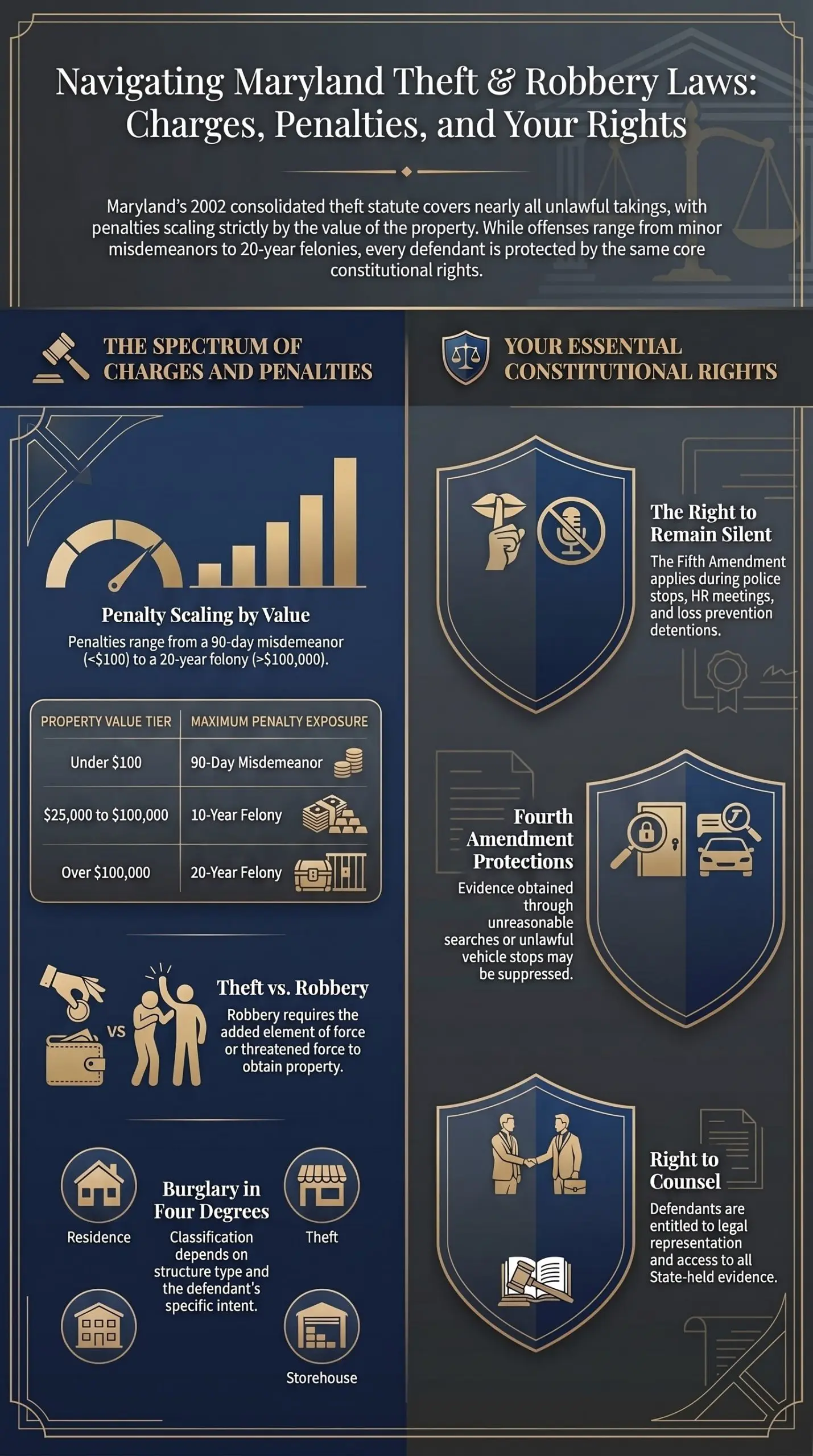
Table of Contents
- Shoplifting at the Wildewood Center and the Concealment Question
- Employee Theft and Embezzlement at St. Mary’s Businesses
- Auto Theft and Unauthorized Use of Vehicle Under § 7-105
- Identity Theft, Credit Card Fraud, and Document Crimes
- Robbery: The Force Element and the Fifteen Year Felony
- Armed Robbery and the Weapons Counts That Stack On
- Carjacking on Route 235 and the Thomas Johnson Bridge
- Burglary in Four Degrees: From Residences to Storehouses
- Receiving Stolen Property and the Knowledge Question
- Theft of Services, Retail Fraud, and the Smaller Cases That Are Not Small
- The Rights That Apply to Every Theft and Robbery Defendant
- Frequently Asked Questions
Theft and robbery cases come from every part of St. Mary’s County. They begin in the parking lots at Wildewood Center in California, in the storerooms of small businesses in Leonardtown, in the driveways of homes in Hollywood and Mechanicsville, on the dark stretches of Route 235 after closing time, and at the gas stations along Route 5 that stay open through the night. Each case begins with a moment that often takes seconds: an item slipped into a bag, a door that should have been locked, a confrontation in a parking lot, a transaction that turned out to be more than a transaction. The case that follows lasts months.
What makes this category of offense particularly difficult is its breadth. The same statute that produces a 90-day misdemeanor for a child caught taking a candy bar produces a 20-year felony for a sophisticated multi-victim scheme. The same Robbery Article governs both a confrontation in a Lexington Park alley and an armed carjacking on the Thomas Johnson Bridge. The penalties span from probation to decades of incarceration, and the defense strategy must be tailored to the specific charge, the specific evidence, and the specific defendant.
This article walks through 10 common theft and robbery scenarios as they typically arise in St. Mary’s County, the legal frameworks that apply to each, and the rights every defendant retains regardless of what is alleged. The goal is not to substitute legal counsel; it is to help people facing these charges (or family members of someone who is) understand the stakes and the protections that the law provides.
1. Shoplifting at the Wildewood Center and the Concealment Question
The retail corridor along Route 235, anchored by Wildewood Center in California and extending through San Souci Plaza, the chain stores near the Lexington Park strip, and the smaller plazas in Hollywood and Charlotte Hall, produces a steady volume of shoplifting cases. Maryland prosecutes shoplifting under the same Criminal Law § 7-104 statute that governs every other theft offense, with the value of the item determining the penalty tier. A pair of $30 sunglasses from a Wildewood retailer is treated as a $30 theft. A $1,200 jacket is treated as a $1,200 theft, which crosses into the next tier with substantially higher exposure.
Most shoplifting cases originate with loss prevention staff at the store. Loss prevention officers observe the alleged conduct (often using the store’s surveillance cameras), confront the suspect after they pass the last point of sale, and detain them in a back office until law enforcement arrives. The deputy from the St. Mary’s County Sheriff’s Office takes a statement from loss prevention, reviews the video, and either issues a citation or makes an arrest, depending on the value, the suspect’s prior history, and the local prosecutorial practice.
Your rights in the loss prevention back office. A loss prevention officer is not law enforcement and does not have to give Miranda warnings. The Fifth Amendment right to remain silent still applies. A suspect detained by store personnel is not required to answer questions, sign written statements, or admit anything. Anything said in that office can be reported to the deputy and used in the prosecution. The most important sentence in that conversation is “I would like to speak with a lawyer.”
A separate civil track runs alongside the criminal case. Maryland law allows merchants to send civil demand letters to suspected shoplifters, requesting payment of a defined civil penalty in lieu of further civil action. Paying the civil demand is not an admission of guilt and does not resolve the criminal case. Refusing to pay the civil demand is also not an admission of anything. Defendants should not respond to civil demand letters without consulting counsel, as their responses can become evidence in the criminal case.
2. Employee Theft and Embezzlement at St. Mary’s Businesses
Employee theft cases are among the most painful prosecutions in St. Mary’s County. They typically begin with an employer’s internal investigation into an employee suspected of taking cash, merchandise, or other assets over time. The employer documents the suspected pattern, often confronts the employee in an HR meeting, and then refers the matter to law enforcement. By the time the employee is charged, the employer has often built a substantial paper case that the State’s Attorney’s Office can use directly.
Maryland’s consolidated theft statute treats embezzlement and breach-of-trust theft under the same § 7-104 framework as ordinary theft. The value of the alleged taking determines the penalty tier. Cases involving long-term skimming, fraudulent expense reports, or unauthorized transfers can quickly aggregate to amounts that push into the felony tiers: $25,000 to $100,000 yields up to 10 years; over $100,000 yields up to 20 years.
The HR meeting is not your friend. Statements made to an employer during an internal investigation can be used against the employee in a subsequent criminal case. The Fifth Amendment privilege against self-incrimination applies in any setting where the statements may be used to prove a crime. Employees called into HR meetings about alleged theft have the right to refuse to answer questions, to refuse to sign written statements, and to consult with counsel before any further interview. Federal employees and certain public employees may be entitled to Garrity warnings before interviews that could lead to criminal charges; counsel evaluates these protections on a case-by-case basis.
For employees who hold security clearances at Naval Air Station Patuxent River or work for federal contractors, the criminal case is only part of the exposure. Self-reporting requirements under DoD reporting rules apply. Base access reviews follow. The right defense addresses the criminal case and the collateral employment consequences as a single coordinated effort.
3. Auto Theft and Unauthorized Use of Vehicle Under § 7-105
Maryland treats motor vehicle theft and unauthorized use of a motor vehicle as separate offenses. Auto theft is prosecuted under the consolidated § 7-104 statute as a high-value theft (most vehicles fall into the $1,500 to $25,000 or $25,000 to $100,000 tiers, exposing the offender to felony charges). Unauthorized use of a motor vehicle, often called UUV or “joyriding,” is prosecuted under § 7-105 as a separate offense and covers conduct in which the defendant took and used a vehicle without permission but did not intend to permanently deprive the owner of it.
The distinction matters for the defense. Auto theft requires the State to prove the intent to permanently deprive the owner. UUV does not require that intent; mere unauthorized use of the vehicle is enough. A defendant whose conduct fits UUV but not theft has a meaningful argument for the lesser charge. Cases sometimes resolve as UUV when the State cannot prove the intent to permanently deprive.
St. Mary’s County auto theft cases often involve vehicles taken from parking lots at Lexington Park apartment complexes, from residential driveways in California or Hollywood, from commercial parking lots along Route 235, or from rural locations in Mechanicsville or Loveville. Recovery of the vehicle in another county, or out of state, complicates jurisdictional questions and sometimes implicates federal law under the Dyer Act for interstate transport.
Your Fourth Amendment rights at the recovery scene. When a vehicle is recovered with a suspect inside or nearby, the deputy will typically conduct a search of the vehicle and the area. The Fourth Amendment limits these searches. Probable cause must support the stop. Consent must be voluntary if relied upon. Search incident to arrest reaches only the area within the arrestee’s immediate control. Counsel reviews the recovery scene carefully because successful suppression of evidence found during an unlawful search often ends the case.
4. Identity Theft, Credit Card Fraud, and Document Crimes
Maryland prosecutes identity theft and related document crimes under Criminal Law § 8-301 and the related provisions in Title 8. The statute reaches the unauthorized use of personal identifying information to obtain a benefit, credit, or access to property. Penalties scale with the harm caused, ranging from misdemeanor exposure for low-value cases to felony exposure that can reach fifteen years for cases involving substantial financial harm or multiple victims.
Identity theft cases frequently involve digital evidence, including email accounts, financial records, IP addresses, mobile device data, and ATM or point-of-sale surveillance footage. The chain of custody for digital evidence is often the strongest defense angle. A federal contractor at PAX River accused of using a coworker’s credit card, an alleged scheme that traveled through multiple counties via online platforms, or a case where the actual user of an account is genuinely uncertain, all turn on the State’s ability to prove the link between the defendant and the digital footprint.
Your right to challenge the digital evidence. Identity theft prosecutions often rely on circumstantial digital evidence linking the defendant to the conduct. The defense has the right to challenge the chain of custody, to test the underlying forensic methods, to cross-examine the State’s expert, and to introduce alternative explanations for the digital footprint. Defendants who simply assume the digital evidence is unimpeachable often lose cases that should have been winnable.
Cases involving electronic transmission across state lines can implicate federal jurisdiction. A St. Mary’s County resident charged with using a stolen credit card across multiple states may face concurrent federal and Maryland prosecutions. Counsel reviews the venue questions early and identifies the proper forum.
Charged with Theft or Robbery in St. Mary’s County?
From a misdemeanor shoplifting citation to a felony armed robbery indictment, the rights that protect you are the same. Haskell & Dyer represents accused individuals throughout St. Mary’s County in District and Circuit Court.
Main Office: 301-627-5844
24/7 Hotline: 240-687-0179
5. Robbery: The Force Element and the Fifteen Year Felony
Robbery under Criminal Law § 3-402 is theft committed by force or by threat of force. The force element distinguishes robbery from theft. A pickpocket who removes a wallet without the victim’s awareness has committed theft. A person who shoves the victim, threatens the victim, or uses any degree of force to overcome resistance has committed robbery. The penalty exposure jumps from the theft tier to a 15-year felony that is heard in the Circuit Court.
Robbery cases in St. Mary’s County tend to cluster in identifiable settings. Convenience store and gas station robberies along Route 235 and Route 5. Late evening street confrontations near bars and restaurants. Sometimes incidents in apartment parking lots. Each case turns heavily on the eyewitness identification of the suspect, because the State must connect the defendant to the alleged conduct, often without forensic evidence.
Your right to challenge eyewitness identification. Eyewitness identification is among the most error-prone evidence in criminal cases. Suggestive lineups, single suspect show-ups conducted minutes after the incident, photo arrays that highlight the suspect, and cross-racial identification all produce documented error rates that defense counsel can develop at trial. Pretrial motions to suppress identification testimony, expert testimony on the science of eyewitness reliability, and careful cross-examination of the identifying witness are all available defense tools.
The force element itself is also litigable. The State must prove that force was used to obtain or retain the property. A taking that occurred without the victim’s awareness, followed by a struggle initiated by the victim to recover the property, is closer to a case of a taking that occurred without the victim’s awareness, followed by a struggle initiated by the victim to recover the property. Courts have drawn lines in this area that experienced counsel uses to challenge the characterization of the robbery.
6. Armed Robbery and the Weapons Counts That Stack On
Armed robbery under Criminal Law § 3-403 is robbery accomplished with a dangerous weapon, with a deadly weapon, or by displaying a written instrument claiming the defendant has a weapon. The penalty climbs to twenty years, and the State typically charges additional counts under the firearm statutes that stack on top of the robbery itself.
The most common companion charge is use of a firearm in the commission of a crime of violence under Criminal Law § 4-204, which adds a separate consecutive sentence with a five-year mandatory minimum. The combined exposure in armed robbery cases reaches into territory that can change the rest of a defendant’s life: a robbery sentence plus a § 4-204 enhancement, served consecutively, can total decades. Our § 4-204 enhancement defense article walks through that statute in depth.
The weapon does not have to be a firearm to support an armed robbery charge. Knives, clubs, and other dangerous weapons all qualify. Even objects that are not traditionally weapons can qualify if they were used or displayed in a way that produced a reasonable fear of immediate harm. The “dangerous weapon” inquiry is fact-specific and is often the threshold defense question.
Your right to a jury trial in Circuit Court. Armed robbery is a felony charged in Circuit Court, where a jury of twelve must reach a unanimous verdict to convict. Every defendant has the right to that jury trial, the right to counsel at every stage, the right to confront and cross-examine the witnesses against him, the right to subpoena defense witnesses, and the right to remain silent without that silence being used against him. These rights are not optional features of the system; they are constitutional guarantees that experienced counsel uses at every stage.
7. Carjacking on Route 235 and the Thomas Johnson Bridge
Carjacking under Criminal Law § 3-405 is the unlawful taking or attempted taking of a motor vehicle from the immediate actual possession of another person, by force or threat of force. Armed carjacking under § 3-405(b) involves a dangerous weapon or deadly weapon during the offense. Both are felonies, with carjacking carrying up to thirty years and armed carjacking carrying up to thirty years with potential additional weapons enhancements.
The geography of St. Mary’s County produces specific carjacking patterns. The corridor along Route 235 between Charlotte Hall and Great Mills sees the highest commuter traffic and produces the largest share of cases. The approaches to the Thomas Johnson Bridge, where vehicles slow and stop in traffic, occasionally result in incidents. Gas stations and convenience stores along the major routes are also common scenes.
Defense in carjacking cases focuses on the same elements that drive robbery defense: identification, the force element, the weapons element when armed carjacking is charged, and the chain of evidence. Suppression motions on the stop and any subsequent search are often central. Identification challenges are frequently the strongest defense angle when the State’s case rests on the victim’s account.
Your right to suppress an unlawful stop. When a defendant is later stopped while driving the alleged carjacked vehicle, the lawfulness of that stop becomes a critical defense question. If the stop was based on a mistaken license plate, an outdated BOLO, an unreliable tip, or a Fourth Amendment defect, the evidence found during the stop and any statements made afterward can be suppressed. A successful motion to suppress in a carjacking case can sometimes end the prosecution entirely.
8. Burglary in Four Degrees: From Residences to Storehouses
Maryland’s burglary statutes are found in Criminal Law §§ 6-202 through 6-205 and divide the offense into four degrees based on the type of structure and the intent involved. First-degree burglary under § 6-202 involves breaking and entering a residence with the intent to commit theft or a crime of violence; the penalty is up to 20 years. Second-degree burglary under § 6-203 involves storehouses (commercial or non-residential structures) and carries a fifteen-year sentence for theft intent and a twenty-year sentence for firearm theft intent. Third degree burglary under § 6-204 is breaking and entering any dwelling with intent to commit a crime; the penalty reaches ten years. Fourth-degree burglary under § 6-205 reaches breaking and entering without the heightened intent and is a misdemeanor.
Burglary cases in St. Mary’s County come from residential break-ins across the county, commercial burglaries at retail and storage locations, vacant property entries during construction or vacancy periods, and outbuilding cases on rural properties in Mechanicsville, Loveville, Bushwood, and the smaller waterfront communities. The investigation often involves forensic evidence (fingerprints, DNA, footprint impressions), surveillance video, and statements from neighbors or witnesses.
Defense in burglary cases turns on the elements: the breaking, the entering, the intent to commit a crime inside, and the identity of the defendant. Each element is independently challengeable. A defendant who entered a structure with permission did not commit breaking and entering. A defendant who entered without specific intent to commit a crime did not commit burglary at the heightened degree. A defendant whose identity is supported only by partial fingerprint or DNA evidence has substantial cross-examination available regarding the forensic evidence.
Your right to challenge a search warrant. Burglary investigations often produce search warrants for the suspect’s residence or vehicle. Counsel reviews every search warrant for probable cause defects, particularity defects, and false statements that could support a Franks hearing. Successful challenges to a warrant can suppress the evidence seized and dramatically alter the case posture.
9. Receiving Stolen Property and the Knowledge Question
Maryland’s consolidated theft statute reaches conduct beyond the original taking. A person who receives, possesses, or disposes of stolen property, knowing or having reason to know that it was stolen, can be charged under § 7-104 the same as the original thief. The penalty depends on the value of the property, with the same tier structure that applies to all consolidated theft offenses.
The knowledge element is the heart of every defense to receiving stolen property. The State must prove that the defendant either knew the property was stolen or had reason to know, meaning that a reasonable person in the defendant’s position would have understood the property to be stolen. Pricing far below market value, suspicious circumstances of the transaction, and missing documentation all contribute to the State’s circumstantial proof of knowledge. None of those factors alone is dispositive, and counsel carefully develops alternative explanations.
Common scenarios in St. Mary’s County include power tools and equipment purchased from informal sellers at flea markets or roadside stands, electronics acquired through online marketplaces at substantially discounted prices, items received in trade from acquaintances, and property kept in a vehicle or residence that the defendant did not know was stolen. The Calvert County analog of these cases is walked through in our Calvert County receiving stolen property defense article.
Your right to challenge constructive possession. A person can be charged with possession of stolen property based on constructive possession, meaning the property was found in a location the defendant controlled. Constructive possession requires more than proximity; the State must prove the defendant had knowledge of the property and the ability to exercise control over it. Items found in a shared residence, a vehicle used by multiple people, or a property accessed by several people often raise constructive possession defenses that defeat the charge.
10. Theft of Services, Retail Fraud, and the Smaller Cases That Are Not Small
The consolidated theft statute also covers theft of services, retail return fraud, package theft, and similar smaller-dollar cases that often appear minor but carry real consequences. Theft of services covers obtaining services (utilities, transportation, hospitality) without paying. Retail return fraud covers schemes to obtain refunds for items not actually purchased, items shoplifted and then returned, and similar patterns. Package theft covers the theft of packages from porches, mailboxes, and delivery locations.
The cases sometimes look like minor matters but the consequences can be substantial. A pattern of return fraud, aggregated across several incidents, can reach the felony tiers under § 7-104. A theft-of-services case involving thousands of dollars in unauthorized utility use can expose the defendant to significant liability. A package theft case with multiple charged incidents can be charged as a pattern of theft with cumulative value.
For first-time defendants in low-tier cases, the most common favorable outcome is Probation Before Judgment under Criminal Procedure Article § 6-220. PBJ closes the case without a conviction record after probation, preserving employment options and avoiding the lifelong record consequence of a theft conviction. Our PBJ in St. Mary’s County guide covers the eligibility and mitigation considerations in detail.
Your right to expungement after disposition. Maryland’s expungement statute under Criminal Procedure § 10-105 allows the removal of certain dispositions from the public record after a waiting period. Acquittals, dismissals, nol pros decisions, and certain PBJ dispositions become eligible for expungement on defined timelines. A theft case that ends favorably can ultimately be removed from Maryland Judiciary Case Search and from public records, restoring the defendant’s record to a fully clean state.
11. The Rights That Apply to Every Theft and Robbery Defendant
Every defendant in every theft or robbery case in St. Mary’s County retains the same set of constitutional and statutory rights from the moment of arrest through final disposition. These rights are not formalities. They are the foundation of every effective defense.
The right to remain silent. The Fifth Amendment privilege against self-incrimination applies before, during, and after arrest. Defendants are not required to answer questions from law enforcement, store loss prevention, employer HR, or anyone else when the answers may be used in a criminal prosecution. The most important sentence in any pre-charge interaction is “I would like to speak with a lawyer.”
The right to counsel. The Sixth Amendment right to counsel attaches at the initiation of formal charges and protects the defendant at every critical stage of the prosecution. For defendants who cannot afford private counsel, the Office of the Public Defender provides representation. For defendants with resources, retained counsel can begin work immediately, often before charges are even filed.
The right to be free from unreasonable searches and seizures. The Fourth Amendment limits the conditions under which police may stop, search, and seize property. Evidence obtained in violation of the Fourth Amendment can be suppressed and excluded from trial, often ending the prosecution before it begins. Suppression motions are among the most powerful tools in defense of theft and robbery charges.
The right to confront witnesses. The Sixth Amendment confrontation clause guarantees the defendant’s right to face the witnesses against him, to cross-examine them under oath, and to challenge the credibility of their testimony. This right shapes every trial and produces many of the defense’s strongest moments.
The right to a jury trial. Maryland law provides a right to a jury trial for any offense carrying a possible penalty of more than 90 days of incarceration. This includes nearly every theft or robbery charge above the smallest tier. The defendant elects whether to exercise the jury right, and the strategic choice between a bench trial in the District Court and a jury trial in the Circuit Court is among the most consequential decisions in the case.
The right to discovery. Maryland Rule 4-263 entitles the defendant to broad discovery from the State, including police reports, witness statements, surveillance video, forensic reports, and other materials in the State’s possession. Diligent discovery review is the foundation of every effective defense.
The right to pretrial release. Maryland law provides for pretrial release on conditions in most cases, allowing defendants to remain in the community while the case is pending. Bail review hearings provide a path to challenge restrictive conditions imposed at the initial appearance.
The right to a speedy trial. Both the Sixth Amendment and Maryland Rule 4-271 provide speedy trial protections. The Hicks rule under Maryland law generally requires trial within 180 days of the first appearance of counsel, with limited exceptions.
The right to expungement. Favorable dispositions and certain other outcomes are eligible for expungement under Criminal Procedure § 10-105. Expungement removes the case from the public record entirely, restoring the defendant’s record to its pre-charge state.
Defense That Starts at the First Phone Call
Whether the case is a shoplifting citation from a Wildewood retailer, an embezzlement allegation from a California business, or an armed carjacking charge in Leonardtown Circuit Court, Haskell & Dyer represents accused individuals throughout St. Mary’s County.
Main Office: 301-627-5844
24/7 Hotline: 240-687-0179
Closing Thoughts
Theft and robbery cases in St. Mary’s County span the full range of criminal exposure. A first-time shoplifting case at a Wildewood retailer can resolve as a citation with PBJ and an eventual expungement. An armed carjacking case on Route 235 can produce decades of incarceration with concurrent federal exposure. Between those poles lie ten common situations this article has examined: shoplifting, employee theft, auto theft, identity theft, robbery, armed robbery, carjacking, burglary, receiving stolen property, and theft of services.
Every one of those situations is governed by the same constitutional framework. The Fifth Amendment protects the defendant’s right to remain silent. The Sixth Amendment guarantees the right to counsel, the right to confront witnesses, and the right to a jury trial. The Fourth Amendment limits the conditions under which searches and seizures may occur. Maryland statutory law adds the rights to discovery, a speedy trial, pretrial release on appropriate conditions, and expungement after a favorable disposition. These rights are not technicalities. They are the substance of effective defense.
Haskell & Dyer represents accused individuals across St. Mary’s County, including residents of Leonardtown, Lexington Park, California, Great Mills, Hollywood, Mechanicsville, Charlotte Hall, Park Hall, Ridge, Piney Point, Callaway, Loveville, Chaptico, Bushwood, Avenue, Coltons Point, St. Inigoes, Tall Timbers, Drayden, and Valley Lee. The firm understands the local courts, prosecutors, and law enforcement agencies, and builds defenses that protect both criminal exposure and the rights guaranteed to every defendant by the law.
Frequently Asked Questions
What law covers theft charges in Maryland?
Maryland theft charges are usually prosecuted under Criminal Law § 7-104, which covers unlawful taking, conversion, deception, and possession of stolen property.
How are theft penalties determined in Maryland?
The penalty depends on the value of the property allegedly taken. Lower value cases may be misdemeanors, while high value theft cases can become felonies with years of prison exposure.
What is the difference between theft and robbery?
Theft involves unlawfully taking property. Robbery involves theft through force or threat of force, which makes it a more serious felony offense.
What is armed robbery in Maryland?
Armed robbery involves robbery with a dangerous or deadly weapon, or displaying something that causes the victim to believe a weapon is present.
Can shoplifting become a serious criminal case?
Yes. Shoplifting is prosecuted under Maryland theft law, and the value of the items determines whether the case is treated as a lower level misdemeanor or a more serious offense.
Can employee theft or embezzlement be charged as a felony?
Yes. Employee theft and embezzlement can become felony cases when the alleged value reaches higher statutory tiers.
What is unauthorized use of a motor vehicle?
Unauthorized use of a motor vehicle involves using a vehicle without permission but without necessarily intending to permanently deprive the owner of it.
What is receiving stolen property?
Receiving stolen property means possessing, receiving, or disposing of property while knowing or having reason to know it was stolen.
Can identity theft be prosecuted in St. Mary’s County?
Yes. Identity theft and credit card fraud cases can be prosecuted under Maryland law and may involve digital evidence, financial records, and surveillance footage.
What rights do theft and robbery defendants have?
Defendants have the right to remain silent, the right to counsel, the right to challenge unlawful searches, the right to confront witnesses, and the right to a jury trial when applicable.
Can theft or robbery evidence be challenged?
Yes. Evidence can be challenged through Fourth Amendment motions, identification challenges, digital evidence review, witness cross examination, and chain of custody issues.
Can a theft case be expunged in Maryland?
Some theft cases may become eligible for expungement after dismissal, acquittal, nolle prosequi, or certain probation before judgment outcomes.
Where are St. Mary’s County theft and robbery cases handled?
Lower level cases are often handled in District Court in Leonardtown, while serious felony cases such as robbery, armed robbery, carjacking, and burglary are handled in Circuit Court.
What should I do after being charged with theft or robbery?
Do not make statements, do not contact witnesses, preserve all paperwork and evidence, and contact a criminal defense attorney immediately.
References
Maryland Code Annotated, Criminal Law Article § 3-402 (2024). Robbery. Annapolis, MD: General Assembly of Maryland.
Maryland Code Annotated, Criminal Law Article § 3-403 (2024). Robbery with dangerous weapon. Annapolis, MD: General Assembly of Maryland.
Maryland Code Annotated, Criminal Law Article § 3-405 (2024). Carjacking and armed carjacking. Annapolis, MD: General Assembly of Maryland.
Maryland Code Annotated, Criminal Law Article § 4-204 (2024). Use of firearm in commission of crime of violence. Annapolis, MD: General Assembly of Maryland.
Maryland Code Annotated, Criminal Law Article § 6-202 (2024). Burglary in the first degree. Annapolis, MD: General Assembly of Maryland.
Maryland Code Annotated, Criminal Law Article § 6-203 (2024). Burglary in the second degree. Annapolis, MD: General Assembly of Maryland.
Maryland Code Annotated, Criminal Law Article § 6-204 (2024). Burglary in the third degree. Annapolis, MD: General Assembly of Maryland.
Maryland Code Annotated, Criminal Law Article § 6-205 (2024). Burglary in the fourth degree. Annapolis, MD: General Assembly of Maryland.
Maryland Code Annotated, Criminal Law Article § 7-104 (2024). Consolidated theft. Annapolis, MD: General Assembly of Maryland.
Maryland Code Annotated, Criminal Law Article § 7-105 (2024). Unauthorized use of motor vehicle. Annapolis, MD: General Assembly of Maryland.
Maryland Code Annotated, Criminal Law Article § 8-301 (2024). Identity fraud. Annapolis, MD: General Assembly of Maryland.
Maryland Code Annotated, Criminal Procedure Article § 6-220 (2024). Probation before judgment. Annapolis, MD: General Assembly of Maryland.
Maryland Code Annotated, Criminal Procedure Article § 10-105 (2024). Expungement of records. Annapolis, MD: General Assembly of Maryland.
Maryland Rules. (2024). Maryland Rule 4-263: Discovery in Circuit Court. Annapolis, MD: Court of Appeals of Maryland.
Maryland Rules. (2024). Maryland Rule 4-271: Trial date in Circuit Court (Hicks rule). Annapolis, MD: Court of Appeals of Maryland.
Garrity v. New Jersey, 385 U.S. 493 (1967). Supreme Court of the United States.
Miranda v. Arizona, 384 U.S. 436 (1966). Supreme Court of the United States.
U.S. Const. amends. IV, V, VI.
Legal Disclaimer: This article provides general information about Maryland theft and robbery law and is not legal advice. Reading it does not create an attorney client relationship with Haskell & Dyer or any of its attorneys. Maryland law changes, and the application of any statute, court rule, or administrative regulation depends on the specific facts of an individual case. Statutes and case decisions are cited as in effect at the time of writing and may have been amended or modified since publication. If you have been charged with a theft, robbery, burglary, or any other criminal offense in St. Mary’s County or anywhere in southern Maryland, you should consult with a qualified attorney about the facts of your case.
For a confidential consultation, call Haskell & Dyer at 301-627-5844 or our 24/7 hotline at 240-687-0179.