

Bottom Line Up Front
Every Calvert County family faces a moment when the legal process collides with loss, legacy, or change. Whether you are planning ahead, settling a loved one’s estate, or working through a trust, the path runs through the Register of Wills and the Orphan’s Court in Prince Frederick. This guide walks you through wills, trusts, probate, and estate planning in plain language, with the perspective of a local firm that has stood beside Calvert County families for decades. Compassion is not a slogan for us. It is the way we practice.
Call The Law Offices of Haskell and Dyer for a free consultation at 📞 301-627-5844 or send a secure message.
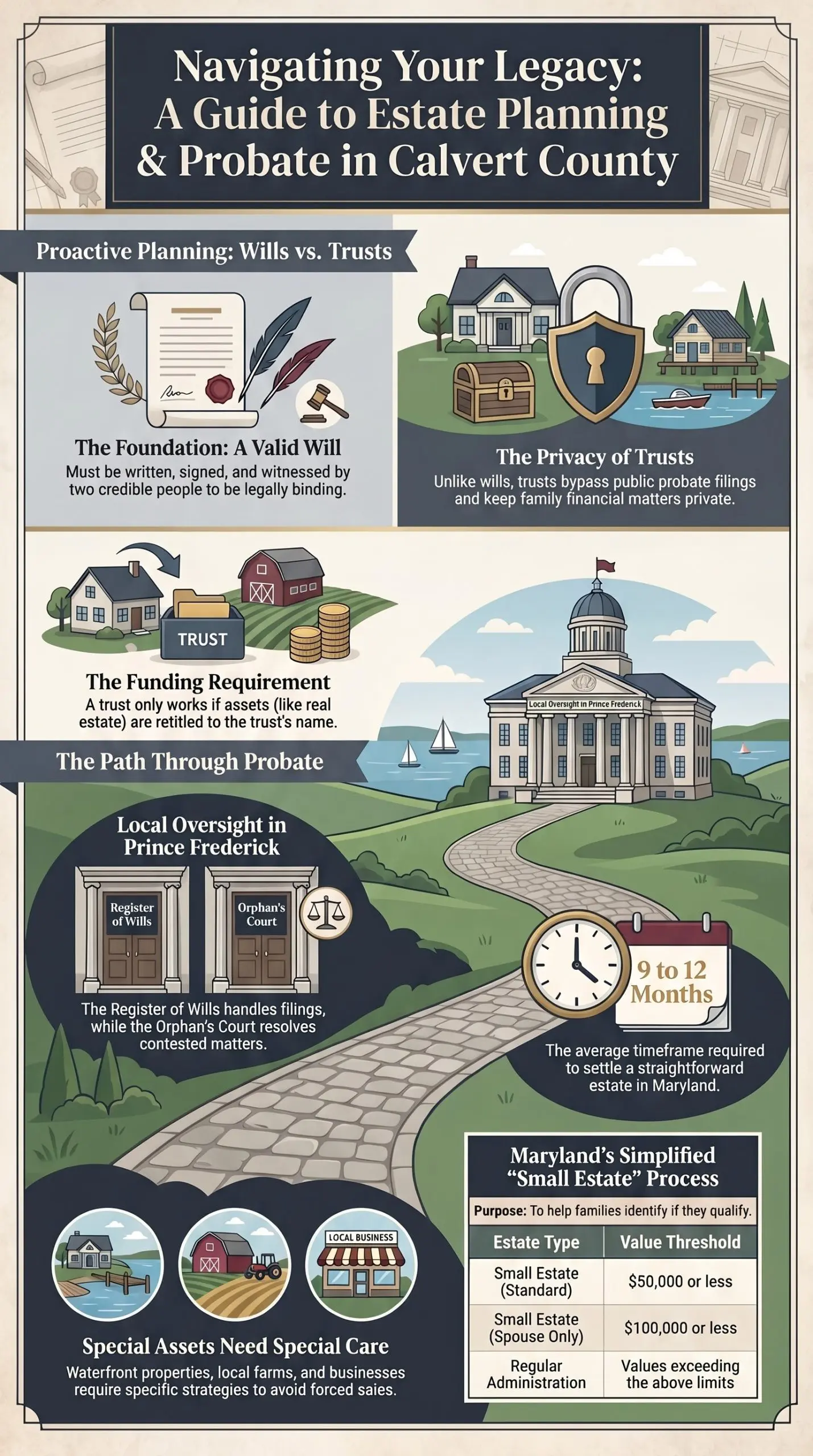
Table of Contents
- Why Estate Planning Matters for Calvert County Families
- The Probate Process in Maryland: How It Actually Works
- The Orphan’s Court of Calvert County and the Register of Wills
- Wills: The Foundation of a Maryland Estate Plan
- Trusts: When and Why They Work Better Than a Will Alone
- Trust Formation: Building a Plan Tailored to Your Life
- Trust Administration: Managing a Trust After It Becomes Active
- Serving as Personal Representative: Your Role and Your Duties
- Planning for Special Situations: Farms, Blended Families, Business Owners, and Waterfront Property
- Working with The Law Offices of Haskell and Dyer
- Summary
- References
1. Why Estate Planning Matters for Calvert County Families
Calvert County is a place where families stay. Land gets passed down. Waterfront cottages move from one generation to the next. Farms in Huntingtown, Owings, and Port Republic have been worked by the same families for a century or more. That continuity is a gift, but it is also a responsibility. Without a plan, the law decides what happens to your property, your business, and sometimes even the care of your children. The law is rarely as thoughtful as you would be.
Estate planning is the private act of deciding these questions in advance. It is making sure your family knows what you want. It is protecting what you have built from the expensive, time-consuming, and sometimes painful default that Maryland statutes impose when someone dies without a plan.
What Good Estate Planning Actually Does
- Names the people who will inherit what you own
- Appoints who will care for minor children and how their inheritance is managed
- Designates a trusted person to make medical and financial decisions if you cannot
- Reduces or avoids Maryland estate tax and inheritance tax where possible
- Keeps private matters out of public probate filings when a trust is used
- Prevents family disputes by stating your wishes clearly in writing
A local reality: Calvert County’s real estate market has appreciated substantially over the last two decades. Homes that were purchased for $150,000 may now be worth $600,000 or more. That appreciation alone can push a family estate across Maryland’s estate tax threshold. The plan you made twenty years ago may no longer be the plan your family needs today.
2. The Probate Process in Maryland: How It Actually Works
Probate is the legal process of transferring a deceased person’s property to their heirs, paying debts and taxes, and officially closing the estate. Every state has its own probate system. Maryland’s system is administered by the Register of Wills in each county, with oversight from the Orphan’s Court. For Calvert County families, that means the process runs through Prince Frederick.
The Basic Steps of a Maryland Probate
- Opening the estate. The person named in the will, or a close relative if there is no will, files a Petition for Administration with the Register of Wills.
- Appointment of the personal representative. The court issues Letters of Administration, a formal document that gives the personal representative authority to act.
- Inventory of assets. Within three months, the personal representative files an inventory listing the estate’s property.
- Notice to creditors. Creditors are notified and given a deadline (generally six months from the date of death) to present claims.
- Information Report. A report is filed disclosing any non-probate assets, which helps calculate inheritance and estate tax.
- Administration account. The personal representative files an accounting showing the assets, expenses, and proposed distributions.
- Distribution and closing. After the court approves the account, the remaining assets are distributed, and the estate is closed.
Regular Administration vs. Modified Administration
Maryland offers two main types of probate for most estates. Regular administration is the standard process described above. Modified administration is a streamlined alternative available when all residuary legatees are close family members, the estate has no significant tax issues, and all interested parties agree. Modified administration can save time and reduce court involvement, but it requires careful evaluation of whether it fits the estate.
Small Estates
For estates valued at $50,000 or less (or $100,000 or less if the surviving spouse is the only beneficiary), Maryland offers a small estate procedure. This is a simpler, faster, and less expensive process than regular administration. Many Calvert County families qualify for this procedure when the decedent’s main assets were jointly titled, designated with beneficiaries, or modest in value.
How Long Does It All Take?
A straightforward estate might close in nine to twelve months. A complex estate involving real estate, business interests, or disputes can take two years or longer. The personal representative cannot rush the process past certain statutory deadlines, and attempting to do so exposes the representative to claims from creditors, beneficiaries, and the court.
For families facing the immediate aftermath of a loss, read our companion piece on probate for North Beach families inheriting coastal properties, which addresses the common situation of inherited real estate in a Calvert County coastal town.
3. The Orphan’s Court of Calvert County and the Register of Wills
Two offices share responsibility for probate in Calvert County, and understanding the distinction helps families know who handles what.
The Register of Wills
The Register of Wills is an elected official with an office in Prince Frederick. The Register’s staff accepts filings, issues Letters of Administration, maintains public records of probate matters, and provides guidance to personal representatives on procedural questions. Most routine probate work flows through the Register’s office. For most Calvert County estates, families have far more interaction with the Register than with any judge.
The Orphan’s Court
The Orphan’s Court of Calvert County is made up of three judges elected by the voters of the county. The court handles contested probate matters, reviews and approves administration accounts, resolves disputes between personal representatives and beneficiaries, and rules on petitions that require judicial action under a statute or procedural rule.
The Orphan’s Court is a specialized tribunal. Its judges focus exclusively on probate and estate matters. That specialization means decisions tend to be informed, consistent, and rooted in local practice. For families unfamiliar with the court, the experience can feel less formal than a typical courtroom, but the orders carry the full force of law.
When the Orphan’s Court gets involved: Most estates move through the Register of Wills without ever appearing before the court. The court typically becomes involved when there is a will contest, a dispute over the personal representative’s conduct, questions about the validity of a will, or a complex administration that requires formal judicial approval.
Where Things Happen Physically
The Register of Wills office and the Orphan’s Court operate from the Calvert County courthouse complex in Prince Frederick. Filings, hearings, and petitions all converge at this location. If you are named as a personal representative, this is where you will make trips to file documents, obtain certified copies of Letters of Administration, and eventually file the final accounting that closes the estate.
4. Wills: The Foundation of a Maryland Estate Plan
A will is the single most important document in any Maryland estate plan. It names an executor (called a personal representative in Maryland), identifies beneficiaries, provides for guardianship of minor children, and gives specific directions about who receives what.
What Makes a Will Valid in Maryland
Under Maryland Estates and Trusts Article § 4-102, a will must be:
- In writing
- Signed by the person making it (the “testator”) or by another person in the testator’s presence and at the testator’s direction
- Attested and signed by two credible witnesses in the presence of the testator
Maryland allows self proving wills, which means the testator and witnesses can sign an affidavit before a notary that establishes the validity of the will without requiring the witnesses to testify during probate. A self proving affidavit saves time and administrative cost later.
What Happens Without a Will
If you die without a will in Maryland, the intestate succession statute decides who inherits. The basic rules under Estates and Trusts Article § 3-102 and following:
- If you have a surviving spouse and no minor children, the spouse receives the first $40,000 plus half of the remaining estate; the rest goes to your parents (if living) or your children from another relationship.
- If you have a surviving spouse and minor children, the spouse receives half of the estate and the children receive the other half, held in trust or guardianship until they reach the age of majority.
- If you have children but no spouse, the children inherit equally.
- If you have no spouse or children, the estate passes to your parents, then to your siblings, and then to more distant relatives.
The intestate rules are rarely what people would have chosen if they had written a will. Blended families, unmarried partners, stepchildren, and friends receive nothing under intestacy, regardless of their relationship to the deceased.
For a focused look at how a will compares to a trust, our related article explains the tradeoffs: Wills vs. Trusts: Estate Planning Essentials in Maryland.
5. Trusts: When and Why They Work Better Than a Will Alone
A trust is a legal arrangement where one person (the settlor or grantor) transfers property to another person or entity (the trustee) to hold and manage for the benefit of a third party (the beneficiary). Trusts have been around for centuries, and they remain one of the most flexible tools in Maryland estate planning.
Why Families Use Trusts
- Probate avoidance. Assets held in a properly funded revocable living trust pass directly to beneficiaries without going through probate.
- Privacy. Probate filings are public record. Trust administration is private.
- Tax planning. Certain trust structures (credit shelter trusts, QTIP trusts, irrevocable life insurance trusts) can reduce or eliminate Maryland estate tax for families whose assets approach or exceed the state exemption.
- Protection for beneficiaries. A trust can provide ongoing support for a minor child, a child with special needs, or a family member who is not equipped to manage a lump sum inheritance.
- Blended family planning. A trust can provide for a second spouse during their lifetime while ensuring that the ultimate beneficiaries are the settlor’s children from a prior marriage.
- Business succession. A trust can hold business interests and facilitate a transition to the next generation without forcing a sale.
Common Trust Types in Maryland
Revocable Living Trust. The most common trust used for probate avoidance. The settlor can change or terminate the trust at any time during their lifetime. At death, the trust becomes irrevocable and the successor trustee distributes according to the terms.
Irrevocable Trust. Cannot be changed or revoked after creation. Offers strong asset protection and tax benefits but requires giving up control. Common variants include irrevocable life insurance trusts (ILITs), qualified personal residence trusts (QPRTs), and charitable remainder trusts.
Testamentary Trust. Created under a will and takes effect only at the settlor’s death. Often used to manage inheritance for minor children or to divide an estate among beneficiaries with different needs.
Special Needs Trust. Designed to provide for a beneficiary with disabilities without disqualifying them from needs based government benefits such as Medicaid or SSI.
Charitable Trust. Holds assets for a charitable purpose while sometimes providing income to the settlor or family members during a specified period.
6. Trust Formation: Building a Plan Tailored to Your Life
Forming a trust is not a one size fits all exercise. A good trust reflects the specific facts of your life: the assets you hold, the family you care about, the values you want to preserve, and the risks you want to manage. The process typically follows a structured path.
Step One: Gather the Facts
Before any document is drafted, the attorney needs to understand what you own and what matters to you. That conversation covers real estate, retirement accounts, life insurance, investment accounts, business interests, personal property of significant value, and any assets held outside Maryland. It also covers family dynamics: who you want to provide for, who you do not want to receive anything, and any particular concerns about beneficiaries.
Step Two: Design the Structure
With the facts on the table, the attorney designs a trust structure that accomplishes your goals. This may involve a single revocable trust, a combination of revocable and irrevocable trusts, or additional planning documents such as a pour over will, powers of attorney, and advance healthcare directives.
Step Three: Draft the Documents
The trust agreement is drafted to reflect your specific wishes. Related documents are prepared at the same time to ensure the overall plan is internally consistent. Every reference to trustees, successors, beneficiaries, and distribution terms is carefully coordinated.
Step Four: Sign and Fund
Execution is relatively straightforward: you and the necessary parties sign in front of a notary. Funding the trust is the step that most people underestimate. A trust only works if the assets you intended to place in it have actually been retitled to the trust. Real estate deeds must be prepared and recorded. Bank and brokerage accounts must be retitled. Beneficiary designations on retirement accounts and life insurance may need to be updated. An unfunded trust is like a safe with nothing inside.
A common failure mode: Clients sign a beautifully drafted trust, feel relieved, and never return to fund it. When they die, their family discovers the trust is empty and the estate still has to go through probate. A good attorney walks clients through funding step by step and follows up until it is done.
7. Trust Administration: Managing a Trust After It Becomes Active
When a trust becomes irrevocable (either because the settlor dies or because the trust terms require it), the trustee takes on a set of legal duties. Trust administration is the ongoing work of managing the trust according to its terms and Maryland law.
The Trustee’s Core Duties
- Duty of loyalty. The trustee must act in the best interests of the beneficiaries, not for personal gain.
- Duty of prudence. The trustee must manage the trust assets with the care a reasonably prudent person would use.
- Duty to inform. The trustee must keep beneficiaries reasonably informed about the trust’s administration.
- Duty of impartiality. When there are multiple beneficiaries, the trustee must act impartially among them.
- Duty to account. The trustee must keep accurate records and provide periodic accountings to beneficiaries.
What Trust Administration Actually Involves
The day-to-day work of a trustee includes identifying and taking control of trust assets, paying trust expenses and taxes, making investment decisions, distributing funds to beneficiaries in accordance with the trust terms, filing trust tax returns, maintaining records, and communicating with beneficiaries about the trust’s status.
For a trustee administering a trust involving out-of-state property or digital assets, complexity rises quickly. Our article on digital asset planning covers the growing importance of accounting for online accounts, cryptocurrency, and digital intellectual property in modern trust administration.
When Trustees Get Into Trouble
Trustee liability is real. A trustee who breaches their duties can be held personally responsible for losses. Common trouble spots include commingling trust assets with personal assets, making poor investment decisions without professional guidance, distributing to the wrong beneficiaries, failing to file required tax returns, and ignoring beneficiary requests for information. Many of these problems can be prevented by working with an attorney familiar with Maryland trust law from the start.
8. Serving as Personal Representative: Your Role and Your Duties
If someone names you in their will as personal representative, or if you become personal representative by operation of law after a loved one dies without a will, you are taking on a role that is both honored and legally binding. The responsibility is real, and so is the potential exposure.
What You Are Asked to Do
A personal representative in Maryland must:
- File the will and petition for administration with the Register of Wills
- Give notice to interested parties, including heirs and beneficiaries
- Locate, secure, and inventory all estate assets
- Manage the assets prudently during the administration
- Pay valid debts and taxes
- Handle creditor claims, including disputing claims that are invalid
- File the required reports, including the inventory and information report
- File the final administration account
- Distribute the remaining assets according to the will or intestate law
- Close the estate
The Personal Representative Can Be Held Accountable
Under Maryland Estates and Trusts Article § 7-101 and following, the personal representative has a fiduciary duty to the estate and to the beneficiaries. Breaching that duty can expose the personal representative to personal liability. Common issues include missing deadlines, distributing assets before creditors are paid, failing to file tax returns, self dealing, and neglecting to maintain records.
Should You Serve?
Being named in a will does not obligate you to accept the role. You can decline, and a successor named in the will, or a court appointed representative, will take over. Before accepting, honestly assess whether you have the time, the patience, and the willingness to work with an attorney to do the job correctly.
A practical reality: The personal representative is entitled to reasonable compensation for the work, typically calculated as a percentage of the estate value. The work is real, and so is the compensation. What makes the difference is having the right support from the beginning.
9. Planning for Special Situations: Farms, Blended Families, Business Owners, and Waterfront Property
Standard estate plans work well for standard families. Calvert County families are often not standard. Here are a few of the situations we handle most often.
Family Farms and Agricultural Land
Calvert County remains home to working farms in Huntingtown, Owings, Port Republic, and throughout the rural stretches of the county. Passing a farm to the next generation involves more than a simple gift. It requires planning to address federal and state estate tax, ongoing operating agreements, conservation easements, and often disagreements between family members who want to farm and those who want to sell. Our piece on legacy planning for agricultural landowners around Huntingtown addresses these issues in depth.
Blended Families
Second marriages, stepchildren, and children from prior relationships all create situations where the default law does not match family intent. A plan that simply says “everything to my spouse” can unintentionally disinherit children from a prior relationship. A plan that says “everything to my children” can leave a surviving spouse without support. Structured trusts, marital property agreements, and careful beneficiary designations address these concerns. See our related article on blended family estate distribution issues.
Business Owners
Calvert County is home to many small businesses: marinas, restaurants, watermen’s operations, construction companies, professional practices, and family run service businesses. When a business owner dies without a succession plan, the business can be forced into a distressed sale. A proper plan includes a succession strategy, buy sell agreements, key person insurance, and trust structures that allow continuity.
Waterfront and Vacation Properties
Chesapeake Bay waterfront homes in North Beach, Chesapeake Beach, Dares Beach, Breezy Point, and the Solomons area represent significant wealth for many families. They also represent emotional attachments that run deeper than dollar values. Passing these properties to multiple children can create ongoing operational challenges: who maintains the property, who pays the taxes, who schedules usage. Trust structures and limited liability companies can address these issues with clear rules everyone understands in advance.
Elder Care Planning
As parents age, Medicaid planning, guardianship, and advance directives all become part of the conversation. Acting early can protect assets, preserve dignity, and avoid forced institutional placement. Our guide on planning for elder care walks through the framework.
Life Insurance and Estate Tax
Many Calvert County families are surprised to learn that life insurance proceeds can push an estate over the Maryland estate tax threshold. Proper planning with an irrevocable life insurance trust can keep those proceeds out of the taxable estate entirely. Our article on life insurance and Maryland estate taxes covers the common mistakes.
10. Working with The Law Offices of Haskell and Dyer
Estate planning and probate work is personal work. It happens at the hardest moments in a family’s life and at the most hopeful. Whether you are building a plan that will outlive you or stepping into the role of personal representative after losing someone you love, the quality of the legal team you choose shapes the experience.
What Sets Our Practice Apart
We are a Southern Maryland firm with decades of experience in the Calvert County courthouse. We know the Register of Wills staff by name. We appear before the Orphan’s Court judges regularly. We have represented Calvert County families through straightforward wills, complex trust structures, contested probate matters, and multi generation succession plans. That local familiarity, combined with careful attention to Maryland law, produces results that are grounded in practice rather than theory.
How Our Clients Describe the Experience
Families who work with us tell us three things most often: we explain things in plain language, we respond when they call, and we treat them like family rather than a file number. Estate matters are deeply personal. We try to honor that at every step.
What Happens When You Call
The first consultation is free. You will speak with an attorney who will listen to your situation, ask questions to understand your goals, and give you a straight answer about what we think the right next steps are. If you decide to work with us, we provide a clear engagement letter that explains the scope of work, the timeline, and the fee structure. We do not use hidden fees, and we do not bill for time we do not spend.
Ready to Talk?
Whether you are planning ahead, settling a loved one’s estate, or somewhere in between, we are ready to listen. Compassion. Clarity. Calvert County experience.
📞 Call 301-627-5844
Send a Secure Message
Learn more about our Estates and Probate practice or our Estate Planning services.
Summary
Estate planning and probate in Calvert County run through two parallel tracks. Planning happens quietly in the years before, through wills, trusts, powers of attorney, and healthcare directives tailored to your life. Administration happens publicly in Prince Frederick, through the Register of Wills and the Orphan’s Court, where personal representatives carry out the process of settling an estate. Good planning makes administration easier for the family left behind. Good representation makes both sides of the process calmer, clearer, and more protective of the people who matter most. Trusts expand what you can do, from probate avoidance to tax reduction to special needs planning to blended family structures. Every plan deserves to reflect the specific family it serves, and every family in Calvert County deserves counsel that understands both the law and the place.
Ready for a free consultation? Call Haskell and Dyer at 301-627-5844 or contact us here.
References
Maryland General Assembly. (2024). Estates and Trusts Article, Title 3: Intestate succession and statutory shares. Maryland Code. https://mgaleg.maryland.gov/
Maryland General Assembly. (2024). Estates and Trusts Article, Title 4: Wills. Maryland Code. https://mgaleg.maryland.gov/
Maryland General Assembly. (2024). Estates and Trusts Article, Title 5: Opening estates. Maryland Code. https://mgaleg.maryland.gov/
Maryland General Assembly. (2024). Estates and Trusts Article, Title 7: Administration of estates. Maryland Code. https://mgaleg.maryland.gov/
Maryland General Assembly. (2024). Estates and Trusts Article, Title 14.5: Maryland Trust Act. Maryland Code. https://mgaleg.maryland.gov/
Register of Wills for Calvert County. (2024). Probate procedures and forms. Maryland Register of Wills. https://registers.maryland.gov/
Orphans’ Court of Maryland. (2024). Orphans’ Court handbook. Maryland Courts. https://www.courts.state.md.us/orphanscourt
Maryland Comptroller. (2024). Maryland estate tax overview. Comptroller of Maryland. https://www.marylandtaxes.gov/
Internal Revenue Service. (2024). Estate and gift tax information. IRS. https://www.irs.gov/businesses/small-businesses-self-employed/estate-and-gift-taxes
Maryland State Bar Association. (2023). Consumer guide to wills, estates, and trusts in Maryland. Maryland State Bar Association. https://www.msba.org/
Uniform Law Commission. (2023). Uniform Trust Code: Overview and state adoptions. Uniform Law Commission. https://www.uniformlaws.org/
The information provided in this article is for general informational purposes only and does not constitute legal advice. Contacting The Law Offices of Haskell and Dyer does not create an attorney client relationship until a formal agreement is signed. For legal advice specific to your situation, please contact our office directly.