

Bottom Line Up Front
A sex crime allegation in Calvert County is among the most serious charges a person can face. The immediate stakes include substantial prison exposure, sometimes life sentences for the most serious offenses. The longer stakes include sex offender registration that can reshape where someone can live, where they can work, who they can see, and what their family life looks like for decades or for the rest of their life. Maryland’s sex crime framework, living primarily in Title 3 Subtitle 3 of the Criminal Law Article, covers rape in the first and second degree, sexual offenses in multiple degrees, sexual abuse of a minor, sexual solicitation of a minor, child sexual abuse material related offenses, incest, sexual conduct by people in positions of authority, prostitution and solicitation offenses, and sex trafficking. Every serious case moves through the Circuit Court in Prince Frederick. Every one requires defense that begins the moment someone learns they are being investigated, not after charges are filed. The decisions made in the first hours, the statements given or withheld, the evidence preserved or lost, the expert witnesses retained or missed, all shape what becomes possible at trial and at sentencing. This guide walks through all ten of the main situational categories that produce Calvert County sex crime cases, the defenses that actually work, and how to protect what can still be protected when a life-altering allegation arrives.
Call The Law Offices of Haskell and Dyer for a confidential consultation at 📞 301-627-5844 or the 24/7 criminal defense hotline at 240-687-0179.
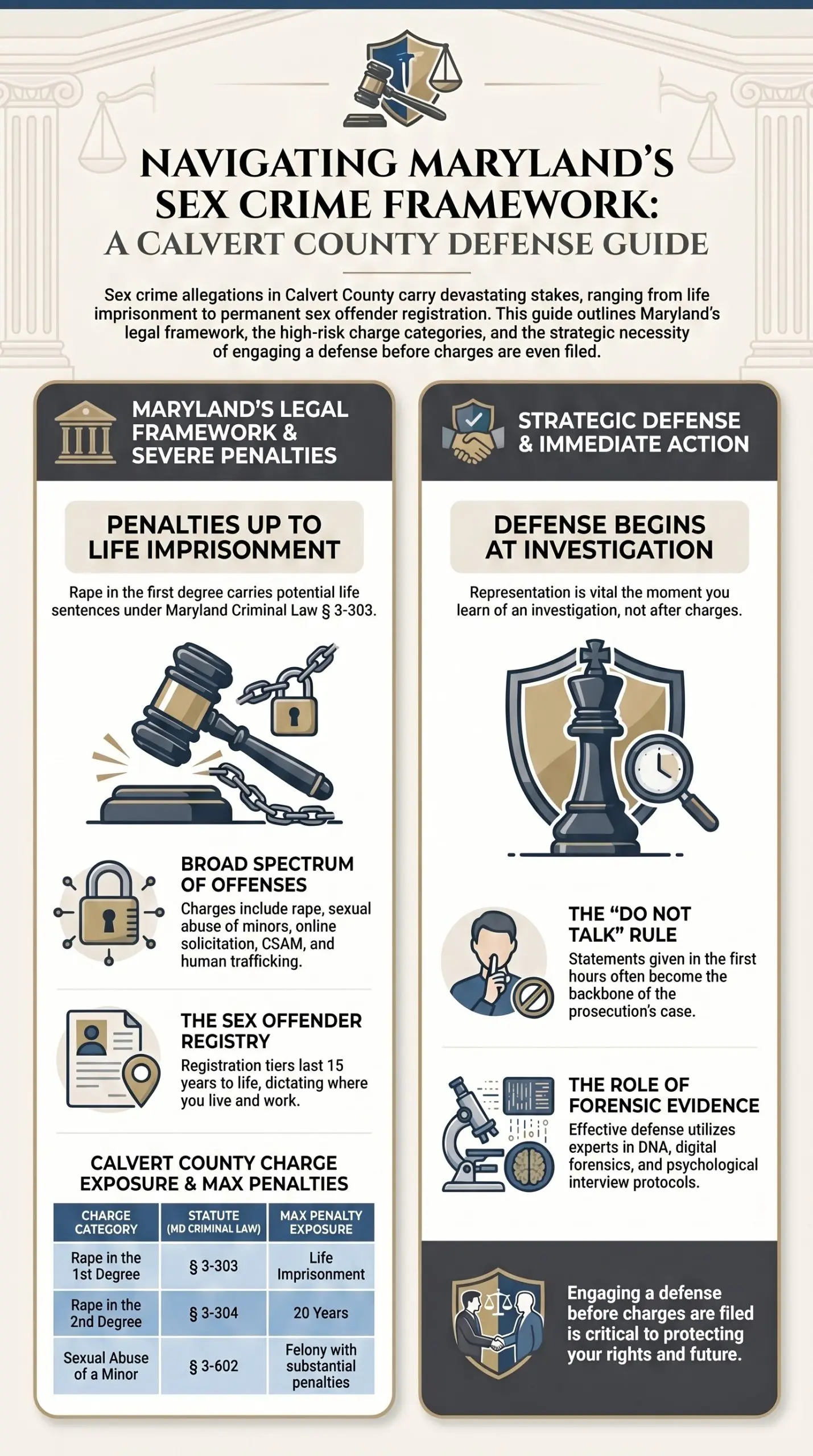
Table of Contents
- Maryland’s Sex Crime Framework and Calvert County Prosecution
- Consent Allegations After a Party or Gathering
- Age-Based Sexual Offenses Involving Minors
- Teachers, Coaches, and Authority Figure Allegations
- Online Solicitation and Sting Operations
- Child Sexual Abuse Material Cases
- Domestic, Marital, and Dating Relationship Allegations
- Repeated Abuse Allegations in the Home and Incest Cases
- Prostitution, Solicitation, and Human Trafficking
- Defense Strategy, Registry Consequences, and Working with Haskell and Dyer
- Summary
- References
1. Maryland’s Sex Crime Framework and Calvert County Prosecution
Maryland’s sex crime laws live primarily in Title 3 of the Criminal Law Article, covering offenses from the most serious (rape in the first degree, which can carry life imprisonment) down through the sexual offense degree structure, sexual abuse of a minor statutes, and related offenses. The framework also includes separate provisions addressing child sexual abuse material, sexual solicitation of a minor, prostitution-related offenses, and sex trafficking.
The Main Charge Categories
- Rape in the first degree under Criminal Law § 3-303, carrying up to life imprisonment
- Rape in the second degree under Criminal Law § 3-304, carrying up to 20 years
- Sexual offenses in the first through fourth degree under Criminal Law §§ 3-305 through 3-308, with graduated penalties
- Sexual abuse of a minor under Criminal Law § 3-602, covering sexual conduct by people with custody or responsibility for a child
- Sexual solicitation of a minor under Criminal Law § 3-324, covering attempts to persuade minors into sexual conduct
- Child sexual abuse material offenses under Criminal Law §§ 11-207 and 11-208, covering production, distribution, and possession
- Incest under Criminal Law § 3-323
- Prostitution and related offenses under Title 11, Subtitle 3
- Sex trafficking and human trafficking under Criminal Law § 11-303
How Calvert County Handles These Cases
Serious sex crime cases in Calvert County proceed in the Circuit Court for Calvert County in Prince Frederick. These cases typically involve:
- Extensive pretrial investigation, sometimes over months
- Forensic evidence including DNA, sexual assault forensic exam (SAFE) evidence, and digital forensics
- Grand jury indictment in serious cases
- Multiple pretrial motion hearings
- Expert witnesses on medical, psychological, and technical issues
- Jury trials with substantial evidentiary complexity
- Sentencing hearings with lengthy presentation of evidence
- Almost inevitable appellate review following conviction
Why Early Defense Engagement Matters More Here Than Elsewhere
Sex crime investigations often begin before the target knows anything is happening. By the time a potential defendant learns of an investigation, law enforcement may have already:
- Interviewed the complainant and other witnesses
- Obtained search warrants for electronic devices, homes, and vehicles
- Preserved cell phone and social media records
- Conducted controlled phone calls where the complainant was recorded talking to the target
- Consulted with the State’s Attorney about charging
Once charges are filed, the public record is immediate. The reputational damage often precedes any fair assessment of the evidence. And in Calvert County, where communities are small and word travels fast, the social consequences of even being investigated can be devastating.
The first rule for anyone under investigation: Do not talk to police or investigators without counsel present. Not a “quick conversation.” Not to “clear this up.” Not to explain your side. Sex crime investigators are experienced, the stakes for you are enormous, and statements given in the first hours become the backbone of the state’s case. Invoke your right to counsel immediately and call an experienced defense attorney.
For broader context on how Calvert County prosecutors approach serious felony cases, see our article on why not to plead guilty in Calvert County without reviewing the case first.
2. Consent Allegations After a Party or Gathering
One of the most common sex crime scenarios in Calvert County arises from parties, gatherings, and social events where both parties had been drinking and one later reports that the encounter was not consensual. These cases often involve Prince Frederick college-aged gatherings, Lusby house parties, Solomons weekend trips, and twin beach summer events.
The Charges
Depending on the specific allegations, these cases can produce:
- Rape in the first or second degree if force, threat, or serious conditions are alleged
- Sexual offense in the first through fourth degree for various types of sexual contact or intercourse
- Attempted rape or attempted sexual offense where completion is not alleged
The Consent Question
Maryland law addresses consent through several concepts:
- Force or threat of force as an element in rape and serious sexual offense charges
- Incapacitation based on alcohol, drugs, unconsciousness, or inability to consent
- Lack of consent in certain fourth-degree sexual offense charges
Cases turn on what happened, what each party understood, what was communicated, and whether the state can prove the specific element of the specific charge.
Alcohol and Incapacitation
Alcohol is often central in consent cases. The legal questions include:
- Whether the complainant was “incapacitated” under Maryland law, not merely intoxicated
- Whether the defendant knew or should have known of the incapacitation
- Whether the intoxication level actually prevented valid consent
- What the defendant’s own intoxication means for their conduct
The line between “drunk” and “legally unable to consent” is not always clear. Defense counsel often works with medical and toxicology experts to evaluate the specific facts.
Common Evidence
Consent cases typically involve:
- Sexual assault forensic exam (SAFE) findings
- DNA evidence
- Text messages before, during, and after the encounter
- Social media activity
- Witness accounts from others at the gathering
- Video from the venue or nearby areas
- Medical records from any examination
- Statements the defendant may have made
Something many people misunderstand: Most consent cases are built on what people said and did AFTER the alleged encounter, not during it. Text messages between the parties in the hours and days afterward, witness accounts of each party’s behavior, social media posts, and statements to friends can all shape the case significantly. Preserving or requesting preservation of these communications early is essential.
Defense Approaches
- Challenging the specific statutory elements (force, threat, incapacitation, lack of consent)
- Presenting evidence of actual consent through communications and behavior
- Challenging identification or participation where applicable
- Cross-examination on credibility issues
- Expert testimony on alcohol effects and memory
- Forensic evidence challenges
- Demonstrating reasonable doubt about specific elements
3. Age-Based Sexual Offenses Involving Minors
Maryland law sets specific age thresholds below which sexual contact with a minor is a crime regardless of whether the encounter was otherwise consensual. These “age-based” cases produce sexual offense charges even in situations where both parties describe the contact as voluntary.
The Statutory Framework
Maryland’s sexual offense statutes include age-based provisions addressing:
- Sexual contact with a person under a certain age threshold by someone significantly older
- Sexual intercourse with a minor below specific age boundaries
- Sexual contact or conduct where the age gap itself constitutes the criminal element
These charges most commonly appear as fourth-degree sexual offense under § 3-308 and third-degree sexual offense under § 3-307, depending on the specific ages and nature of the conduct.
Common Calvert County Scenarios
- An older teenager or young adult in a relationship with a younger teenager
- Contact at a party where the age of one participant was not known or disclosed
- Long-term relationships that crossed statutory lines
- Online contacts where ages were misrepresented
- Workplace relationships where a younger employee was underage
The “Consent” Confusion
A common and devastating misunderstanding: a minor’s willingness or even active participation does not make age-based charges go away. Maryland law sets age thresholds precisely because the legislature determined that certain young people cannot legally consent to sexual contact with older partners, regardless of their personal willingness.
Defendants who believed the relationship was “consensual” often face the full force of age-based sexual offense charges when the relationship comes to light.
Defense Approaches
- Challenging the defendant’s knowledge of the complainant’s age where relevant
- Evaluating the specific statutory elements including precise age gap requirements
- Examining whether the alleged conduct meets the statutory definition
- Forensic and medical evidence challenges
- Where charges are technically valid, strategic positioning for the least severe possible outcome
- Considering diversion and deferred disposition options where available
- Critical attention to registry consequences (addressed in Chapter 10)
For related reading on juvenile cases where minors are themselves involved in the conduct, see our cornerstone: Calvert County Juvenile Offense Defense: The Complete Guide.
4. Teachers, Coaches, and Authority Figure Allegations
Maryland law specifically addresses sexual misconduct by people in positions of authority over younger participants. These cases can arise in schools, athletic programs, religious institutions, camps, tutoring relationships, scouting organizations, and other settings where an adult holds authority over a substantially younger person.
The Statutory Framework
Maryland Criminal Law includes specific provisions addressing sexual misconduct in the context of teacher-student, coach-athlete, and similar authority relationships. These provisions can apply even where the younger participant would otherwise be of age to consent, because the authority differential itself is treated as removing the capacity for valid consent within that specific relationship.
Common Settings
- Calvert County Public Schools teachers, aides, or staff accused of conduct with students
- Youth sports coaches at public or private programs
- Private tutors and music instructors
- Religious educators or youth group leaders
- Camp counselors and activity instructors
- Therapists, counselors, or mentors in clinical or supportive roles
- Scouting or youth organization leaders
What Makes These Cases Distinct
Authority figure cases have several specific features:
- Institutional records often provide evidence (attendance, communication logs, meeting records)
- Multiple potential witnesses in the institutional setting
- Mandatory reporter obligations that may have produced contemporaneous documentation
- Professional licensing implications alongside criminal exposure
- Civil liability for both the accused and potentially the institution
- Heightened scrutiny from prosecutors and media
For educators, coaches, and authority figures facing an allegation: Do not engage with the institution’s internal investigation without legal counsel. Statements to principals, HR officials, or organizational investigators can become evidence in the criminal case. The criminal defense, the employment matter, and any professional licensing issue all need to be addressed together.
Defense Approaches
- Detailed factual investigation of the alleged conduct and the context
- Review of institutional records and communications
- Careful witness investigation
- Digital evidence analysis including texts, emails, and platform communications
- Challenge to the specific statutory elements
- Coordination with employment and professional licensing counsel
- Consideration of reputational issues alongside criminal defense
5. Online Solicitation and Sting Operations
Maryland Criminal Law § 3-324 addresses sexual solicitation of a minor. The statute criminalizes using any communication method to persuade, induce, entice, or solicit a minor to engage in sexual conduct. The statute and related provisions have been expanded and strengthened in recent years as law enforcement focus on this area has grown.
How These Cases Arise
Actual Minor Contacts
A case can develop when an adult communicates with an actual minor through social media, dating apps, messaging platforms, or other channels, and the communications are discovered by parents, teachers, or law enforcement.
Undercover Sting Operations
Law enforcement across Maryland and federally conducts substantial sting operations. An officer poses as a minor on apps, social media platforms, or dating sites. Adults who engage with the presumed minor and pursue sexual conversation or attempt to meet face investigation and charges.
Sting operations can involve:
- Maryland State Police or Calvert County Sheriff’s Office investigators
- Federal FBI or Homeland Security task forces
- Multi-jurisdictional units specifically focused on child exploitation
- Internet Crimes Against Children (ICAC) task forces
The Charge Structure
Online solicitation cases can produce multiple charges:
- Sexual solicitation of a minor under § 3-324
- Attempted sexual offense charges
- Child sexual abuse material charges if explicit images were requested, sent, or received
- Federal charges in cases involving interstate communications
- Related attempt and conspiracy charges
The Severity of Exposure
Solicitation cases carry substantial penalties and almost always trigger sex offender registration requirements. Federal prosecution in appropriate cases can add additional mandatory minimum exposure.
Defense Approaches
- Entrapment in appropriate cases where government agents induced conduct the defendant would not otherwise have pursued
- Challenge to the specific communications and their legal significance
- Digital forensic analysis to verify platform, account, and device attributions
- Mental health and capacity evaluation where applicable
- Challenges to jurisdictional reach in interstate cases
- Strategic resolution to minimize registry impact where full defense may not prevail
- Expert testimony on specific online contexts and communications
A critical early step: If you have been contacted by law enforcement about online communications, do not continue any of the communications. Do not delete anything. Do not discuss the case with anyone other than counsel. Call an experienced defense attorney immediately. The digital evidence is already preserved on the government’s side. Your conduct in the hours and days after first contact matters.
6. Child Sexual Abuse Material Cases
Maryland Criminal Law §§ 11-207 and 11-208 address what is commonly called child pornography but is more accurately described as child sexual abuse material (CSAM). These laws criminalize the production, distribution, and possession of sexually explicit images or videos involving minors. The statutes address different levels of conduct with different penalty structures.
The Spectrum of Conduct
- Production — actively creating the material, which carries the most severe penalties
- Distribution — sharing material with others, whether for profit or not
- Solicitation — requesting or arranging for production or distribution
- Possession — having the material on a device, in cloud storage, or otherwise accessible
Federal law criminalizes the same conduct, and many CSAM cases are prosecuted in federal court in addition to or instead of state court. Federal penalties are typically more severe and include mandatory minimums.
How Cases Come to Light
- Tips from platforms that detect CSAM through automated systems (NCMEC reports)
- Forensic examination of devices seized in unrelated investigations
- Analysis of file-sharing networks
- Tips from individuals who discovered material
- Follow-up from other sex crime investigations
- Border or international transmission detection
The Technology Dimension
CSAM cases involve specialized digital forensic evidence:
- File hash matching against known CSAM databases
- Metadata analysis showing when and where files existed
- Device attribution to specific users and accounts
- Cloud storage analysis across multiple services
- Deleted file recovery
- Network and access logs
Defense counsel retains qualified digital forensic experts to review the government’s forensic work. These cases often turn on specific technical details.
The Unwitting Receipt Issue
Some CSAM cases involve material the defendant did not knowingly acquire. Unsolicited content received through group messaging, files downloaded through peer-to-peer software containing hidden content, or material sent by another person can create possession liability even without the defendant’s awareness or intent. Defense counsel evaluates knowledge and intent carefully in these cases.
The Defense Framework
- Immediate engagement of experienced counsel familiar with both state and federal CSAM law
- Qualified digital forensic expert retention
- Comprehensive analysis of the specific files, their origin, and their attribution
- Knowledge and intent challenges where applicable
- Fourth Amendment challenges to device seizures and searches
- Evaluation of federal prosecution risk and strategic positioning
- Attention to registry and employment consequences throughout
7. Domestic, Marital, and Dating Relationship Allegations
Sex crime allegations arising from within marriages, long-term relationships, and dating contexts have their own specific dynamics. These cases often follow breakups, custody disputes, divorce proceedings, or changes in circumstances that produce retrospective claims about conduct that may have happened weeks, months, or years earlier.
The Charge Structure
Allegations from within relationships can produce:
- Rape in the first or second degree
- Various degrees of sexual offense
- Related domestic violence charges
- Protective order proceedings running in parallel
Maryland law no longer exempts marital partners from sexual assault charges; the historical “spousal exemption” has been eliminated in the modern framework.
Common Dynamics
- Allegations arising during or after divorce proceedings
- Custody disputes that intensify existing allegations
- Financial or property dynamics that correlate with the timing of allegations
- Relationships where control, domestic violence, or other serious issues coexist
- Cases where the relationship ended before the allegation was made
The Credibility Battlefield
Relationship allegation cases typically turn heavily on credibility. Defense counsel must evaluate:
- The consistency of the complainant’s accounts over time
- Communications between the parties before, during, and after the alleged conduct
- Third-party witnesses who observed the relationship
- Prior statements by the complainant to friends, family, therapists, or others
- Timing of the allegation relative to other events in the relationship
- Motive evidence including custody, financial, or emotional considerations
The Role of Communications
Text messages, emails, and social media communications between the parties often become central evidence. Defense counsel should preserve all available communications and analyze them for:
- Content inconsistent with the allegations
- Expressions of affection or continued voluntary relationship
- Statements about other subjects that contradict or contextualize the allegation
- Patterns of communication that support or undermine specific claims
For anyone facing allegations from a former partner: Preserve every communication you have had with the complainant. Do not delete messages, emails, or social media content, even content that might seem irrelevant. And do not contact the complainant directly after an allegation, even to defend yourself. Work through counsel. Unauthorized contact can produce protective order violations and additional charges.
Parallel Protective Order Proceedings
Sex crime allegations from within relationships almost always generate protective order proceedings. These civil cases move faster than the criminal matter and can produce restrictions on contact, housing, and custody before the criminal case reaches any meaningful stage. For related reading, see our article on common situations where protective orders are necessary.
8. Repeated Abuse Allegations in the Home and Incest Cases
Among the most serious and emotionally difficult sex crime cases involve allegations of repeated abuse of a child in a household context, or allegations of sexual conduct between close relatives.
Sexual Abuse of a Minor
Maryland Criminal Law § 3-602 specifically addresses sexual abuse of a minor by a parent, relative, household member, or other person with permanent or temporary care, custody, or responsibility for the child. The charge reaches:
- Biological parents
- Stepparents and adoptive parents
- Other relatives living in or frequenting the home
- Babysitters and caregivers
- Household members including partners of parents
- Other adults with supervisory responsibility
Sexual abuse of a minor is a felony with substantial penalties. It also inherently involves registration consequences.
Incest
Maryland Criminal Law § 3-323 addresses incest, covering sexual conduct between certain close relatives. The statute applies regardless of the ages of the parties in some circumstances and combines with other sex crime provisions depending on the specific facts.
How These Cases Develop
- Disclosure by a child to another adult (teacher, counselor, mandatory reporter)
- Discovery of evidence by another household member
- Disclosure during a therapy or counseling session
- Medical examinations that raise concerns
- Investigations initiated after divorce or custody disputes
- Delayed disclosure by now-adult former victims
The Forensic Interview Process
Child disclosure cases typically involve forensic interviews conducted at child advocacy centers using specialized protocols. These interviews are recorded and often become central evidence. Defense counsel evaluates:
- The interviewer’s compliance with established protocols
- The specific questions asked and how they were asked
- The child’s responses and any inconsistencies
- Information the child had before the interview that may have shaped responses
- The quality of the disclosure over time
The Medical Evidence
Some cases involve medical examination findings. Defense counsel works with qualified medical experts who can evaluate:
- Whether the findings actually indicate what the state claims
- Alternative explanations for specific findings
- The reliability of the examiner’s conclusions
- The quality of the examination and documentation
These cases demand extraordinary care: The stakes for defendants include decades of prison exposure and lifetime registration. The sensitivities around child victims require careful handling. The medical and psychological evidence requires specialist expertise. These are not cases to handle without experienced counsel who understands every dimension.
Parallel Family Court Proceedings
Child abuse allegations trigger immediate family court and Department of Social Services involvement. Emergency custody changes, protective orders, and potential termination of parental rights proceedings often run parallel to the criminal case. Coordination across these proceedings is essential.
9. Prostitution, Solicitation, and Human Trafficking
Maryland’s framework for commercial sexual offenses includes a range of provisions from prostitution-related misdemeanors to sex trafficking felonies with substantial mandatory minimum exposure.
Prostitution and Related Conduct
Maryland law addresses prostitution, solicitation of prostitution, and operation of premises used for prostitution through Title 11 Subtitle 3 of the Criminal Law Article. These provisions include:
- Engaging in prostitution
- Solicitation of prostitution
- Pandering and pimping
- Operating or maintaining premises for prostitution
- Transportation for purposes of prostitution
Penalties range from misdemeanor level for basic solicitation to felony level for pandering and operation of premises.
Calvert County Enforcement Patterns
Prostitution-related charges in Calvert County often arise from:
- Online advertising stings conducted by law enforcement
- Hotel and motel investigations
- Traffic stops that produce relevant evidence
- Broader investigations into commercial sexual activity
Sex Trafficking
Maryland Criminal Law § 11-303 addresses sex trafficking, which differs from prostitution in that it involves force, fraud, coercion, or control used to cause another person to engage in commercial sex. Sex trafficking is a serious felony offense with substantial penalties.
The state’s evidence in trafficking cases typically includes:
- Statements from the alleged victim and potentially other victims
- Financial records showing commercial transactions
- Communications documenting the alleged coercion or control
- Physical evidence from locations involved
- Travel and movement records
- Digital evidence from devices and accounts
Federal Prosecution Risk
Trafficking cases often have federal exposure under the Trafficking Victims Protection Act and related federal statutes. Federal penalties are typically severe and include mandatory minimums. Coordination between state and federal defense considerations is essential.
Defense Approaches
- For prostitution-related charges: Entrapment analysis, challenge to specific communications and conduct, consideration of diversion or deferred adjudication options
- For pandering and operation charges: Challenge to the defendant’s specific role and knowledge, Fourth Amendment challenges to searches
- For trafficking charges: Challenge to the force, fraud, or coercion element; credibility challenges to alleged victims where appropriate; evaluation of whether commercial activity actually occurred; federal prosecution positioning
For the broader Maryland criminal defense framework, see our Calvert County Drug Crimes Defense guide and our Calvert County Assault and Battery Defense guide, both of which address overlapping investigative and charging patterns.
10. Defense Strategy, Registry Consequences, and Working with Haskell and Dyer
Sex crime defense in Maryland requires a specific combination of legal skill, forensic understanding, investigative depth, and sensitivity. The stakes are severe, the evidence is often complex, and the consequences of missteps are lasting. Here is how our firm approaches these cases.
The Pre-Charge Window
Where possible, engagement before charges are filed produces the best outcomes. An attorney engaged during the investigation stage can:
- Protect the client from self-incriminating statements
- Communicate with the State’s Attorney about the theory of the case
- Preserve defense evidence before it becomes harder to obtain
- Identify and retain necessary experts
- Sometimes shape the charging decision itself
- Advise the client about parallel issues (employment, licensing, family matters)
The Forensic Evidence Battle
Sex crime cases often turn on forensic evidence. Defense counsel works with qualified experts including:
- Forensic pathologists and SAFE nurse examiners for physical evidence
- DNA analysts to review the state’s conclusions
- Digital forensic specialists for device and communication evidence
- Forensic psychologists for memory, suggestibility, and interview protocol issues
- Medical specialists for specific findings
The Sex Offender Registration Reality
Maryland maintains a sex offender registry with three tiers based on the seriousness of the offense. Registration requirements can include:
- Registration for 15 years, 25 years, or life depending on the offense tier
- Quarterly or more frequent in-person reporting
- Restrictions on where the registrant can live
- Restrictions on employment and educational settings
- Public searchable database for certain tiers
- Internet identifier reporting
- Travel notification requirements
- Restrictions on contact with minors
Registration consequences often outweigh the criminal penalties themselves. Defense strategy must consider registration impact at every decision point.
Charges That Avoid Registration
Not every sex-related charge triggers registration. Some charges, outcomes, or dispositions avoid registration entirely. Strategic decisions during the case can sometimes preserve the client’s ability to avoid registry consequences, and this consideration often shapes plea discussions and trial strategy.
Collateral Consequences Beyond Registration
Sex crime convictions produce extensive collateral consequences:
- Professional license revocation in many fields
- Employment disqualification from many industries
- Immigration consequences including deportation for non-citizens
- Federal firearm prohibitions
- Housing restrictions tied to registration
- Travel restrictions, including international travel
- Custody and family court implications
- Civil liability exposure in parallel suits
- Social and community consequences
What Sets Our Practice Apart
The Law Offices of Haskell and Dyer has defended serious criminal cases throughout Southern Maryland for years. A few principles guide our work on sex crime cases:
- Every case gets a full defense. We do not assume guilt because the state filed charges. We build the defense from the evidence.
- We engage early. Pre-charge representation, when possible, produces the best outcomes.
- We work with qualified experts. Forensic, medical, psychological, and digital specialists all can change the case.
- We take registration seriously. Every strategic decision accounts for registry consequences.
- We coordinate with other counsel. Employment, licensing, immigration, and family law intersections all require attention.
- We understand the local courts. Prince Frederick has its own dynamics, and local familiarity produces better results.
- We maintain confidentiality. Sex crime cases demand discretion. We provide it.
Facing a Sex Crime Allegation or Investigation?
The stakes include prison, registry, and the rest of your life. Every hour matters. Every statement matters. Call in confidence. The first consultation is free, and the 24/7 hotline is always open.
📞 Call 301-627-5844
Send a Secure Message
24/7 Criminal Defense Hotline: 240-687-0179
Learn more about our Criminal Defense practice.
Summary
Maryland sex crime law, found primarily in Title 3 of the Criminal Law Article, covers rape in the first and second degree, sexual offenses in four degrees, sexual abuse of a minor, sexual solicitation of a minor, child sexual abuse material offenses, incest, prostitution-related offenses, and sex trafficking. Penalties range from misdemeanor exposure on certain lesser offenses up to life imprisonment for first degree rape and qualifying offenses. All serious cases in Calvert County proceed through the Circuit Court in Prince Frederick. The most common scenarios include party and gathering consent cases, age-based offenses where a minor was involved, authority figure allegations involving teachers and coaches, online solicitation and sting operation cases, child sexual abuse material cases involving electronic evidence, allegations within marriages and dating relationships, repeated abuse allegations in household settings including incest cases, and prostitution or human trafficking offenses. Every category has its own evidence profile, its own defense framework, and its own set of consequences. Sex offender registration consequences often outweigh the criminal penalties themselves, reshaping housing, employment, family life, and community relationships for decades or life. The best defense starts before charges are filed, engages qualified forensic and medical experts, addresses every element of every charge, and maintains attention to registry and collateral consequences at every strategic decision. These are not cases to handle without experienced counsel. The stakes are too high, and the mistakes are too lasting.
Ready for a confidential consultation? Call Haskell and Dyer at 301-627-5844, use the 24/7 hotline at 240-687-0179, or contact us here.
References
Maryland General Assembly. (2024). Criminal Law Article, Title 3, Subtitle 3: Sexual Crimes. Maryland Code. https://mgaleg.maryland.gov/
Maryland General Assembly. (2024). Criminal Law Article § 3-303: Rape in the first degree. Maryland Code. https://mgaleg.maryland.gov/
Maryland General Assembly. (2024). Criminal Law Article § 3-304: Rape in the second degree. Maryland Code. https://mgaleg.maryland.gov/
Maryland General Assembly. (2024). Criminal Law Article §§ 3-305 through 3-308: Sexual offenses in the first through fourth degrees. Maryland Code. https://mgaleg.maryland.gov/
Maryland General Assembly. (2024). Criminal Law Article § 3-323: Incest. Maryland Code. https://mgaleg.maryland.gov/
Maryland General Assembly. (2024). Criminal Law Article § 3-324: Sexual solicitation of minor. Maryland Code. https://mgaleg.maryland.gov/
Maryland General Assembly. (2024). Criminal Law Article § 3-602: Sexual abuse of a minor. Maryland Code. https://mgaleg.maryland.gov/
Maryland General Assembly. (2024). Criminal Law Article §§ 11-207, 11-208: Child sexual abuse material offenses. Maryland Code. https://mgaleg.maryland.gov/
Maryland General Assembly. (2024). Criminal Law Article, Title 11, Subtitle 3: Prostitution and Related Crimes. Maryland Code. https://mgaleg.maryland.gov/
Maryland General Assembly. (2024). Criminal Law Article § 11-303: Human trafficking. Maryland Code. https://mgaleg.maryland.gov/
Maryland General Assembly. (2024). Criminal Procedure Article, Title 11, Subtitle 7: Sex Offender Registration Act. Maryland Code. https://mgaleg.maryland.gov/
Maryland Department of Public Safety and Correctional Services. (2024). Maryland Sex Offender Registry. DPSCS. https://www.dpscs.state.md.us/
Maryland Judiciary. (2024). Circuit Court for Calvert County. Maryland Courts. https://www.courts.state.md.us/circuit
Maryland Office of the Public Defender. (2024). Sex offense defense resources. Office of the Public Defender. https://www.opd.state.md.us/
United States Department of Justice. (2024). Child exploitation and obscenity section. DOJ Criminal Division. https://www.justice.gov/criminal-ceos
National Center for Missing & Exploited Children. (2024). CyberTipline and reporting resources. NCMEC. https://www.missingkids.org/
Maryland State Bar Association. (2023). Consumer’s guide to criminal law in Maryland. Maryland State Bar Association. https://www.msba.org/
The information provided in this article is for general informational purposes only and does not constitute legal advice. Contacting The Law Offices of Haskell and Dyer does not create an attorney client relationship until a formal agreement is signed. For legal advice specific to your situation, please contact our office directly.