
Bottom Line Up Front
Maryland drug charges in Calvert County are governed by the Maryland Criminal Law Code Title 5, covering Controlled Dangerous Substances. The range runs from misdemeanor possession with modest fines to drug kingpin and importation charges carrying 20 to 40 years in prison and fines up to $1 million. Every case moves through the courthouse in Prince Frederick, either in the District Court for most misdemeanors or in the Circuit Court for felonies and jury trials. The penalties are serious, the collateral consequences are often worse than the sentence, and the decisions made in the first days after an arrest shape everything that follows. This guide walks through all ten major categories of Maryland drug charges, the defenses that actually work, and how to protect your future when the state has decided to charge you.
Call The Law Offices of Haskell and Dyer for a free consultation at 📞 301-627-5844 or the 24/7 criminal defense hotline at 240-687-0179.
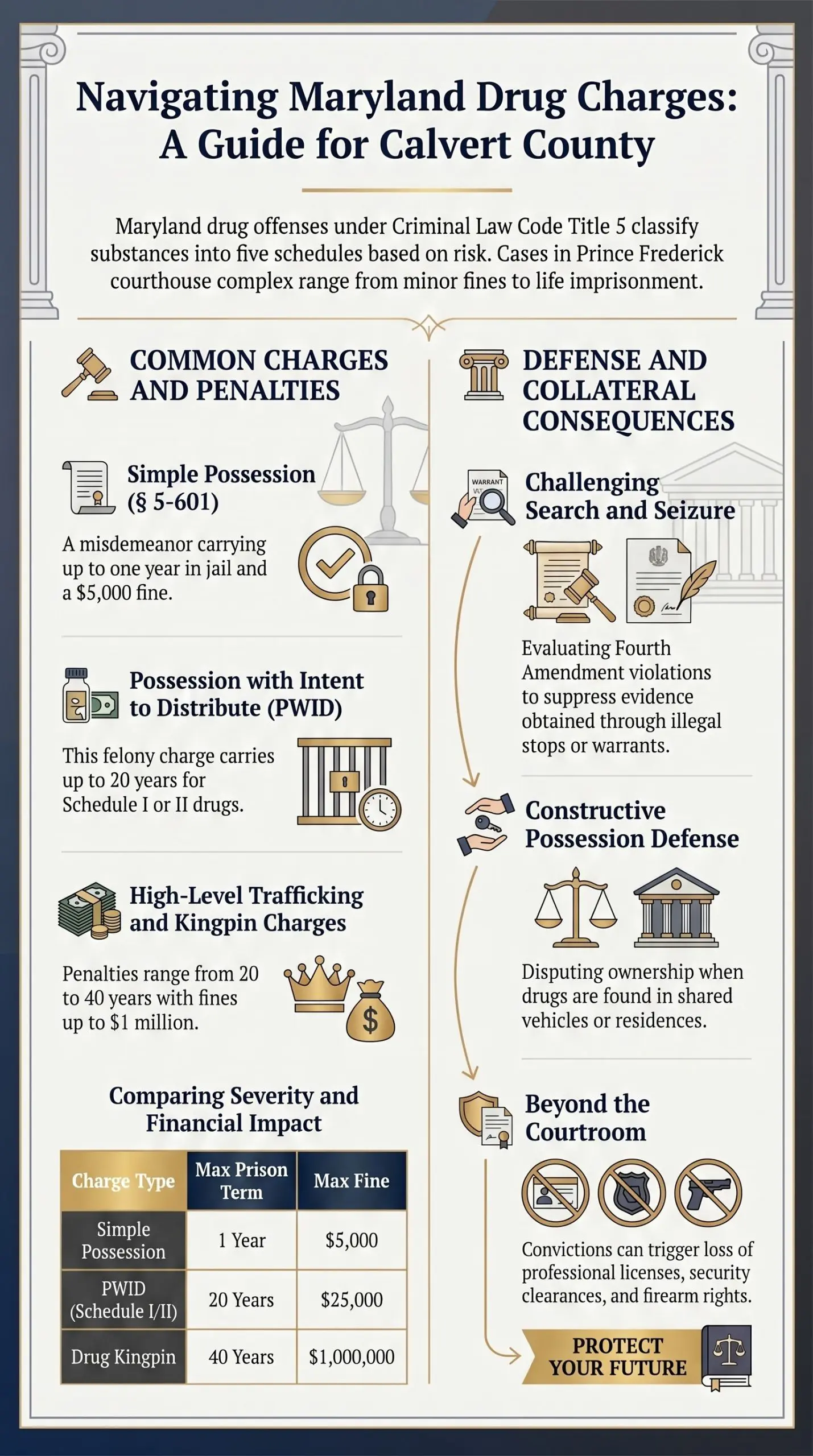
Table of Contents
- Maryland’s CDS Framework and Calvert County Drug Enforcement
- Drug Possession Under Maryland Criminal Law § 5-601
- Possession with Intent to Distribute Under § 5-602
- Drug Trafficking and the Volume Dealer Statute § 5-612
- Drug Manufacturing and Cultivation Under § 5-603
- Prescription Drug Fraud
- Drug Paraphernalia Under § 5-619
- Distribution to Minors and School Zone Violations Under § 5-627
- Drug Kingpin § 5-613 and Importation § 5-614
- Defense Strategies, Collateral Consequences, and Working with Haskell and Dyer
- Summary
- References
1. Maryland’s CDS Framework and Calvert County Drug Enforcement
Maryland’s drug laws live in Title 5 of the Criminal Law Article, titled Controlled Dangerous Substances, Prescriptions, and Other Substances. The framework organizes drugs into five schedules (I through V) based on medical use, abuse potential, and dependency risk. Schedule I and Schedule II drugs, including heroin, cocaine, methamphetamine, fentanyl, PCP, LSD, and most opioid narcotics, carry the heaviest penalties. Schedule III, IV, and V drugs, including anabolic steroids, certain tranquilizers, and certain prescription medications, are treated less severely but still produce real consequences.
How Drug Cases Enter the Calvert County System
Drug arrests in Calvert County come through several common pathways:
- Traffic stops along Route 4, Route 2/4, and Route 231 where officers develop probable cause to search
- Sheriff’s Office narcotics investigations targeting local distribution
- Regional and federal task force operations involving the DEA, Maryland State Police, and multi county units
- Search warrants executed at residences, vehicles, or businesses
- Arrests at the Prince Frederick detention center following unrelated charges, when searches reveal drugs
- School resource officer and campus investigations
- Tips from informants, neighbors, or cooperating defendants
Where Cases Are Heard
Every Calvert County drug case moves through the courthouse complex in Prince Frederick. Misdemeanor possession, paraphernalia, and certain lower level offenses typically begin in the District Court. Felony drug charges, jury trial demands, and the more serious distribution and trafficking cases proceed in the Circuit Court for Calvert County. The prosecutors, the judges, and the courthouse staff all work out of the same complex on Duke Street.
Important reality: Drug cases involve substantial discovery. Search warrant affidavits, lab reports, surveillance logs, informant information, and digital evidence all have to be reviewed carefully. A real defense starts with a complete understanding of what the state actually has.
For an overview of the firm’s approach to drug defense across Maryland, see our Drug Crimes practice page and our article on Maryland drug crimes: possession, trafficking, cultivation, and defense.
2. Drug Possession Under Maryland Criminal Law § 5-601
Simple possession is the most commonly charged drug offense in Calvert County. Under Maryland Criminal Law § 5-601, possessing any controlled dangerous substance without a valid prescription is a crime.
The Penalty Structure
- Most controlled substances: Misdemeanor with up to one year in jail and a fine up to $5,000
- Marijuana over 2.5 ounces (where still unlawful to possess without cannabis license): Up to six months in jail and a fine up to $1,000
- Felony enhancements can apply based on quantity, type, and circumstances
What the State Has to Prove
For a possession conviction, the prosecutor must prove:
- The substance is actually a controlled dangerous substance (requires lab testing)
- The defendant knowingly possessed it
- The defendant had the ability to exercise control over it
- The defendant did not have a valid prescription or authorization
The Actual vs. Constructive Possession Issue
Maryland recognizes both actual possession (drugs on the person) and constructive possession (drugs in a location the defendant controlled). Constructive possession cases are often the weakest for the state. When drugs are found in a shared vehicle, a shared residence, or a location multiple people had access to, the defense can challenge whether the state can actually prove which person possessed them.
Common Defense Angles
- Challenging the search that produced the drugs (Fourth Amendment issues)
- Challenging the lab testing and chain of custody
- Disputing knowledge and control in constructive possession cases
- Identifying valid prescription or authorization defenses
- Medical marijuana compliance issues for cannabis cases
3. Possession with Intent to Distribute Under § 5-602
Possession with intent to distribute (PWID) is where drug cases become felonies. Under Maryland Criminal Law § 5-602, possessing any CDS with the intent to distribute is punishable based on the schedule of the drug involved.
The Penalty Structure
- Schedule I or II drugs (heroin, cocaine, methamphetamine, fentanyl, most opioids): Up to 20 years in prison and a fine up to $25,000
- Schedule III, IV, or V drugs: Up to 5 years in prison and a fine up to $15,000
- Certain repeat offender provisions can enhance penalties further
How the State Proves Intent to Distribute
The state rarely has direct evidence of an intent to distribute. Most PWID cases are built on circumstantial evidence, commonly including:
- Quantity of the drug, which exceeds what a personal user would carry
- Packaging (individual bags, vials, or doses ready for sale)
- Scales, cutting agents, or packaging materials
- Large amounts of cash in small denominations
- Cell phone communications referencing sales or transactions
- Multiple cell phones
- Absence of paraphernalia associated with personal use
- Expert testimony from a narcotics investigator about the quantity and context
Strategic note: A PWID case can often be reduced to simple possession if the state cannot prove the intent-to-distribute element. The quantity that appears to be distribution to an officer may appear to be personal use to a jury when the defense presents the full context. The fight over the intent element is often the heart of the case.
Common Defense Angles
- Challenging the search and seizure that produced the evidence
- Challenging the state’s circumstantial case for intent
- Demonstrating personal use consistent with the quantity
- Cross examining the state’s expert witness on narcotics practices
- Pressing on any cooperating informant’s credibility
4. Drug Trafficking and the Volume Dealer Statute § 5-612
Maryland’s volume dealer statute at Criminal Law § 5-612, imposes mandatory minimum penalties on defendants who possess or transport certain threshold quantities of controlled substances. This is the charge that transforms a serious case into a life changing case.
The Threshold Quantities
The statute applies when a defendant possesses or transports:
- 50 pounds or more of cannabis
- 448 grams or more of cocaine
- 448 grams or more of cocaine base (crack)
- 28 grams or more of morphine or opium
- 1,000 dosage units of LSD
- 16 ounces or more of phencyclidine (PCP) in liquid form
- Threshold quantities of other Schedule I and II drugs set by statute
The Penalty Structure
- Mandatory minimum of 5 years in prison
- Maximum of life imprisonment
- Fine up to $100,000
- No possibility of parole during the mandatory minimum
Why Volume Dealer Cases Are Different
The mandatory minimum eliminates much of the negotiating room that exists in other drug cases. A prosecutor who proves the threshold quantity has the judge’s hands tied on sentencing at the low end. That reality significantly changes the dynamics of plea discussions.
Volume dealer cases typically arise from:
- Traffic stops producing large quantities of drugs in vehicles
- Search warrants at stash houses or distribution points
- Long term investigations that culminate in a controlled delivery or buy
- Federal and state task force operations targeting specific organizations
Defense Strategies
- Challenging whether the state can actually prove the threshold quantity
- Fourth Amendment challenges to the search and seizure
- Challenging the chain of custody for the seized drugs
- Disputing knowledge and possession where the drugs were in a shared space
- Evaluating whether the evidence supports PWID (which does not carry the mandatory minimum) rather than volume dealer
5. Drug Manufacturing and Cultivation Under § 5-603
Manufacturing and cultivation charges under Maryland Criminal Law § 5-603 apply when a defendant produces, grows, prepares, or manufactures controlled dangerous substances without authorization.
The Penalty Structure
- Schedule I or II drugs: Up to 20 years in prison and a fine up to $25,000
- Illegal cannabis cultivation beyond legal limits: Up to 3 years in prison and a fine up to $5,000 (misdemeanor)
- Methamphetamine manufacturing carries specific enhanced provisions
Common Manufacturing Case Patterns
- Marijuana grow operations exceeding personal use limits
- Methamphetamine production, often discovered through smell, fires, or toxic chemical signs
- Fentanyl press operations where imported powder is converted to tablets
- Synthesis of synthetic cannabinoids, cathinones, or other designer substances
- Conversion of cocaine to cocaine base (crack)
- Illegal extraction or processing of legitimate pharmaceuticals
Manufacturing Evidence Typically Includes
- The equipment used (presses, grow lights, chemistry glassware, scales)
- Precursor chemicals and raw materials
- Finished product
- Recipes, notes, or instructions
- Energy bills or utility records showing unusual consumption
- Witness accounts of smells, sounds, or visible activity
Cannabis Cultivation in the Current Maryland Framework
Maryland’s cannabis laws have changed substantially. Adults may grow a limited number of cannabis plants at home without criminal liability. Exceeding the allowed plant count, however, still exposes the grower to criminal charges under § 5-603. For commercial operations, proper licensing under Maryland’s medical and adult use cannabis programs is essential. Operating outside the licensed framework is still a crime.
6. Prescription Drug Fraud
Prescription drug fraud charges arise under Maryland Criminal Law § 5-601 and related provisions, including § 21-2-01 on prescription practices. The charge applies when a defendant obtains or attempts to obtain prescription controlled substances through fraud, deception, forgery, or misrepresentation.
The Penalty Structure
Prescription drug fraud is charged as a felony, with penalties up to 5 years in prison and associated fines.
How These Cases Typically Arise
- Forging a physician’s signature on a prescription pad
- Altering a legitimate prescription (changing the quantity or dosage)
- Doctor shopping across multiple providers without disclosing concurrent prescriptions
- Using another person’s prescription
- Obtaining prescriptions through false identity or misrepresented medical symptoms
- Using stolen prescription pads or electronic access to prescribing systems
- Calling in prescriptions while impersonating a medical office
Why These Cases Are Often Layered
Prescription fraud rarely comes as a single charge. Common companion charges include:
- Identity theft (for using another person’s information)
- Forgery (for altered prescription documents)
- Simple possession of the obtained drugs
- Distribution charges if the drugs were then sold or shared
- Federal charges in some cases (HIPAA violations, interstate activity)
Professional License Implications
For defendants who work in healthcare (nurses, pharmacists, physicians, dentists, medical office staff), prescription fraud charges can end careers. State licensing boards receive reporting of these charges and often pursue license action independent of the criminal case.
For healthcare workers: A prescription fraud charge is both a criminal matter and a licensing matter. Both need to be handled together. Statements made to employers or licensing investigators can affect the criminal case. Coordination between criminal defense and licensing counsel is essential.
7. Drug Paraphernalia Under § 5-619
Drug paraphernalia charges under Maryland Criminal Law § 5-619 apply to the possession, use, or distribution of equipment, products, or materials intended to be used in connection with controlled dangerous substances.
The Penalty Structure
- First offense possession or use: Civil citation or fine up to $500
- Subsequent offense: Up to 2 years in jail and a fine up to $2,000
- Distribution or manufacture of paraphernalia: Separate enhanced penalty structure
What Counts as Paraphernalia
Maryland’s statute defines paraphernalia broadly. Common items include:
- Pipes, bongs, and smoking devices
- Rolling papers and related materials
- Syringes and hypodermic needles (with limited exceptions)
- Scales used for weighing drug quantities
- Grinders, scoops, sifters used to process drugs
- Containers used to store drugs
- Kits for testing drug purity
- Cutting agents
The paraphernalia statute includes factors the court considers in determining whether an item qualifies: the proximity to controlled substances, residue of controlled substances on the item, statements about intended use, and the manner in which the item was displayed or offered for sale.
Defense Angles
- Challenging whether the item actually qualifies as paraphernalia
- Challenging the circumstances linking the item to drug use
- Legitimate alternative uses for the item
- Search and seizure challenges
- Issues with the state’s proof of knowledge or intent
8. Distribution to Minors and School Zone Violations Under § 5-627
Maryland Criminal Law § 5-627 creates enhanced felony penalties for two related offenses: distributing controlled substances to a minor, and distributing within 1,000 feet of a school, school vehicle, or certain child care facilities.
Distribution to Minors
- Felony classification
- Up to 20 years in prison
- Fine up to $20,000
- Applies to any adult who distributes CDS to a person under 18
School Zone Violations
- Felony classification
- Up to 20 years in prison
- Fine up to $20,000
- Applies to distribution within 1,000 feet of a school, school vehicle, or child care facility
The School Zone Issue in Calvert County
Calvert County has schools distributed across every town: Prince Frederick, Huntingtown, Dunkirk, Owings, Lusby, Solomons, Barstow Elementary, and others. A 1,000 foot radius around each school covers substantial portions of commercial and residential areas. Distribution incidents that happen in apparently unrelated settings (a transaction in a parking lot, a sale at an apartment complex, an exchange in a residential neighborhood) can fall within a school zone simply by virtue of geography.
Prosecutors do not need to prove the defendant knew they were within a school zone. The geographic element applies regardless of intent. This is one reason why school zone enhancements frequently appear in Calvert County cases, even when the defendant had no awareness of a nearby school.
Defense Strategies
- Challenging the actual distance measurement (which school, which property lines, how measured)
- Disputing whether a qualifying facility was actually within 1,000 feet at the time of the offense
- Challenging the underlying distribution charge itself
- Identifying whether the transaction actually constitutes distribution under the statute
- For minor distribution cases, challenging knowledge of the recipient’s age where applicable
9. Drug Kingpin § 5-613 and Importation § 5-614
Maryland’s most serious drug charges target high level organizational activity. The drug kingpin statute and the importation statute each carry penalties that can result in decades of incarceration.
Drug Kingpin Under § 5-613
A defendant qualifies as a drug kingpin when they organize, supervise, finance, or direct five or more people engaged in a conspiracy to produce, distribute, import, or transport controlled substances. The statute targets leadership roles in trafficking organizations.
- Felony classification
- 20 to 40 years in prison without parole during the minimum
- Fine up to $1,000,000
Kingpin cases are typically the product of long-term investigations involving wiretaps, informants, cooperating defendants, surveillance, and federal or multi-jurisdictional task forces. These cases are not charged or defended lightly.
Drug Importation Under § 5-614
Maryland’s drug importation statute criminalizes the transportation of large quantities of controlled substances into the state.
- Felony classification
- Up to 25 years in prison
- Fine up to $50,000
Importation cases often arise from traffic stops on major corridors (I 95, Route 4, Route 50) where drugs are discovered in vehicles moving through Maryland. Calvert County’s location on the Route 4 corridor and near the Thomas Johnson Bridge puts it on some trafficking routes. The same searches that produce PWID charges can produce importation charges when the quantities and interstate movement indicators are present.
Why These Cases Demand Specialized Defense
Kingpin and importation cases involve:
- Federal evidentiary considerations even in state court
- Complex wiretap and surveillance legal challenges
- Cooperator and informant credibility fights
- Mandatory minimum and no parole provisions that limit sentencing flexibility
- Parallel federal prosecution risk
- Asset forfeiture proceedings running alongside the criminal case
- Long pretrial periods with substantial discovery
For defendants charged under these statutes: Experienced defense counsel is not optional. These cases involve complex legal challenges, strategic decisions about cooperation versus trial, and the possibility of federal prosecution in addition to state. Early representation changes what is possible at sentencing.
10. Defense Strategies, Collateral Consequences, and Working with Haskell and Dyer
The Core Defense Framework
Every Calvert County drug case deserves a real evaluation on several fronts.
Search and Seizure
Most drug cases rise or fall on the search that produced the evidence. Fourth Amendment challenges can result in suppression of the evidence, which often ends the case. Common issues include:
- The basis for the initial traffic stop or contact
- The basis for extending the stop beyond its original purpose
- Consent to search that was not voluntary
- Warrantless searches that required a warrant
- Search warrants based on defective affidavits
- K-9 sniff issues and the reliability of the specific dog
- Scope issues when searches exceeded what the warrant authorized
Lab Testing and Chain of Custody
The state has to prove the seized substance is actually a controlled substance through lab analysis. Chain-of-custody issues, lab procedure deviations, and analyst credibility can all affect the state’s case.
Constructive Possession Challenges
Where drugs were found in a shared space, the defense often focuses on whether the state can actually prove which person possessed them.
Informant and Cooperator Credibility
Cases built on cooperating defendant testimony or informant information have their own vulnerabilities. Informants almost always have motives (charges reduced, money received, threats pending) that affect credibility.
Diversion and Treatment Programs
Maryland offers drug court programs and diversion options for certain defendants. When appropriate, these programs can resolve a case without a conviction while addressing underlying substance use issues. Not every client fits diversion, but for those who do, the outcomes are often better than a traditional plea.
The Collateral Consequences
Drug convictions carry consequences that reach far beyond the criminal sentence:
- Federal firearm prohibition for felony convictions
- Loss of professional licenses for nurses, teachers, pharmacists, healthcare workers, real estate agents, and others
- Immigration consequences including deportation for non citizens on even minor drug offenses
- Loss of security clearances for federal workers and contractors
- Student loan implications under federal education rules
- Public housing eligibility affected for the defendant and household members
- Driver’s license consequences in certain cases
- Employment background check impact that can last years
- Child custody and family court implications
- Asset forfeiture proceedings that can strip significant property
For related reading on how Calvert County prosecutors stack charges and build cases, see our article on why not to plead guilty in Calvert County without reviewing the case first. For broader defense context, see our Calvert County Assault and Battery Defense guide. And for a regional perspective on drug crime consequences, see our article on drug crimes and their ripple effects in St. Mary’s County.
Working With Our Firm
The Law Offices of Haskell and Dyer has defended drug cases throughout Southern Maryland for years. Our approach is grounded in a few principles:
- Every case gets a full defense evaluation. We do not assume guilt because the police decided to charge. We build the defense from the evidence.
- We know the local courts. We practice at Prince Frederick District Court and Calvert County Circuit Court. Familiarity with the local prosecutors, judges, and practices matters.
- We take the collateral consequences seriously. A plea that looks acceptable in court can be devastating to an immigration status, a professional license, or a federal clearance. We address the full picture.
- We prepare every case for trial. That preparation is the only way to negotiate from strength. It also produces better outcomes at trial when trial is the right path.
- The 24/7 hotline is real. Drug arrests happen at all hours. We answer the phone.
Ready to Talk About Your Case?
Whether you are facing a simple possession charge in District Court or a felony distribution case heading to Circuit Court, we are ready to listen and to fight. The first consultation is free, and the 24/7 hotline is always open.
📞 Call 301-627-5844
Send a Secure Message
24/7 Criminal Defense Hotline: 240-687-0179
Learn more about our Drug Crimes practice or our Criminal Defense services.
Summary
Maryland drug crimes in Calvert County are charged under Title 5 of the Criminal Law Article. The range runs from simple possession, a misdemeanor that can still bring a year in jail, to drug kingpin charges carrying 40 years without parole and a million dollar fine. Possession with intent to distribute transforms a case into a felony based on circumstantial evidence about intent. The volume dealer statute adds mandatory minimums when drug quantities cross specific thresholds. Manufacturing and cultivation charges target production, from meth labs to unlicensed cannabis grows. Prescription fraud produces felonies with professional license consequences. Paraphernalia is a comparatively minor charge but often accompanies more serious offenses. Distribution to minors and school zone violations both carry 20 year exposure under § 5-627. Drug kingpin and importation cases demand specialized defense and often implicate federal prosecution. Every Calvert County case moves through the Prince Frederick courthouse. Every case deserves a real defense that addresses the search and seizure, the lab evidence, the possession issues, the informant credibility, and the full range of collateral consequences that follow a drug conviction. The decisions made in the first days after arrest shape the outcome.
Ready for a free consultation? Call Haskell and Dyer at 301-627-5844, use the 24/7 hotline at 240-687-0179, or contact us here.
References
Maryland General Assembly. (2024). Criminal Law Article, Title 5: Controlled Dangerous Substances, Prescriptions, and Other Substances. Maryland Code. https://mgaleg.maryland.gov/
Maryland General Assembly. (2024). Criminal Law Article § 5-601: Possessing or administering controlled dangerous substance. Maryland Code. https://mgaleg.maryland.gov/
Maryland General Assembly. (2024). Criminal Law Article § 5-602: Distributing, possessing with intent to distribute. Maryland Code. https://mgaleg.maryland.gov/
Maryland General Assembly. (2024). Criminal Law Article § 5-603: Manufacturing controlled dangerous substance or paraphernalia. Maryland Code. https://mgaleg.maryland.gov/
Maryland General Assembly. (2024). Criminal Law Article § 5-612: Volume dealer. Maryland Code. https://mgaleg.maryland.gov/
Maryland General Assembly. (2024). Criminal Law Article § 5-613: Drug kingpin. Maryland Code. https://mgaleg.maryland.gov/
Maryland General Assembly. (2024). Criminal Law Article § 5-614: Importation of controlled dangerous substance. Maryland Code. https://mgaleg.maryland.gov/
Maryland General Assembly. (2024). Criminal Law Article § 5-619: Drug paraphernalia. Maryland Code. https://mgaleg.maryland.gov/
Maryland General Assembly. (2024). Criminal Law Article § 5-627: Use of firearm in drug trafficking crime; distribution to minors and within school zones. Maryland Code. https://mgaleg.maryland.gov/
Maryland Judiciary. (2024). District Court of Maryland for Calvert County. Maryland Courts. https://www.courts.state.md.us/district/directories/courtmap
Maryland Judiciary. (2024). Circuit Court for Calvert County. Maryland Courts. https://www.courts.state.md.us/circuit
United States Drug Enforcement Administration. (2024). Controlled substance schedules. DEA Diversion Control Division. https://www.deadiversion.usdoj.gov/
Maryland Department of Health. (2024). Office of Controlled Substances Administration. Maryland Department of Health. https://health.maryland.gov/
Maryland Cannabis Administration. (2024). Adult use cannabis regulations and licensing. Maryland Cannabis Administration. https://cannabis.maryland.gov/
Maryland State Bar Association. (2023). Consumer’s guide to criminal law in Maryland. Maryland State Bar Association. https://www.msba.org/
The information provided in this article is for general informational purposes only and does not constitute legal advice. Contacting The Law Offices of Haskell and Dyer does not create an attorney client relationship until a formal agreement is signed. For legal advice specific to your situation, please contact our office directly.