

Bottom Line Up Front
Maryland abolished the separate offense of battery in 1996 and folded it into a single statutory assault scheme. What used to be charged as “assault and battery” in Prince George’s County is now charged as second-degree assault, first-degree assault, or reckless endangerment, sometimes alongside related counts. The penalty exposure is wide. Second-degree assault is a misdemeanor with up to ten years of incarceration. First-degree assault is a felony with up to twenty-five years. The same set of facts (a confrontation outside a Hyattsville bar, a heated argument in a Bowie kitchen, a parking lot incident at FedEx Field on a Sunday afternoon, a dispute on the casino floor at MGM National Harbor) can support multiple charges at once. The first decisions made after an arrest, often in the back seat of a Prince George’s County Police Department patrol vehicle or in the booking area at the Department of Corrections in Upper Marlboro, shape every outcome that follows.
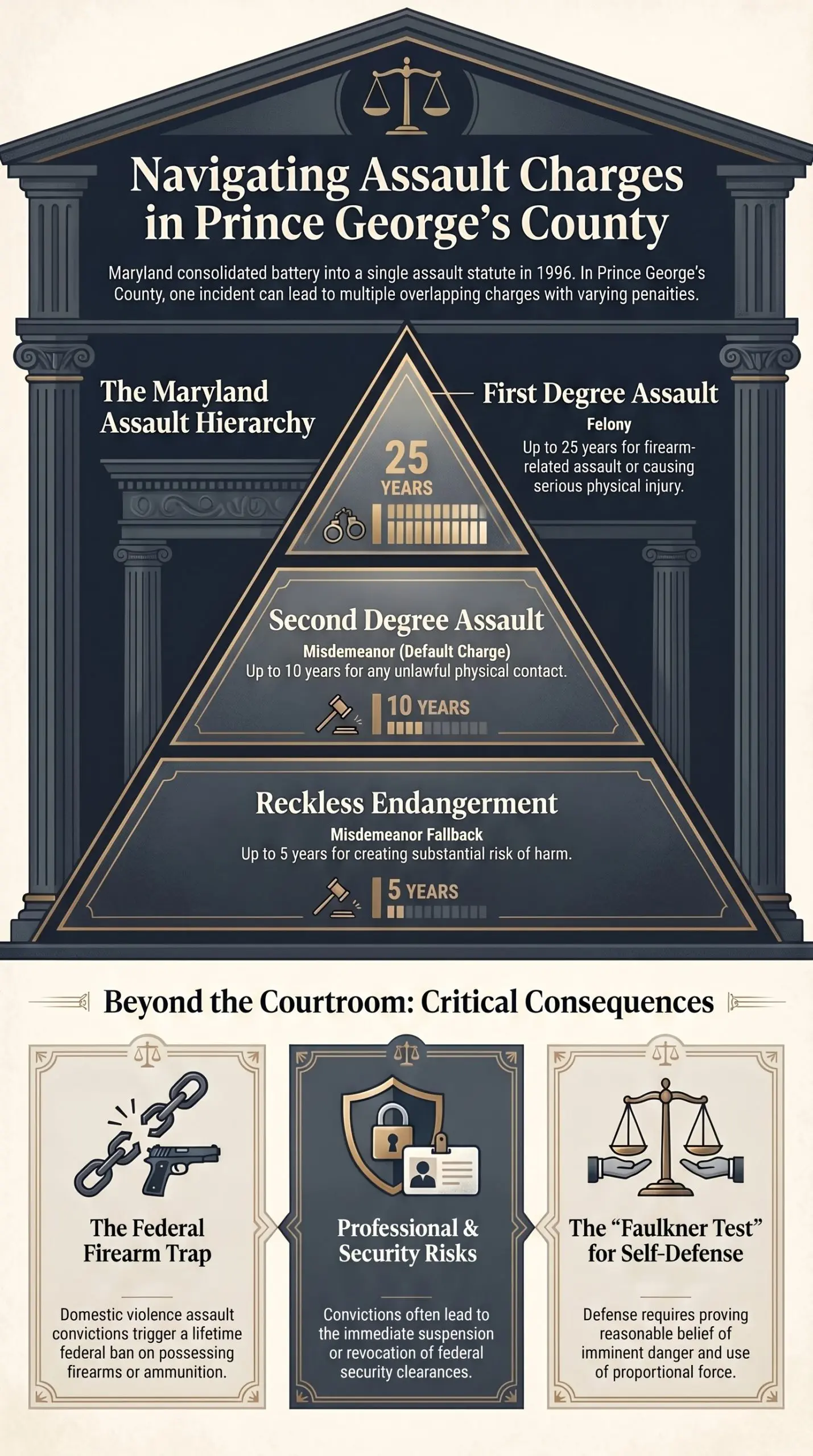
Table of Contents
- Maryland’s Assault Framework: One Statute, Three Charges
- Second Degree Assault: The Default Charge in Prince George’s County
- First Degree Assault: When Misdemeanor Becomes Felony
- Reckless Endangerment: The Lesser Included Alternative
- Domestic Violence Assault and the Protective Order Track
- Assault on Law Enforcement, First Responders, and Corrections Officers
- Self Defense, Defense of Others, and Imperfect Self Defense
- Common Scenarios from Hyattsville to National Harbor
- The Federal Firearm Disqualification Trap
- From Charge to Disposition in Prince George’s County
- Frequently Asked Questions
Prince George’s County is the second largest jurisdiction in Maryland, with nearly one million residents spread across cities and unincorporated communities ranging from the Route 1 corridor in the north (Hyattsville, College Park, Riverdale Park, Mount Rainier, Brentwood) through Greenbelt and Laurel along I-95, into Bowie and Upper Marlboro in the central county, and down through Fort Washington, Camp Springs, Clinton, Oxon Hill, and National Harbor in the south. The county shares its western border with the District of Columbia, runs along the eastern half of the Capital Beltway, and houses Joint Base Andrews, NASA Goddard Space Flight Center, the University of Maryland’s flagship campus, FedExField, and MGM National Harbor.
That density and diversity produces a steady volume of assault and battery cases. The cases come from bar and restaurant strips along Route 1 and University Boulevard. They come from MGM National Harbor and the resorts and restaurants nearby. They come from FedEx Field on game days, from Metro stations along the Green Line and Orange Line, from apartment complexes throughout the county, from family homes in every community, and from the I-495 commuter traffic that connects all of it. Each case proceeds through the Maryland District and Circuit Courts at Hyattsville (north county) or Upper Marlboro (south county and county seat), with the criminal exposure shaped by the same statutory framework that applies anywhere in Maryland but local procedure that has its own rhythms.
This article walks through the full Maryland framework for assault and battery prosecution, with particular attention to how those rules play out in Prince George’s County. It covers the statutory structure, the degree distinctions, the domestic violence overlay, the self-defense doctrine, the federal firearm consequences, and the path from charge to disposition. The goal is not to substitute legal counsel; it is to give people facing assault charges (or family members of someone facing them) the framework needed to understand the stakes early enough to defend the case effectively.
1. Maryland’s Assault Framework: One Statute, Three Charges
Before 1996, Maryland followed the common law tradition that separated assault from battery. Assault was the threat or attempt to inflict physical contact; battery was the actual contact. The General Assembly consolidated those concepts during the mid-1990s criminal code recodification, and the modern framework is found in Title 3, Subtitle 2 of the Criminal Law Article. Section 3-201 simply states that “assault” means the offenses of assault, battery, and assault and battery, retaining their judicially determined meanings, and the rest of the subtitle assigns degrees and penalties.
The structure that emerged divides assaultive conduct into three principal counts. Second-degree assault under Criminal Law § 3-203 is the default. It covers the broad range of unlawful physical contact, attempts, and threats that produce most of the charges seen in District Court. First-degree assault under § 3-202 elevates the offense when the conduct involves serious physical injury or a firearm. Reckless endangerment under § 3-204 is a separate count that does not require contact at all and that the State often charges as an alternative theory.
The substantive law is identical across Maryland’s twenty-four jurisdictions, but the local prosecutorial practices differ. The Office of the State’s Attorney for Prince George’s County, headquartered in Upper Marlboro and supported by branch offices and assistant State’s Attorneys assigned to the various District Court sessions, runs the largest assault docket in the state outside of Baltimore City. The volume affects everything: the speed of charging decisions, the timing of plea offers, the structure of pretrial conferences, and the typical disposition patterns. Counsel familiar with Prince George’s practices is materially helpful in cases that proceed at this scale.
One incident, multiple counts. A single incident often supports more than one count. A bar fight on Route 1 in Hyattsville that produces a broken nose can be charged as first-degree assault (serious physical injury), second-degree assault (the contact itself), and reckless endangerment (the conduct that created the risk). The State elects which theory to advance at trial, and the defense must address all of them.
The framework produces practical consequences. Second-degree assault is a misdemeanor by default, charged in District Court, carrying up to ten years incarceration and a $2,500 fine. First-degree assault is a felony, charged in Circuit Court (or originating in District Court and removed to Circuit Court via a jury demand), carrying up to twenty-five years. Reckless endangerment is a misdemeanor with a five-year cap and a $5,000 fine, often used as a fallback when the State’s evidence on the principal assault count is weaker.
The same framework applies in the firm’s home counties to the south. For comparison, our Calvert County assault and battery defense guide walks through the parallel framework as it applies in Prince Frederick, and our St. Mary’s County assault and battery defense guide covers the framework as it applies in Leonardtown. The substantive law is the same; the local practice differs.
2. Second Degree Assault: The Default Charge in Prince George’s County
Most assault prosecutions in Prince George’s County are second-degree assault cases. The statute is broad. It covers the actual or attempted unlawful application of force to another person, even slight force, and it covers placing another person in reasonable apprehension of immediate harmful or offensive contact. A push, a slap, a thrown drink, a raised fist accompanied by a threat, a grabbed wrist, a swung elbow, a shoved chest, all support the charge.
The breadth of the statute is the reason it is the default. Officers from the Prince George’s County Police Department, Maryland State Police troopers from Barrack “Q” in Forestville, and municipal officers from the various city departments (Hyattsville, College Park, Bowie, Greenbelt, Laurel, Riverdale Park, and others) responding to a call rarely have the full picture at the scene. They have witness accounts that often conflict, physical evidence that often looks ambiguous, and the pressure to make a charging decision before they leave. Second degree assault is the safe choice. It is broad enough to cover most observed conduct, and the case can be refined or modified later by the State’s Attorney’s Office during the review and pretrial process.
The penalty exposure on second-degree assault is serious despite its misdemeanor classification. Up to ten years of incarceration is the headline number. Most first time defendants do not face anywhere near that exposure as a practical matter, but the statutory ceiling shapes the negotiating posture. A conviction results in a permanent criminal record, visible to employers, professional licensing boards, security clearance investigators, and immigration authorities. The collateral consequences often outlast any sentence imposed.
The threat-style second degree. Many people do not realize that no contact is required. A reasonable apprehension of immediate harmful contact is enough. A raised fist, a verbal threat made with the apparent ability to follow through, a feint toward a person, all can support the charge even when no one is touched. The defense in these cases often turns on the reasonableness of the alleged victim’s apprehension and on the immediacy element.
Second-degree assault cases in North County typically run through the District Court of Maryland for Prince George’s County at Hyattsville (14735 Main Street, Upper Marlboro) and the Hyattsville location at 4990 Rhode Island Avenue. South county cases proceed through the courthouse complex in Upper Marlboro. Defendants who demand a jury trial transfer to the Circuit Court for Prince George’s County in Upper Marlboro. The decision to demand a jury is strategic and depends on the strength of the State’s evidence, the driver’s record, and the disposition options available in each forum.
3. First Degree Assault: When Misdemeanor Becomes Felony
First degree assault under Criminal Law § 3-202 is the felony charge in the Maryland assault scheme. The statute reaches conduct in two ways. The first prohibits intentionally causing or attempting to cause serious physical injury to another person. The second prohibits committing an assault with a firearm, including a regulated firearm, a handgun, or other defined categories. Either route produces the same penalty exposure: up to twenty-five years of incarceration.
The phrase “serious physical injury” is defined and is narrower than ordinary injury. Maryland courts have read it to require either a substantial risk of death, protracted disfigurement, protracted loss or impairment of the function of a bodily member or organ, or a similar level of severity. A broken bone may or may not qualify depending on the facts. A laceration requiring stitches is often the threshold question in first-degree cases. Prosecutors charge first degree when the medical evidence meets the elevated standard, and second degree as an alternate count in cases where it does not.
The firearm route is more straightforward as a matter of pleading but more serious as a matter of consequences. Pointing a handgun at another person, brandishing one during an argument, or discharging one in a way that places another person in apprehension all can support the charge regardless of whether anyone was actually injured. Cases involving firearms in Prince George’s County often result in additional weapons counts under Criminal Law § 4-203 and related sections, and the combined exposure climbs quickly. Maryland’s framework on firearms is detailed in our Calvert County weapons charges defense guide; the same statutes apply in Prince George’s.
Where these cases are heard. Felony first-degree assault cases proceed in the Circuit Court for Prince George’s County at the Marlboro Pike courthouse complex in Upper Marlboro. They are typically tried before a jury rather than the bench, although bench trials remain possible by election. The procedure is more formal and the discovery process is more extensive than in District Court.
Defense in first-degree cases focuses heavily on the injury element when the firearm route is not at issue. The medical records, the emergency department documentation from MedStar Southern Maryland Hospital Center, Doctors Community Hospital, Adventist HealthCare’s Fort Washington Medical Center, or the University of Maryland Capital Region facilities, the follow-up treatment notes, and any photographic evidence are all reviewed. Cases sometimes resolve to a plea on second-degree assault when the medical evidence falls short of the serious physical injury threshold, even when the State initially charged first-degree. Identifying that argument early shapes the negotiation.
Charged with Assault in Prince George’s County?
For first-, second-, or reckless endangerment, the case starts moving the moment the charging document is filed. Haskell & Dyer represents accused individuals throughout Prince George’s County, from Hyattsville to Bowie to National Harbor.
Main Office: 301-627-5844
24/7 Hotline: 240-687-0179
4. Reckless Endangerment: The Lesser Included Alternative
Reckless endangerment under Criminal Law § 3-204 is a separate count that often appears alongside an assault charge, particularly in cases involving weapons, vehicles, or conduct that created a risk of harm beyond the immediate target. The statute prohibits recklessly engaging in conduct that creates a substantial risk of death or serious physical injury to another, and separately prohibits discharging a firearm from a motor vehicle in a way that creates such a risk.
The recklessness standard is what makes the count useful to prosecutors. Where assault generally requires intent (or at least general intent), reckless endangerment captures conduct that the actor did not specifically intend to harm anyone with, but that created a substantial risk anyway. A driver who fires a gun in the air during an argument outside a Hyattsville bar, a person who throws a bottle into a crowd at a College Park gathering, or someone who swings a heavy object in a confined space without intending to hit a specific person, all can be charged under § 3-204 even when the assault elements are difficult to prove.
The penalty cap is five years of incarceration and a $5,000 fine. That is lower than either first- or second-degree assault, but it is still a substantial misdemeanor with the same collateral consequences. A conviction goes on the record. Insurance, employment, professional licensing, and security clearance reviews all see it. The reduced penalty does not translate to a reduced impact on the rest of the defendant’s life.
Defense strategy in reckless endangerment cases often focuses on the risk’s substantiality. The statute requires a substantial risk of death or serious physical injury, not just any risk. Conduct that produced annoyance, fear, or even minor injury without rising to the substantial-risk standard may not support the count. Cases sometimes resolve when the State’s evidence shows risk but not a substantial risk of the specific severity the statute requires.
5. Domestic Violence Assault and the Protective Order Track
Domestic violence assault is not a separate charge under Maryland law. It is the same second-degree (or first-degree) assault statute, applied in a domestic context, with an entire parallel system of civil protective orders running alongside the criminal case. Prince George’s County has one of the highest domestic violence caseloads in the state, with the Family Division of the District Court running daily protective order dockets and the State’s Attorney’s Office maintaining a dedicated Family Violence Unit. Understanding both tracks is essential because mistakes on the protective order side can wreck the criminal defense, and vice versa.
The criminal side proceeds the same way as any other assault prosecution. The Prince George’s County Police Department or the responding municipal department takes statements, the primary aggressor analysis often shapes who gets arrested when both parties allege physical contact, and the case runs through District Court (or Circuit Court for first degree). The Family Violence Unit at the State’s Attorney’s Office prosecutes the more serious cases with assigned attorneys who specialize in this area.
The civil side proceeds under Family Law Article §§ 4-501 through 4-516. A petitioner can request an interim protective order from a District Court commissioner if the courts are closed, then a temporary protective order at a hearing within seven days, then a final protective order at a separate hearing, typically within seven days of the temporary. A final protective order can last up to one year (sometimes longer in certain circumstances), and it can include orders to vacate the home, surrender firearms, stay away from specific locations, and limit contact.
What you say at the protective order hearing can be used against you in the criminal case. The two proceedings are separate, but the testimony is not sealed. Statements made under oath at a protective order hearing become part of the record and are available to the State’s Attorney’s Office. Defendants who appear at the protective order hearing without counsel often hand the State usable evidence. Counsel coordinates both tracks to avoid that result.
The geography of domestic violence cases in Prince George’s County reflects the county’s residential geography. Cases come from across the entire region: apartment complexes in Hyattsville, Riverdale Park, Adelphi, and Langley Park, single family homes in Bowie, Mitchellville, and Fort Washington, townhouses in Greenbelt, Laurel, and Beltsville, and the more densely populated communities of Capitol Heights, District Heights, Suitland, Forestville, Clinton, and Camp Springs. Civil protective order hearings are held at the District Court locations in Hyattsville and Upper Marlboro, in the same buildings that handle criminal cases.
Defense in domestic cases requires careful attention to the specific allegations, the credibility of the witnesses, the parties’ prior history, the presence or absence of corroborating evidence, and the effect of any pending custody or divorce proceeding. The criminal case may settle differently when divorce litigation is in progress than when no separate civil dispute exists, and the parties’ incentives can shift between the criminal and civil tracks. Our St. Mary’s County domestic violence and protective orders article walks through the dual track structure in detail; the same structure applies in Prince George’s.
6. Assault on Law Enforcement, First Responders, and Corrections Officers
Criminal Law § 3-203(c) elevates second-degree assault to a felony when the assault intentionally causes physical injury, and the defendant knew or had reason to know that the alleged victim was a law enforcement officer engaged in official duties, a parole or probation officer, a firefighter, an EMT, a correctional officer, or another category of public safety personnel. The penalty rises to 10 years of incarceration as a felony, and the conviction record remains a felony classification permanently.
The charge appears most often in Prince George’s County in three contexts. The first is during arrests, where an officer alleges that the suspect struck or otherwise made physical contact with the officer during a struggle. Bar fight scenes, domestic call interventions, and traffic stop confrontations all produce these allegations regularly. The second is in the correctional setting, when a person held at the Prince George’s County Department of Corrections in Upper Marlboro allegedly assaults a correctional officer during housing operations. The third is in the federal context: alleged assaults on federal officers at Joint Base Andrews, NASA Goddard, the IRS facility in New Carrollton, or other federal facilities can produce both Maryland and federal charges.
The elements that the State must prove are specific. The conduct must intentionally cause physical injury (not just contact or attempted contact), and the defendant must have known or had reason to know that the alleged victim was a member of the protected category in the performance of official duties. Defense in these cases often focuses on the injury and intent elements. A scuffle during an arrest that produced a scrape on the officer’s hand may not rise to physical injury within the statute. A reflexive movement by an arrested person during a takedown to balance may not be intentional.
Body- and dash-cam evidence is central. Prince George’s County Police Department officers wear body cameras during patrol functions, as do most municipal officers in the county and Maryland State Police troopers from Barrack “Q” in Forestville. The video record is the most important piece of evidence in most law enforcement assault cases. The video either supports or contradicts the officer’s report, and counsel reviews it frame by frame.
The collateral consequences of an assault on law enforcement convictions are severe. The felony classification triggers a federal firearm prohibition under 18 U.S.C. § 922(g)(1) regardless of the duration of any sentence imposed. Many employers, particularly federal agencies and contractors that draw from the Prince George’s County workforce, treat the conviction as disqualifying for ongoing employment. Security clearances are typically suspended pending review and often revoked. Immigration consequences attach for non citizens.
7. Self Defense, Defense of Others, and Imperfect Self Defense
Maryland recognizes self-defense as a complete defense to assault charges when the conditions of the doctrine are met. The Court of Appeals decision in State v. Faulkner (1984) established the controlling four-part test that defense counsel still uses today. To prove self defense, the defendant must have (1) actually believed he was in apparent imminent or immediate danger of bodily harm, (2) held that belief reasonably, (3) not been the aggressor or have provoked the conflict, and (4) used no more force than was reasonably necessary.
Maryland generally imposes a duty to retreat when a person can do so safely. The exception is the castle doctrine, which removes the duty to retreat when a person is in their own home. Outside the home (in a parking lot at FedEx Field, on the casino floor at MGM National Harbor, on a sidewalk on Route 1, in a Hyattsville bar), Maryland law expects the defendant to retreat from the confrontation when retreat is safely possible. This duty distinguishes Maryland from stand-your-ground states and alters the analysis in many bar-fight and street-confrontation cases.
Defense of others operates on similar principles. A person may use force to defend a third party when the third party would have been entitled to use force in self-defense, and the defender’s belief about the threat is reasonable. The defense is most often raised when a family member, friend, or stranger intervenes during an altercation involving someone else.
Imperfect self-defense is the doctrine that mitigates rather than excuses. Where perfect self-defense requires both an actual and a reasonable belief in imminent danger, imperfect self-defense applies when the defendant actually believed he was in danger, but the belief was unreasonable. Imperfect self defense is not a complete defense to misdemeanor assault. It plays a more direct role in homicide cases, where it reduces what would otherwise be murder to manslaughter. In assault cases, the doctrine sometimes shapes plea negotiations even when it does not formally apply. The full Maryland self-defense framework is walked through in our Maryland self-defense and the Faulkner test article.
The aggressor question is fact-specific. Who started the confrontation matters under the Faulkner test. A defendant who threw the first punch is generally not entitled to claim self defense for what followed. A defendant who escalated from words to physical action is treated as the aggressor for purposes of the doctrine. Counsel carefully reviews the witness accounts, video evidence, and timeline to determine whether the State can prove the defendant initiated the confrontation.
Procedurally, self-defense is an affirmative defense that the defense raises, and the defendant has the burden of producing evidence to support. Once the evidence is produced and the trial court finds the defense generated, the burden shifts to the State to disprove self-defense beyond a reasonable doubt. That burden is meaningful. A jury that believes the defendant might have acted in self-defense must acquit, even if the jury is not certain the defendant acted in self-defense.
8. Common Scenarios from Hyattsville to National Harbor
Assault cases in Prince George’s County tend to cluster in identifiable settings. Understanding the typical scenarios helps frame what the evidence usually looks like and where the defense usually finds traction.
Bar and restaurant fights along Route 1. The corridor running from the District line through Mount Rainier, Hyattsville, College Park, and into Beltsville carries one of the highest concentrations of bars and restaurants in the county. Late-night confrontations at venues near the University of Maryland’s College Park campus, the established bars in Hyattsville, and the chain restaurants along Route 1 produce a steady flow of cases. Body camera footage from responding officers, security camera footage from the establishment, and witness statements from bartenders and other patrons typically form the evidentiary core.
MGM National Harbor and the Fort Washington area. MGM National Harbor is a major incident generator. The casino floor, the surrounding restaurants and bars, the hotel, and the parking facilities all produce assault cases on weekend evenings throughout the year. The volume of patrons, the alcohol service, and the presence of significant amounts of cash and high-value items combine to produce conditions that occasionally turn violent. Cases originating at MGM National Harbor are investigated by Prince George’s County Police and prosecuted by the State’s Attorney’s Office, with substantial surveillance video typically available.
FedEx Field on game days. Sundays during the football season produce a predictable spike in assault calls at and around FedEx Field in Landover. Tailgate confrontations in the parking lots, in-stadium incidents involving fans, and post-game disputes near the venue all draw responding officers. The enclosed parking complex, the predictable game schedule, and the alcohol-fueled environment combine to make this one of the most consistent sources of assault charges in the central county.
Domestic and family incidents. Cases come from every part of the county, from the densest apartment complexes in Hyattsville and Langley Park to the single-family homes in Bowie and Mitchellville to the rural addresses in the south county. The procedural path is uniform across geography. The criminal case proceeds in District Court, the protective order petition proceeds in the same building, and the two cases inform each other.
Road rage on the Beltway and the major arterials. I-495 (the Capital Beltway), I-95, I-295 (BW Parkway), US 50, US 301, Route 1, and MD 210 all produce road rage cases on a regular basis. Vehicle confrontations that escalate to physical violence almost always involve dash and traffic camera footage, and they often result in charges on both sides. The Calvert County analog of these cases appears in our Route 4 Huntingtown road rage assault defense guide; the dynamics are the same on Prince George’s roads.
University of Maryland and college campus conflicts. The University of Maryland’s flagship campus in College Park draws approximately 41,000 students, whose social activities occasionally result in assault charges. Dorm incidents, fraternity and sorority confrontations, off-campus party disputes, and parking lot incidents after sporting and entertainment events all produce cases that proceed through the District Court at Hyattsville. The University of Maryland Police Department investigates campus incidents and coordinates with the State’s Attorney’s Office.
Metro and transit incidents. The Green Line and Orange Line both run through Prince George’s County, with stations at College Park, Prince George’s Plaza, West Hyattsville, Greenbelt, New Carrollton, Landover, Cheverly, Naylor Road, Suitland, Branch Avenue, Southern Avenue, Capitol Heights, and Largo Town Center. Incidents on Metro trains, in stations, and at bus connections often produce assault charges, with Metro Transit Police typically taking the initial report and either handling the case or referring it to local police.
Workplace, sporting, and event incidents. Assault cases also occur in workplaces (including federal offices nationwide), at youth sports games at various recreational fields, at family gatherings, and at one-time events such as weddings, fundraisers, and community festivals. These cases often involve people with no prior criminal history and produce strong mitigation potential when handled properly.
9. The Federal Firearm Disqualification Trap
Some of the most painful consequences of an assault conviction are not in the Maryland Code at all; they are in federal law. The Lautenberg Amendment, codified at 18 U.S.C. § 922(g)(9), prohibits any person convicted of a misdemeanor crime of domestic violence from possessing a firearm or ammunition for life. The disqualification is automatic, federal, and largely permanent.
The triggering conviction is not a specifically designated charge in Maryland. Any second-degree assault conviction can qualify as a misdemeanor crime of domestic violence under federal law if the relationship between the defendant and the alleged victim falls within the federal definition (current or former spouse, parent, guardian, person who shares a child with the victim, person cohabiting with the victim, or a person similarly situated). The conviction does not have to be labeled “domestic violence” in the Maryland charging document for the federal prohibition to attach.
The implications are particularly severe in Prince George’s County, where a substantial portion of the population works at or with the federal government. Joint Base Andrews, NASA Goddard, the IRS facility in New Carrollton, the Beltsville Agricultural Research Center, the Census Bureau in Suitland, the Food and Drug Administration headquarters, and dozens of other federal agencies and military installations either sit in the county or draw their workforce from it. Active-duty service members, federal civilian employees, and contractors with security clearances all face professional consequences under § 922(g)(9). Restoration of firearm rights after a federal disqualification is procedurally difficult and often functionally unavailable for the domestic violence misdemeanor category.
Probation Before Judgment is not always a safe harbor. Federal courts have read § 922(g)(9) inconsistently as applied to PBJ dispositions. The conservative defense approach is to assume that any assault disposition involving a domestic relationship triggers the federal prohibition unless the case ends in outright dismissal, acquittal, or a plea to a non-qualifying offense. Counsel structures the defense from the start with this risk in mind.
Felony assault convictions trigger a separate and broader federal firearm prohibition under 18 U.S.C. § 922(g)(1), which applies to anyone convicted of a crime punishable by more than one year of imprisonment. First-degree assault and the felony version of assault on law enforcement both fall within that category. Restoration of firearm rights after a federal disqualification is procedurally difficult and often functionally unavailable, particularly for the domestic violence misdemeanor category. Maryland’s separate firearms framework is covered in our Calvert County weapons charges defense guide.
10. From Charge to Disposition in Prince George’s County
The path of a Prince George’s County assault case from charge to disposition is structured but not uniform. Most cases pass through several common stages, with branching points where decisions made by counsel and the defendant shape the trajectory.
Initial appearance and pretrial release. A defendant arrested on assault charges is typically taken to the Prince George’s County Department of Corrections in Upper Marlboro. A District Court commissioner conducts an initial appearance to set conditions of pretrial release, often within hours of the arrest. The conditions may include unsecured personal recognizance, secured bail, supervised pretrial release, no-contact orders, and others. A bail review hearing before a judge can follow within a day or two if the commissioner imposes conditions the defendant cannot meet.
Arraignment and discovery. The arraignment date is typically set within thirty to sixty days of the charge. The District Court of Maryland for Prince George’s County operates from two courthouses (Hyattsville for north county cases and Upper Marlboro for south county cases). Counsel files a request for discovery, and the State’s Attorney’s Office produces the police reports, witness statements, body camera footage, dash camera footage, photograph evidence, and any other materials in its possession. A diligent discovery review is the foundation of the defense.
Pretrial motions and conferences. Before trial, counsel may file motions to suppress evidence (challenging the legality of any statements obtained, any searches conducted, or any identifications made), motions in limine (limiting the evidence the State may introduce at trial), and motions to dismiss (when legal grounds exist). Pretrial conferences with the assistant State’s Attorney often produce plea offers, scheduling decisions, and clarification of the State’s theory.
Trial. Cases that do not resolve through plea negotiations proceed to trial. Misdemeanor cases in District Court are tried by the bench unless a jury demand is filed. Felony cases in Circuit Court at Upper Marlboro are tried before a jury unless the defendant elects a bench trial. The defense decides which witnesses to call, whether the defendant will testify, and how to structure the closing argument. A reasonable doubt finding by the trier of fact ends the case.
Sentencing and PBJ. When the case ends in a guilty finding, sentencing follows. Maryland’s Probation Before Judgment statute under Criminal Procedure § 6-220 allows the court to defer entry of judgment for first-time defendants and dispose of the case without a conviction record after successful completion of probation. PBJ is not available for every assault charge, and the prosecutor’s position influences whether the court grants it. Mitigation evidence (anger management completion, counseling, character letters, employment, community ties) materially affects sentencing decisions and PBJ eligibility. Our PBJ defense article walks through the eligibility and mitigation considerations in detail.
Mitigation begins before court. Defendants who arrive at sentencing having already completed an anger management program, having begun counseling, and having produced strong character evidence give the court a record on which to grant favorable dispositions. Defendants who arrive empty-handed often leave with convictions when they did not need to.
The collateral consequences of an assault conviction in Prince George’s County reach beyond the courtroom. Employment effects are substantial, particularly for federal employees, contractors, and security clearance holders. Insurance, professional licensing, and immigration consequences all attach to certain dispositions. The federal firearm prohibitions discussed earlier attach by operation of law and do not require any further finding by the Maryland court.
Defense That Starts at the Charging Document
Whether the case is a misunderstanding outside a Hyattsville bar, a domestic incident in Bowie, a casino floor confrontation at MGM National Harbor, or a felony allegation in Upper Marlboro Circuit Court, Haskell & Dyer represents accused individuals throughout Prince George’s County. Call before the first hearing, not after.
Main Office: 301-627-5844
24/7 Hotline: 240-687-0179
Closing Thoughts
Prince George’s County assault cases come from every part of the county and from every walk of life. A bar argument in Hyattsville, a heated dispute in a Bowie kitchen, a parking lot confrontation at FedEx Field on a Sunday afternoon, an incident at a fundraiser in Upper Marlboro, a workplace conflict at a federal facility, a casino floor altercation at MGM National Harbor, a family argument that boiled over in Fort Washington, all can produce the same set of charges and the same set of consequences. What separates the cases that end well from the cases that do not is the early decision making, the discipline in the protective order proceedings, the quality of the discovery review, and the strategic choices about plea, trial, and sentencing.
Maryland’s combined assault and battery statute is broad. It captures conduct that ranges from the genuinely dangerous to the merely embarrassing. Prosecutors charge it widely because the breadth allows them to file quickly and refine later. Defense counsel works the same breadth from the other side, identifying which theories the State can prove, which it cannot, and where the defense can build a record sufficient to acquit, dismiss, or resolve the case to a non-conviction disposition.
The collateral consequences of a conviction in this area can last for decades beyond the sentence. Federal firearm disqualification, security clearance impact, employment effects, and immigration implications all attach to assault dispositions in ways that often surprise defendants. Prince George’s County’s heavy federal workforce makes these consequences particularly common here. The right defense addresses those consequences from the first conversation, not as an afterthought at sentencing.
Haskell & Dyer represents accused individuals across Prince George’s County, including residents of Hyattsville, College Park, Riverdale Park, Mount Rainier, Brentwood, Cheverly, Bladensburg, Cottage City, Edmonston, North Brentwood, Greenbelt, Berwyn Heights, New Carrollton, Lanham, Beltsville, Adelphi, Langley Park, University Park, Hillcrest Heights, Suitland, Forestville, District Heights, Capitol Heights, Seat Pleasant, Glenarden, Landover, Largo, Mitchellville, Bowie, Laurel, Upper Marlboro, Croom, Aquasco, Brandywine, Clinton, Camp Springs, Temple Hills, Oxon Hill, Fort Washington, Accokeek, and National Harbor. The firm understands the local courts, prosecutors, and law enforcement agencies, and it builds defenses that account for both the criminal and the collateral consequences of every charge.
Frequently Asked Questions
Is assault and battery still a separate charge in Maryland?
No. Maryland folded assault, battery, and assault and battery into one statutory assault framework. Cases are usually charged as second degree assault, first degree assault, or reckless endangerment.
What is second degree assault in Prince George’s County?
Second degree assault covers unwanted physical contact, attempted harmful contact, or placing someone in reasonable fear of immediate harm.
What is first degree assault in Maryland?
First degree assault is a felony involving serious physical injury, attempted serious injury, or use of a firearm during an assault.
What is reckless endangerment?
Reckless endangerment involves conduct that creates a substantial risk of death or serious physical injury, even if no one is physically touched.
Where are Prince George’s County assault cases handled?
Cases are generally handled in District Court in Hyattsville or Upper Marlboro. Felony cases and jury trials are handled in Circuit Court in Upper Marlboro.
Can a domestic assault case also involve a protective order?
Yes. Domestic assault cases often involve both a criminal case and a civil protective order case, which can affect contact, housing, custody, and firearm rights.
Can statements at a protective order hearing be used in criminal court?
Yes. Statements made under oath during a protective order hearing can be used in the related criminal assault case.
Can self defense apply to an assault charge?
Yes. Self defense may apply when the accused reasonably believed they were in immediate danger, did not start the conflict, and used reasonable force.
What evidence matters in Prince George’s County assault cases?
Important evidence can include body camera footage, surveillance video, medical records, 911 calls, witness statements, photographs, and text messages.
Can an assault conviction affect firearm rights?
Yes. Felony assault convictions and qualifying domestic violence convictions can trigger federal and Maryland firearm restrictions.
Can an assault charge affect a federal job or security clearance?
Yes. Prince George’s County has many federal employees, military personnel, and contractors, and assault charges can trigger clearance reviews, employment issues, and reporting duties.
What are common assault case locations in Prince George’s County?
Common locations include Hyattsville, College Park, Bowie, Upper Marlboro, National Harbor, FedEx Field, MGM National Harbor, Metro stations, and residential communities across the county.
Can I get Probation Before Judgment for assault?
Probation Before Judgment may be available in some cases, especially for first time defendants, but it depends on the charge, facts, prior record, and court approval.
What should I do after an assault arrest in Prince George’s County?
Do not contact the alleged victim, do not post about the case, preserve evidence, follow court orders, and contact a defense attorney immediately.
References
18 U.S.C. § 922(g) (2024). Unlawful acts: Possession of firearms and ammunition by prohibited persons. Washington, DC: U.S. Government Publishing Office.
Burch v. State, 346 Md. 253 (1997). Court of Appeals of Maryland.
Maryland Code Annotated, Criminal Law Article § 3-201 (2024). Definitions. Annapolis, MD: General Assembly of Maryland.
Maryland Code Annotated, Criminal Law Article § 3-202 (2024). Assault in the first degree. Annapolis, MD: General Assembly of Maryland.
Maryland Code Annotated, Criminal Law Article § 3-203 (2024). Assault in the second degree. Annapolis, MD: General Assembly of Maryland.
Maryland Code Annotated, Criminal Law Article § 3-204 (2024). Reckless endangerment. Annapolis, MD: General Assembly of Maryland.
Maryland Code Annotated, Criminal Law Article § 4-203 (2024). Wearing, carrying, or transporting handgun. Annapolis, MD: General Assembly of Maryland.
Maryland Code Annotated, Criminal Procedure Article § 6-220 (2024). Probation before judgment. Annapolis, MD: General Assembly of Maryland.
Maryland Code Annotated, Family Law Article §§ 4-501 to 4-516 (2024). Domestic violence: Protective orders. Annapolis, MD: General Assembly of Maryland.
Maryland Judiciary. (2024). District Court of Maryland for Prince George’s County: Hyattsville and Upper Marlboro locations. Annapolis, MD: Author.
Maryland Rules. (2024). Title 4: Criminal causes. Annapolis, MD: Court of Appeals of Maryland.
Office of the State’s Attorney for Prince George’s County. (2024). Family Violence Unit prosecution policies. Upper Marlboro, MD: Author.
Prince George’s County Police Department. (2024). Body-worn camera policy and use guidelines. Largo, MD: Author.
State v. Faulkner, 301 Md. 482 (1984). Court of Appeals of Maryland.
U.S. Department of Defense. (2023). Personnel security clearance reporting requirements: DoD Directive 5220.6. Arlington, VA: Author.
U.S. Department of Justice, Bureau of Alcohol, Tobacco, Firearms and Explosives. (2024). Federal firearms regulations: Domestic violence misdemeanor disqualification. Washington, DC: U.S. Department of Justice.
Legal Disclaimer: This article provides general information about Maryland assault and battery law and is not legal advice. Reading it does not create an attorney client relationship with Haskell & Dyer or any of its attorneys. Maryland law changes, and the application of any statute, court rule, or administrative regulation depends on the specific facts of an individual case. Statutes are cited to the Maryland Code as in effect at the time of writing and may have been amended since publication. If you have been charged with assault, a domestic violence offense, or any other crime in Prince George’s County or anywhere in Maryland, you should consult with a qualified attorney about the facts of your case.
For a confidential consultation, call Haskell & Dyer at 301-627-5844 or our 24/7 hotline at 240-687-0179.