

Bottom Line Up Front
A DUI or serious traffic charge in St. Mary’s County travels two roads at once. One ends at the District Court in Leonardtown, where the State seeks a conviction and a sentence. The other ends at the Maryland Motor Vehicle Administration, where your driver’s license is at stake within ten days of the stop. Each path has its own deadlines, its own evidence rules, and its own outcomes, and missing one can wreck the other. From a routine stop on Route 235 in California to a felony crash investigation near the Thomas Johnson Bridge, an effective defense starts the night of the arrest, not the morning of court.
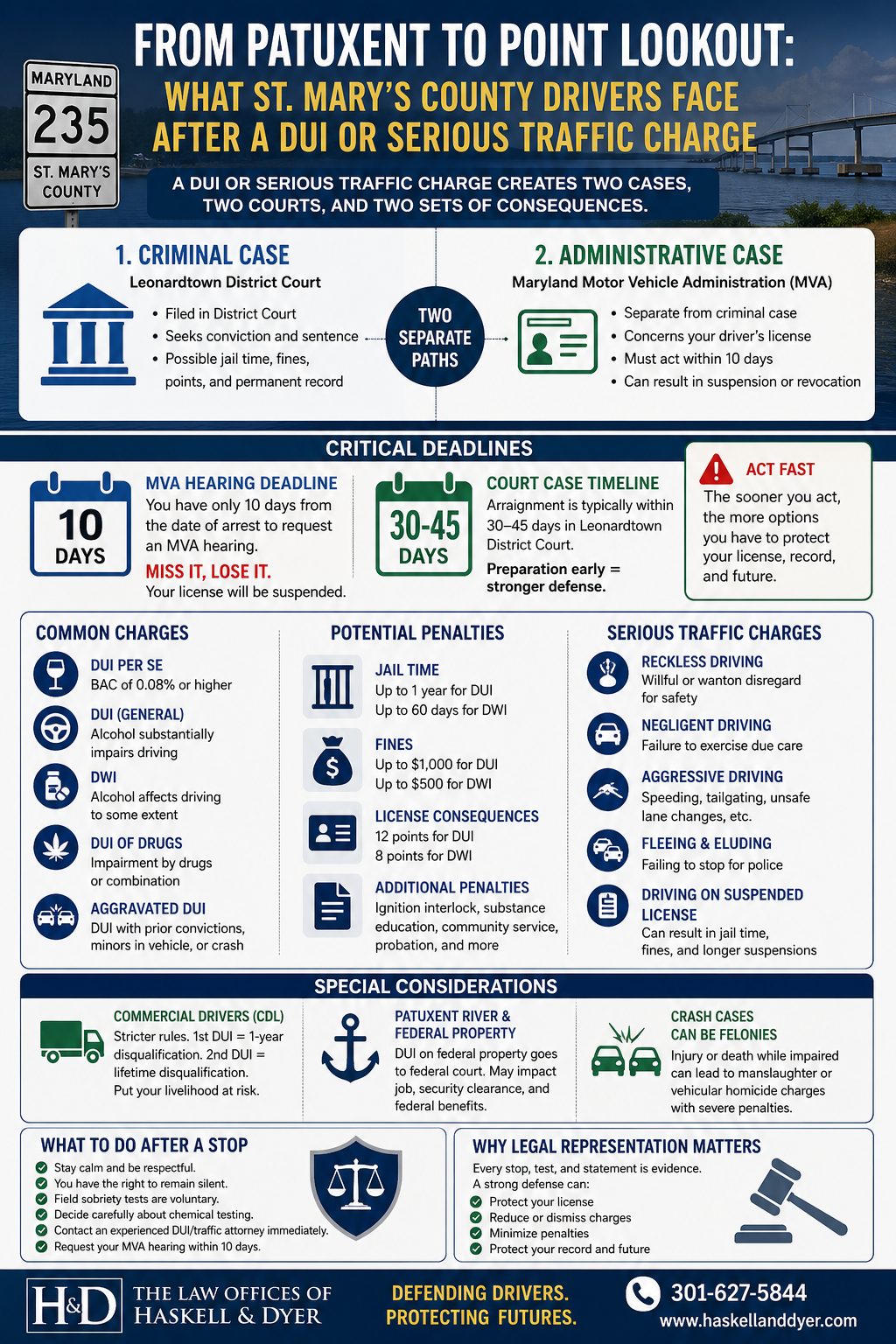
Table of Contents
- Two Offenses, Not One: How Maryland Splits DUI from DWI
- The Traffic Stop on Three Notch Road
- Field Sobriety Tests and the Roadside Performance
- Breath, Blood, and Maryland’s Implied Consent Law
- The MVA Hearing: A Separate Fight for Your License
- A First Offense in Leonardtown District Court
- Repeat and Aggravated DUI Offenses
- Commercial Drivers and the Patuxent River Federal Question
- Reckless, Negligent, and Aggressive Driving Charges
- When a Crash Becomes a Felony
The drive between Charlotte Hall in the north and Ridge near Point Lookout covers nearly the full length of St. Mary’s County. A driver passing through that corridor moves through Mechanicsville, Hollywood, California, Lexington Park, Great Mills, and Park Hall before reaching the southern tip. On any Friday or Saturday night, that same stretch of road sees Maryland State Police troopers from Barrack “U” in Leonardtown, deputies from the St. Mary’s County Sheriff’s Office, officers from the Leonardtown Police Department, and base police near Naval Air Station Patuxent River. A single traffic stop can come from any of them, and the consequences depend on who pulled the driver over, where the stop happened, and what the officer wrote in the report afterward.
A DUI charge in Maryland is not one case but two. The criminal case proceeds in District Court, almost always at the courthouse on Courthouse Drive in Leonardtown. The administrative case proceeds before the Office of Administrative Hearings on behalf of the MVA. Both move on tight timelines. Both produce penalties. Both can be defended, but only when the driver acts before the early deadlines pass. Serious traffic offenses, including reckless driving, fleeing and eluding, and driving on a suspended license, follow a similar path through the same courthouse and can carry consequences nearly as severe.
This article walks through the full path of a St. Mary’s County DUI or serious traffic case from the stop through trial. It covers the road rules unique to commercial drivers, the federal jurisdiction issues that arise on the PAX River base, and the felony exposure that attaches when an impaired driver is involved in a fatal crash. The goal is not to substitute legal counsel; it is to help drivers and families understand the stakes early enough to protect a record, a license, and a livelihood.
1. Two Offenses, Not One: How Maryland Splits DUI from DWI
Maryland Code, Transportation Article § 21-902 contains the entire framework for impaired driving offenses in the state, and it splits them into separate counts that often appear together on a single citation. Understanding the split is the starting point for any defense.
Driving Under the Influence per se applies when a driver’s blood alcohol concentration registers 0.08 or higher within two hours of driving. The State does not need to prove that the driver was actually impaired. The BAC number does the work. Driving Under the Influence in the general sense requires proof that alcohol substantially affected the driver’s ability to operate the vehicle safely. Driving While Impaired by alcohol is a lesser standard and applies when alcohol affected driving to some extent, even if not substantially. Driving Under the Influence of drugs, or under the combined influence of drugs and alcohol, falls under separate subsections that prosecutors charge with increasing frequency, particularly in cases involving prescription medications or cannabis.
Why the split matters: A first offense DUI carries up to one year in jail and a $1,000 fine. A first offense DWI tops out at 60 days in jail and $500. The points assessed against a license also differ: 12 points for a DUI, which triggers a revocation review, against 8 points for a DWI, which triggers a suspension review.
Most cases in Leonardtown District Court resolve as DWI convictions, DUI convictions, or Probation Before Judgment dispositions, and which one applies often turns on the breath result, the field test performance, and the negotiating posture established at arraignment. For drivers stopped on Route 235 near Lexington Park or on Route 5 outside Leonardtown, the difference between a 0.07 reading and a 0.09 reading is often the line between a likely DWI prosecution and a per se DUI prosecution. Both are defensible. The strategy is not identical.
The same citation that lists DUI per se almost always lists DWI as a backup count, because the two charges allow the State to argue alternate theories at trial. A defense that targets only one count and ignores the other is incomplete.
2. The Traffic Stop on Three Notch Road
Every DUI case begins with a stop, and every defense begins with whether that stop was lawful. Under Maryland law and the Fourth Amendment, an officer needs reasonable articulable suspicion of a traffic violation or criminal activity to pull a vehicle over. A hunch is not enough. Time of night is not enough. The reputation of the bar a driver just left is not enough.
Common stop justifications along Route 235 (Three Notch Road), Route 5 (Point Lookout Road), and Route 4 (Solomons Island Road) include weaving within a lane, crossing the fog line, equipment violations, expired tags, speed, and failure to signal. On the rural stretches between Hollywood and Park Hall, or between Mechanicsville and Charlotte Hall, officers often cite center line crossings or shoulder drifts on roads where the lanes themselves are narrow and the shoulders are gravel. Those conditions can support a stop, but they can also undermine one when the road geometry explains the movement better than impairment does.
The St. Mary’s County Sheriff’s Office runs patrol throughout the county. The Maryland State Police operate from Barrack “U” in Leonardtown and frequently work the Route 235 corridor between Charlotte Hall and Lexington Park. The Leonardtown Police Department patrols within the town limits. On Patuxent River Naval Air Station, base police and federal authorities have jurisdiction, which carries different procedural rules entirely (covered in Chapter 8).
What the video shows often decides the case. Body camera and dashboard camera footage have become standard evidence in St. Mary’s County prosecutions. The recording either supports the officer’s written report or contradicts it, and the difference can decide a case before it ever reaches trial.
A driver who appears steady on video, follows directions, and produces documents without difficulty creates a record that undercuts later claims of obvious impairment. A driver who is recorded stumbling, slurring, or admitting to drinking creates the opposite. Defense counsel reviews every available video frame by frame, listens to dispatch audio, and pulls the officer’s training file. When a stop lacks a lawful basis, every piece of evidence downstream of it can be suppressed, including the breath test result. That is true whether the stop happened at the Wildewood light in California or on a quiet stretch of Budds Creek Road outside Mechanicsville.
3. Field Sobriety Tests and the Roadside Performance
After the stop, officers typically ask the driver to step out of the vehicle and perform a series of roadside tests. The National Highway Traffic Safety Administration recognizes three Standardized Field Sobriety Tests: the Horizontal Gaze Nystagmus test, the Walk and Turn, and the One Leg Stand. Officers in St. Mary’s County are trained on these tests, and most reports describe the same set of “clues” that the testing manual identifies.
The Horizontal Gaze Nystagmus test asks the driver to follow a stimulus (often a pen or finger) with the eyes only. The officer looks for involuntary jerking that can correlate with alcohol consumption. The Walk and Turn requires the driver to take nine heel to toe steps along an imaginary line, turn in a prescribed manner, and return. The One Leg Stand requires balance on one foot for thirty seconds while counting aloud. Each test has a list of validated clues, and the officer scores performance against those clues.
The tests are designed to be administered under specific conditions: a level, hard, dry, non-slippery surface with adequate lighting and minimal distraction. Few stretches of road in St. Mary’s County match those conditions. The shoulder of Route 5 outside Leonardtown is rarely level. The grass edge of Route 234 near Loveville is often uneven. The blue and red strobes from the patrol car add visual distraction. Weather, footwear, age, weight, medical conditions, and prior injuries can all affect performance. A defense strategy that uses the testing manual against the officer’s own report is one of the most effective tools in the courtroom.
The tests are voluntary. Maryland law does not require a driver to participate in field sobriety tests. Refusing them does not produce the same license consequences as refusing a breath test. Officers rarely advertise this fact at the roadside.
Many drivers participate in the tests believing they have no choice. The decision to participate becomes evidence at trial regardless of the result. Cross examination on the tests, on the conditions under which they were given, and on the officer’s training and experience can shift the weight a judge or jury gives to that evidence. The video, again, is often more persuasive than the report.
4. Breath, Blood, and Maryland’s Implied Consent Law
By driving on Maryland roads, every motorist is deemed to have consented to a chemical test of breath or blood when an officer has reasonable grounds to suspect an impaired driving offense. That principle, codified in Transportation Article § 16-205.1, is the engine of the implied consent law and the source of the most painful consequences a driver faces in the first 24 hours.
When an officer requests a breath test, the driver must be advised of the consequences of taking the test, the consequences of refusing, and the right to a hearing. That advice comes on a form known as the DR-15. The form is dense, often read at 2 a.m. in the booking area at the Leonardtown barracks or the St. Mary’s County Detention Center, and the decision the driver makes within the next few minutes shapes the license consequences for months or years to come.
A test that produces a result of 0.08 or higher triggers a license suspension. A refusal triggers a longer suspension and, importantly, makes the driver ineligible for many of the modification options available to drivers who took the test. A second refusal within five years triggers a substantially longer period without driving privileges. The numbers shift over time as the General Assembly amends the statute, but the structure has held: refusal carries heavier license penalties than a failed test.
Noah’s Law changed the rules in 2016. Maryland’s Drunk Driving Reduction Act expanded the ignition interlock program. A driver convicted of DUI is required to enroll in the program for a defined period before regular driving privileges return, and a driver who refused the breath test is also subject to interlock requirements as a condition of obtaining a restricted license.
The interlock device is installed on the steering column area of the vehicle. The driver blows into it before the engine will start, and it logs every attempt. Tampering, missed rolling retests, and failed starts all generate reports that the MVA reviews. A clean year in the program ends with the device removed and full privileges restored. A reported violation can extend the program or trigger a hearing.
The breath machine itself, the EC/IR II in most Maryland jurisdictions, must be operated by a certified technician within strict timing windows after the stop. Calibration records, observation period documentation, and operator certification are all subject to challenge. A breath result is not the end of the analysis; it is the beginning of one.
Stopped, Charged, or Worried About Tomorrow Morning?
The first ten days after a DUI stop in St. Mary’s County determine whether you keep your license while the criminal case is pending. Haskell & Dyer represents drivers across Leonardtown, Lexington Park, California, and the surrounding communities.
Main Office: 301-627-5844
24/7 Hotline: 240-687-0179
5. The MVA Hearing: A Separate Fight for Your License
The criminal case is not the only matter that opens when a driver is charged with DUI in St. Mary’s County. The MVA opens its own administrative case the moment the officer submits the paperwork. The driver is given a temporary paper license valid for a defined period after the stop, typically 45 days. To preserve the right to a hearing on the suspension, the driver must request that hearing within ten days of the stop and pay the filing fee.
That ten day window is unforgiving. A driver who waits past the deadline loses the right to a hearing entirely, and the suspension takes effect by operation of law. Many drivers in the rural parts of St. Mary’s County, including Bushwood, Avenue, Chaptico, and Coltons Point, depend on driving for work, child care, or medical appointments. The hearing is the only chance to argue for modification before the suspension begins.
Hearings are held by the Maryland Office of Administrative Hearings. Most are conducted by video or phone, which means the driver does not need to travel out of the county to participate. The administrative law judge reviews the officer’s certification, the test result or refusal, and any evidence the driver offers in defense. The standard of proof is lower than in criminal court, and the rules of evidence are more relaxed. That cuts both ways. A driver can introduce mitigating evidence that would not be admissible in a trial, and the State can introduce documents without the officer present.
Modification, not just dismissal. Even when the suspension is going to take effect, the hearing officer can grant a restricted license or order participation in the Ignition Interlock Program in lieu of a hard suspension. For many St. Mary’s County drivers commuting to PAX River, to the Patuxent River Naval Air Station civilian workforce, or to jobs in Calvert County across the Thomas Johnson Bridge, that modification is the difference between keeping a job and losing one.
The MVA case proceeds on a faster track than the criminal case. A hearing is often resolved within a few weeks of the request, while the criminal case may take months to reach trial. The two cases inform each other. A favorable ruling at the MVA can shape the criminal negotiation. A bad ruling at the MVA does not preclude a favorable result in court, but it changes the strategy.
6. A First Offense in Leonardtown District Court
The St. Mary’s County District Court at 41605 Courthouse Drive in Leonardtown handles the overwhelming majority of DUI prosecutions in the county. Most first offense cases begin with an arraignment date listed on the citation, followed by a trial date set within sixty to ninety days. The path from arraignment to disposition is shorter and faster than many drivers expect, and decisions made early are difficult to undo later.
At the first appearance, a driver enters a plea or requests a continuance, often to retain counsel and gather records. A jury trial demand transfers the case from District Court to the Circuit Court for St. Mary’s County, also located on Courthouse Drive in Leonardtown. That decision is strategic and depends on the strength of the State’s evidence, the driver’s record, and the disposition options available in each forum.
For a driver with no prior record, the most common favorable outcome is Probation Before Judgment under Criminal Procedure § 6-220. PBJ is not an acquittal, but it is also not a conviction. After successful completion of probation, the case is closed without a guilty finding for most purposes, including most employment background checks. The court typically conditions PBJ on completion of an alcohol education program, the MADD Victim Impact Panel, and sometimes a period of supervised probation. A subsequent offense within ten years can preclude another PBJ for the same charge.
Mitigation starts before court. Drivers who arrive at sentencing having already completed an alcohol assessment, begun any recommended treatment, attended a victim impact panel, and produced strong character evidence give the court a record on which to grant PBJ. Drivers who arrive without those steps often leave with a conviction.
Local resources include the St. Mary’s County Health Department behavioral health programs, MedStar St. Mary’s Hospital outpatient services, and several private treatment providers in the Leonardtown and California areas. A certified assessor evaluates the driver and recommends an appropriate level of care. The recommendation is admissible at sentencing and shows the court that the driver is treating the case seriously.
A first offense conviction, by contrast, carries license points, a fine, possible jail time, mandatory probation, ignition interlock under Noah’s Law, and a record visible to insurers and employers. The cost of a conviction extends well beyond the courtroom. Insurance premiums often double or triple, security clearances at PAX River face review, and CDL holders face independent disqualification. The defense strategy is built backward from those consequences.
7. Repeat and Aggravated DUI Offenses
A second DUI conviction in Maryland is a different animal. The maximum exposure climbs to two years in jail and a $2,000 fine, and the statute imposes a mandatory minimum period of incarceration when the second offense occurs within five years of the first. A third offense raises the maximum further and adds longer mandatory minimums. The MVA penalties also escalate, with longer suspension periods and longer interlock requirements.
Aggravating factors can transform an ordinary DUI into a charge with substantially higher penalty exposure. Driving under the influence with a minor in the vehicle is treated more harshly under § 21-902(g), with both increased fines and increased jail exposure. The State Department of Social Services may also be notified depending on the circumstances, opening a separate child welfare review independent of the criminal case.
A high BAC reading, often defined as 0.15 or higher, brings additional administrative consequences and extended interlock periods. Crashes with property damage or injury elevate the negotiating posture even when no separate charge is filed. Resisting arrest, fleeing the scene, or attempting to dispose of evidence add separate counts that can run consecutively with the DUI sentence.
Lookback periods matter. Maryland uses different lookback periods for different purposes. The MVA looks back further than the sentencing court does. A prior PBJ, even though it is not a conviction, can still factor into how a current case is treated. A defense that does not account for the full prior record on both the criminal and administrative sides leaves opportunities on the table.
Defense strategy in repeat cases shifts from outright dismissal toward damage control. Motions to suppress remain central, particularly when the second case involves issues with the stop, the testing protocol, or the booking procedure. When the State’s evidence is strong, the focus moves to the conditions of any plea: cap on incarceration, eligibility for work release, treatment in lieu of incarceration, and the structure of probation.
Drivers with prior records who live and work in St. Mary’s County often face an additional challenge. The community is small enough that prior cases are recognized at sentencing, and reputation effects can outlast the formal sentence. Counsel familiar with the practices of the State’s Attorney’s Office for St. Mary’s County and the bench in Leonardtown is valuable in shaping the outcome to something a driver can rebuild from.
8. Commercial Drivers and the Patuxent River Federal Question
St. Mary’s County has two driver populations that face DUI law differently than the average motorist. Commercial Driver’s License holders are governed by federal regulations that impose stricter standards and harsher consequences. Drivers stopped on Naval Air Station Patuxent River are subject to federal jurisdiction and a separate court system entirely.
For CDL holders, the BAC threshold for a per se DUI in a commercial vehicle is 0.04, half the limit for a regular driver. A first offense in a commercial vehicle results in a one year disqualification of the CDL. A second offense produces a lifetime disqualification under federal law, with limited reinstatement provisions. The disqualification applies even if the offense occurred while the driver was operating a personal vehicle off duty, because the CDL is a federal credential and the regulations track the holder, not the truck.
That structure produces hard cases. A commercial driver living in Mechanicsville or Hollywood who is charged with DUI on a Saturday night in a personal pickup faces both the criminal case in Leonardtown District Court and the loss of a livelihood independent of how the criminal case resolves. PBJ is not available to defeat the disqualification. Federal regulations treat PBJ as a conviction for CDL purposes regardless of how Maryland characterizes it.
The PAX River jurisdiction problem. A traffic stop inside the gates of Patuxent River Naval Air Station is a federal stop. The case proceeds in the United States District Court for the District of Maryland, typically before a magistrate judge in Greenbelt, not in the District Court in Leonardtown. The procedural rules, the prosecutor, the sentencing options, and the discovery process are all different.
Federal DUI cases on PAX often involve civilian contractors, military personnel, and dependents. A military service member faces parallel administrative consequences within the chain of command, including possible non judicial punishment and loss of security clearance. A civilian contractor can face employment consequences independent of the criminal outcome, including loss of base access, which often ends the job. Defense in these cases requires familiarity with both Maryland and federal practice and with the specific magistrate court calendar.
Drivers crossing the Thomas Johnson Bridge between Solomons in Calvert County and Lexington Park in St. Mary’s County also occasionally face cross-jurisdictional issues, particularly when the stop initiates in one county but the arrest occurs in the other. The two counties’ practices are similar but not identical, and counsel familiar with both is helpful.
9. Reckless, Negligent, and Aggressive Driving Charges
Not every serious traffic case in St. Mary’s County involves alcohol. Reckless driving, negligent driving, aggressive driving, fleeing and eluding, and driving on a suspended or revoked license are all charges that produce real consequences in Leonardtown District Court, including possible jail time, license action, and employment fallout.
Reckless driving under Transportation Article § 21-901.1(a) is defined as driving in a manner that indicates a wanton or willful disregard for the safety of persons or property. It carries six points, a substantial fine, and potential jail exposure. Negligent driving under § 21-901.1(b) is the lesser standard of careless and imprudent operation in a manner that endangers others. The two charges often appear on the same citation, with the State asking for a conviction on the higher count and a lesser-included alternative ready in case the higher count fails.
Aggressive driving under § 21-901.2 requires the State to prove the driver committed at least three of a defined list of moving violations during a single episode of continuous driving. The list includes following too closely, unsafe lane changes, failure to yield, failure to stop or yield at a sign or signal, exceeding the speed limit, and traffic control device violations. The aggressive driving statute is often charged on the busy stretches of Route 235 between California and Lexington Park, where heavy commuter traffic and merging zones produce the conditions the statute targets.
Fleeing and eluding is treated harshly. Transportation Article § 21-904 covers attempts to flee a police officer signaling a stop. Even a brief failure to pull over, sometimes a few hundred yards along Route 5 or Route 234, can produce the charge. When the alleged flight involves higher speeds or causes injury, the charge becomes a misdemeanor with substantial jail exposure, and a felony enhancement applies in cases involving injury or death.
Driving on a suspended license under § 16-303 is one of the most common serious traffic charges filed in St. Mary’s County. Many drivers do not realize the suspension is in effect until they are stopped. A conviction adds points, can result in additional suspension time, and is often charged in cases where the underlying suspension stemmed from a prior DUI that the driver never resolved properly. These cases often involve drivers who let an earlier MVA hearing go by default and now find themselves accumulating new charges on top of an old one.
Defense in these cases turns on the specifics. The radar or lidar reading in a speed-based reckless case must be supported by current calibration records and proper officer training. The pattern of driving in an aggressive driving case must include the requisite number of statutory violations, not a generalized impression of bad driving. The notice of suspension in a suspended license case must have actually reached the driver. Each element is subject to challenge.
10. When a Crash Becomes a Felony
The most serious traffic cases in St. Mary’s County are the ones that begin with a crash and an injury or death. Single vehicle crashes on Route 234 outside Loveville, two vehicle collisions at the intersections in California or Charlotte Hall, and fatal incidents on the Thomas Johnson Bridge can all produce felony charges that proceed in the Circuit Court for St. Mary’s County rather than the District Court.
Vehicular manslaughter under Criminal Law § 2-209 applies when a death results from the gross negligence of a driver. The statute does not require alcohol or drugs to be involved. A pattern of dangerous driving that demonstrates a wanton disregard for the lives of others, resulting in a death, is enough. The penalty exposure reaches ten years of incarceration.
Homicide by motor vehicle while under the influence under Criminal Law § 2-503 applies when a driver causes a death while driving under the influence of alcohol or drugs. The statute has a parallel provision under § 2-504 for deaths caused while driving while impaired. The penalties differ: § 2-503 carries up to five years (and up to ten in certain circumstances), and the impaired version under § 2-504 carries lower exposure but is still a serious felony.
Counsel before the interview. In any case involving a crash with injury or death, investigators often seek a statement from the surviving driver before charges are filed. That statement, given without counsel and often while the driver is in a hospital bed at MedStar St. Mary’s Hospital or transferred to a regional trauma center, becomes some of the most damaging evidence in the case. The right to remain silent applies before charges, not just after.
Investigation of a fatal crash typically involves the Maryland State Police Crash Reconstruction Unit, scene photography, vehicle data downloads (the event data recorder in modern vehicles preserves speed, braking, and steering input in the seconds before impact), toxicology results, and witness statements. The evidence file in a vehicular homicide case can run thousands of pages. Reconstruction analysis is highly technical and often requires retained experts on the defense side to challenge the State’s conclusions.
The collateral consequences are severe. Beyond incarceration, a felony conviction affects voting rights, firearm rights, employment, professional licensing, and immigration status. Civil liability often runs alongside the criminal case, with families of injured or deceased victims pursuing damages that can reach into the millions of dollars. Insurance coverage is rarely sufficient. Early counsel in these cases is not optional.
Defense That Starts the Night of the Charge
Whether the case is a first offense DUI in Lexington Park, a CDL stop on Route 235, a federal citation issued at the PAX River main gate, or a fatal crash on the Thomas Johnson Bridge, Haskell & Dyer represents drivers throughout St. Mary’s County. Call before the ten day MVA window closes.
Main Office: 301-627-5844
24/7 Hotline: 240-687-0179
Closing Thoughts
St. Mary’s County is a community where most people know someone affected by a DUI or a serious traffic case. The geography of the county, the long commutes between Charlotte Hall, Lexington Park, and Ridge, the heavy presence of the Patuxent River Naval Air Station, and the rural roads that connect the smaller communities of Bushwood, Avenue, Loveville, Chaptico, and Coltons Point all combine to put a lot of cars on roads where enforcement is active and where the consequences of a mistake fall heavily on the driver and the family.
The legal framework is layered. Maryland law sets the criminal exposure. The MVA sets the license consequences. Federal law adds another layer for CDL holders and for stops on federal property. Two parallel cases often run on different tracks at different speeds, with different evidence rules and different decision makers. The legal questions are detailed enough that small differences in fact (the time between the stop and the breath test, the angle of the shoulder where the field tests were given, the words the officer used when reading the DR-15) can change outcomes.
What does not change is the value of acting early. The ten day MVA window, the choice of plea at arraignment, the decision whether to participate in field tests, the decision whether to give a statement to investigators after a crash, all of those moments shape the case before counsel is ever retained. The earlier a defense attorney is involved, the more options remain on the table. Haskell & Dyer has represented drivers across St. Mary’s County, from routine first offense DUI cases in Leonardtown District Court to felony homicide cases in the Circuit Court, and the firm understands how the local courts, prosecutors, and law enforcement agencies handle these matters.
References
Maryland Code Annotated, Criminal Law Article § 2-209 (2024). Manslaughter by vehicle or vessel. Annapolis, MD: General Assembly of Maryland.
Maryland Code Annotated, Criminal Law Article § 2-503 (2024). Homicide by motor vehicle or vessel while under the influence of alcohol. Annapolis, MD: General Assembly of Maryland.
Maryland Code Annotated, Criminal Law Article § 2-504 (2024). Homicide by motor vehicle or vessel while impaired by alcohol. Annapolis, MD: General Assembly of Maryland.
Maryland Code Annotated, Criminal Procedure Article § 6-220 (2024). Probation before judgment. Annapolis, MD: General Assembly of Maryland.
Maryland Code Annotated, Transportation Article § 16-205.1 (2024). Suspension or disqualification for refusal to take chemical test for intoxication or for test result indicating alcohol concentration. Annapolis, MD: General Assembly of Maryland.
Maryland Code Annotated, Transportation Article § 16-303 (2024). Driving while license is suspended, revoked, canceled, refused. Annapolis, MD: General Assembly of Maryland.
Maryland Code Annotated, Transportation Article § 21-901.1 (2024). Reckless and negligent driving. Annapolis, MD: General Assembly of Maryland.
Maryland Code Annotated, Transportation Article § 21-901.2 (2024). Aggressive driving. Annapolis, MD: General Assembly of Maryland.
Maryland Code Annotated, Transportation Article § 21-902 (2024). Driving while under the influence of alcohol, while impaired by alcohol, while under the influence of drugs, drugs and alcohol, or while impaired by controlled dangerous substances. Annapolis, MD: General Assembly of Maryland.
Maryland Code Annotated, Transportation Article § 21-904 (2024). Fleeing or eluding police officers. Annapolis, MD: General Assembly of Maryland.
Maryland General Assembly. (2016). Drunk Driving Reduction Act of 2016 (Noah’s Law), Chapters 26 and 27. Annapolis, MD: Author.
Maryland Motor Vehicle Administration. (2024). Administrative per se: Advice of rights (DR-15). Glen Burnie, MD: Maryland Department of Transportation.
Maryland Office of Administrative Hearings. (2024). Procedural rules for license suspension hearings. Hunt Valley, MD: Author.
National Highway Traffic Safety Administration. (2023). DWI detection and standardized field sobriety testing: Participant manual. Washington, DC: U.S. Department of Transportation.
Federal Motor Carrier Safety Administration. (2024). Commercial driver’s license standards: 49 C.F.R. § 383. Washington, DC: U.S. Department of Transportation.
Legal Disclaimer: This article provides general information about Maryland DUI and traffic law and is not legal advice. Reading it does not create an attorney client relationship with Haskell & Dyer or any of its attorneys. Maryland law changes, and the application of any statute, court rule, or administrative regulation depends on the specific facts of an individual case. Statutes are cited to the Maryland Code as in effect at the time of writing and may have been amended since publication. If you have been charged with a DUI, a serious traffic offense, or any other crime in St. Mary’s County or anywhere in southern Maryland, you should consult with a qualified attorney about the facts of your case.
For a confidential consultation, call Haskell & Dyer at 301-627-5844 or our 24/7 hotline at 240-687-0179.