
Bottom Line Up Front
Maryland juvenile court is different from adult court by design. It exists to redirect, rehabilitate, and preserve a child’s future, not to punish and discard. But juvenile allegations still carry real consequences: school discipline, records that follow through college applications, immigration implications, and in serious cases, transfer to adult court. In Calvert County, most juvenile matters flow through the Prince Frederick courthouse and involve a mix of delinquent acts (conduct that would be a crime for an adult) and CINS matters (Child in Need of Supervision). This guide walks through the full framework: the types of charges, the court process, the rights that apply to juveniles, and the defense strategies that protect a young person’s future. Because the decisions made in the first days after a juvenile arrest or citation shape what the rest of that child’s life looks like.
Call The Law Offices of Haskell and Dyer for a free consultation at 📞 301-627-5844 or the 24/7 criminal defense hotline at 240-687-0179.
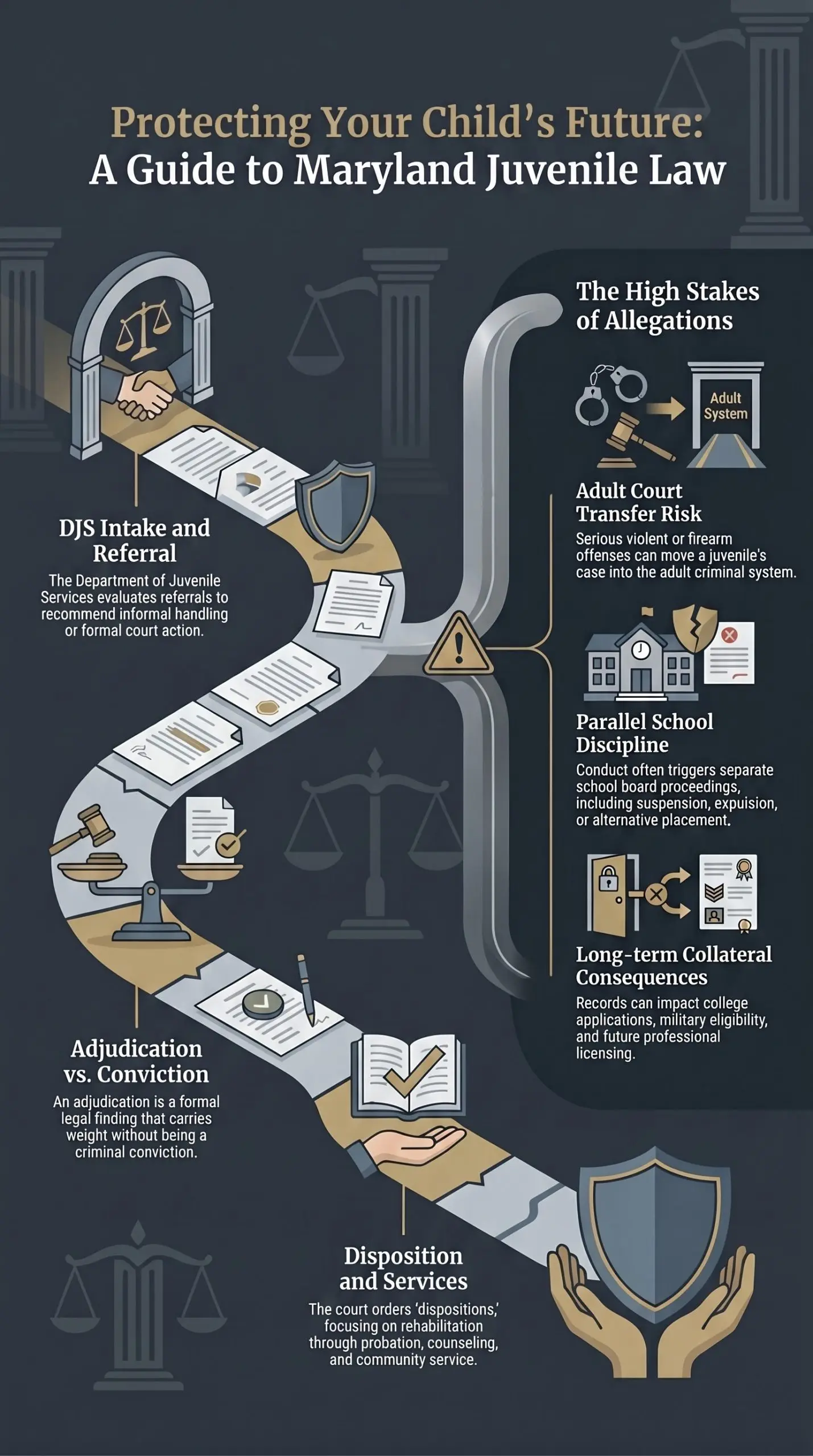
Table of Contents
- Maryland Juvenile Law: The Framework and Philosophy
- Delinquent Acts vs. CINS: The Two Main Categories
- Assault, Fighting, and Violent Offense Allegations
- Theft, Property, and Burglary Allegations
- Drug, Alcohol, and Paraphernalia Allegations
- Weapons, Sex Offenses, and Charges That Can Send a Child to Adult Court
- School-Based, Cyber, and Disorderly Conduct Allegations
- The Calvert County Juvenile Court Process
- Records, Collateral Consequences, and Your Child’s Future
- Defense Strategies and Working with Haskell and Dyer
- Summary
- References
1. Maryland Juvenile Law: The Framework and Philosophy
Maryland’s juvenile justice system operates under a distinct philosophy. Where adult criminal courts prioritize punishment, accountability, and public protection, juvenile courts are designed to emphasize rehabilitation, supervision, and the preservation of a child’s future. The governing framework lives primarily in the Courts and Judicial Proceedings Article, Title 3, Subtitle 8A of the Maryland Code, which addresses juvenile causes.
That philosophical difference shows up throughout the process. Juvenile courts use different terminology: adjudications instead of convictions, dispositions instead of sentences, respondents instead of defendants. Proceedings are generally closed to the public. Records are treated more protectively. And the outcomes the court aims for are often focused on services, counseling, education, and family support rather than incarceration.
None of that means juvenile charges are minor. A delinquency finding can affect school enrollment, scholarship eligibility, military service options, immigration status, and the ability to obtain certain licenses later in life. Some serious charges pull a child out of juvenile court entirely and into adult Circuit Court. Families sometimes arrive at the first hearing believing the system is informal and forgiving. It is not.
Who Counts as a Juvenile in Maryland
Maryland juvenile court jurisdiction generally applies to conduct that occurred before the individual’s 18th birthday. Children as young as 13 can be subject to juvenile delinquency proceedings for most offenses, and younger children have their own framework that focuses even more heavily on support services. For serious violent offenses and certain firearm offenses, Maryland law can place older juveniles into adult court automatically or through a waiver process.
How the Calvert County Court Handles These Cases
Juvenile matters in Calvert County proceed through the Circuit Court sitting as a juvenile court. The Calvert County courthouse in Prince Frederick handles intake, adjudication, and disposition. The Maryland Department of Juvenile Services (DJS) plays a central role in evaluating cases, making recommendations to the court, and providing services to adjudicated youth and their families.
One important point: Calvert County does not maintain its own separate list of juvenile offenses. The county applies Maryland juvenile law through its local juvenile court process. Understanding the statewide framework is the foundation for understanding what happens to your child’s case in Prince Frederick.
2. Delinquent Acts vs. CINS: The Two Main Categories
Most juvenile cases in Calvert County fall into one of two categories, and understanding the distinction matters because the processes, the stakes, and the defense strategies differ.
Delinquent Acts
A “delinquent act” is any conduct that would be a crime if an adult committed it. Shoplifting, simple assault, drug possession, vandalism, burglary, and dozens of other charges all fall into this category. When the juvenile court finds that a child committed a delinquent act, the court has made a formal adjudication of delinquency. That adjudication is not a criminal conviction, but it is a formal finding that carries legal weight.
Delinquency matters are initiated when the State’s Attorney files a petition or when the Department of Juvenile Services accepts a referral and forwards it for court action. Maryland’s juvenile law provides many of the same procedural protections as adult criminal trials, including the right to counsel, the right to confront witnesses, and the requirement that the state prove its case beyond a reasonable doubt.
Child in Need of Supervision (CINS)
CINS matters are different. A CINS case involves conduct that is not criminal when an adult does it but becomes actionable when a child does it. Common CINS categories include:
- Habitual truancy from school
- Being beyond parental control in ways that require court intervention
- Running away from home repeatedly
- Engaging in dangerous behavior that presents risk to the child or others
- Other child-specific misconduct addressed by juvenile law
CINS proceedings focus even more heavily than delinquency cases on services, family support, and rehabilitation. The court can order school attendance requirements, counseling, family therapy, drug and alcohol evaluation, and other services designed to address the underlying issues. CINS dispositions rarely result in detention or placement outside the home except in serious cases.
Why the Distinction Matters for Defense Strategy
Both categories can land a child in front of a Prince Frederick juvenile judge. Both produce court records. Both can affect school and family life. But defense strategy looks different:
- Delinquency defense often focuses on challenging the evidence, preserving constitutional rights, and negotiating outcomes that avoid formal adjudication
- CINS defense often focuses on demonstrating family capacity to address the underlying issues without court intervention, or on shaping the services the court orders
3. Assault, Fighting, and Violent Offense Allegations
Assault and fighting allegations are among the most common delinquency charges in Calvert County. Fights on school grounds, schoolyard threats, offensive touching, altercations at youth sports events, and disputes at parties all produce juvenile assault petitions.
Second Degree Assault
Most juvenile assault allegations are second degree assault, which mirrors the adult charge under Maryland Criminal Law § 3-203. The conduct covered ranges from pushing and shoving during a school confrontation to harder contact during fights. Threat-based assault, where the child allegedly placed another child in reasonable fear of imminent harmful contact, can also support a second-degree charge even without physical contact.
First Degree Assault Allegations
First degree assault allegations are more serious. These arise when the allegation involves serious physical injury or the use of a weapon. For older juveniles, first-degree assault allegations can trigger transfer consideration to adult Circuit Court. The statutory framework for these charges mirrors the adult law addressed in our cornerstone on Calvert County assault and battery defense.
School-Based Fighting Allegations
Fights at Calvert County schools often produce both school discipline and juvenile court proceedings. The two tracks are separate:
- School discipline (suspension, expulsion, alternative placement) is administered by the Calvert County Public Schools under its own code of conduct
- Juvenile court proceedings follow their own timeline and standards
Statements and written documents in one proceeding can affect the other. Parents should coordinate the response across both tracks.
Sports and Youth Event Altercations
Youth sports leagues, tournaments, and community events in Calvert County occasionally produce assault allegations involving both juveniles and the adults around them. When a young athlete is accused in an assault, the case dynamics often involve parents, coaches, and other adults as witnesses. For related context on the adult side of these incidents, see our article on Barstow school and youth sports assault defense.
A practical note for parents: When your child has been accused of assault at school, resist the urge to call the alleged victim’s family to apologize or smooth things over. Well-intentioned contact can produce additional evidence for the state or trigger protective order proceedings. Work through your attorney.
4. Theft, Property, and Burglary Allegations
Property offenses make up a large share of juvenile petitions in Calvert County. These cases range from relatively minor shoplifting to serious felony allegations.
Shoplifting and Minor Theft
Shoplifting allegations from retail stores across Calvert County, including stores in Prince Frederick, Dunkirk, Solomons, and the twin beaches, frequently produce juvenile petitions. Modern retail surveillance makes shoplifting cases unusually well-documented. Common scenarios include:
- Theft of cosmetics, clothing, electronics, or other goods from retail stores
- Group shoplifting where several juveniles participate
- Refund fraud or price tag switching
- Taking items from employer’s workplaces
Theft of Money or Property
Beyond shoplifting, juvenile theft allegations can involve taking money or property from family members, friends, schools, or workplaces. The charge structure generally follows Maryland’s theft statute framework, with the value of the property determining whether the allegation is a misdemeanor or a felony.
Unauthorized Use of a Vehicle
Taking a family car, a friend’s vehicle, or another person’s car without permission can produce an unauthorized use charge. In Maryland, unauthorized use is a specific offense distinct from theft, focused on the temporary taking rather than intent to permanently deprive.
Motor Vehicle Theft Related Conduct
More serious auto theft allegations can involve younger drivers in stolen vehicles, participation in car theft rings, or related conduct. These cases can expose juveniles to felony-level charges and sometimes trigger consideration of transfer to adult court for older juveniles.
Vandalism and Malicious Destruction
Graffiti on school property, broken windows, damaged fences, and vandalism of cars, homes, and public property all support malicious destruction charges. The seriousness of the charge depends on the amount of damage. Parents sometimes discover that their family is also facing civil liability for the damage in addition to the juvenile court matter.
Burglary and Breaking Related Offenses
Breaking and entering, burglary, and attempted burglary charges arise when a juvenile enters a dwelling, storage building, or other structure without authorization. The specific charge depends on the type of structure entered, whether it was occupied, and what the juvenile allegedly intended to do inside. Fourth-degree burglary (the least serious) can be a misdemeanor-level delinquent act, while first-degree burglary (dwelling with intent to commit violence) is a serious felony allegation.
Robbery and Violent Felony Allegations
Robbery involves taking property from a person through force or threat of force. Robbery charges, particularly armed robbery or robbery with a weapon, fall among the most serious juvenile allegations. Carjacking-type conduct carries similar weight. These cases often trigger transfer consideration to adult court for older juveniles.
5. Drug, Alcohol, and Paraphernalia Allegations
Juvenile drug and alcohol allegations in Calvert County range from first-time possession matters that resolve through services to serious distribution allegations that can transfer to adult court.
Cannabis and Controlled Substance Possession
Most juvenile drug cases begin with possession of cannabis, a small amount of other controlled substances, or paraphernalia. Maryland’s adult-use cannabis framework has changed the landscape for adults but has not changed the landscape for minors. Cannabis possession by someone under 21 remains unlawful. Possession of controlled substances by any juvenile is a delinquent act under Maryland Criminal Law § 5-601.
For Calvert County juveniles, these allegations typically arise from:
- School searches of lockers, backpacks, or vehicles
- Traffic stops where older teenage drivers are stopped
- Parent reports to law enforcement
- Party and gathering investigations
- Contact with school resource officers
Possession with Intent to Distribute
Juvenile allegations involving distribution or possession with intent to distribute are more serious. The same factors that build an adult PWID case apply in juvenile court: quantity, packaging, scales, cash, and cell phone evidence. For the adult framework, see our Calvert County drug crimes defense complete guide.
Paraphernalia Allegations
Paraphernalia charges under Maryland Criminal Law § 5-619 apply in juvenile cases as they do in adult cases. Pipes, rolling papers, scales, and related items can produce charges, often as companions to possession allegations.
Underage Alcohol Possession and Use
Alcohol violations involving minors fall into their own category. Depending on the specific circumstances, these can be handled as delinquency matters, as alcohol-specific juvenile citations, or occasionally through civil citation processes. Common scenarios include:
- Underage drinking at parties
- Fake ID use
- Driving under the influence by a minor
- Open containers in vehicles
- Providing alcohol to other minors
For parents navigating a drug or alcohol allegation: If substance use is an underlying issue, the juvenile court may focus heavily on services, evaluation, and treatment options. Engaging voluntarily with treatment early can positively shape the disposition. But coordinate with counsel first, because statements in evaluations can sometimes affect the case.
6. Weapons, Sex Offenses, and Charges That Can Send a Child to Adult Court
Certain juvenile allegations carry the possibility of being treated in adult court. Understanding the categories that trigger this exposure is essential.
Weapons Offenses
Juvenile weapons allegations include:
- Unlawful possession of a firearm
- Carrying a concealed weapon
- Possession of a prohibited weapon (switchblades, certain knives, brass knuckles)
- Weapon-related conduct at school
- Use of a weapon in connection with another offense
Maryland treats firearm offenses by juveniles seriously. Certain firearm allegations for older juveniles, particularly those involving handguns or the use of a firearm in a crime, can place the case in adult Circuit Court rather than juvenile court.
Sex Offense Allegations
Juvenile sex offense allegations range from unlawful sexual contact or lower-level sexual offense charges to more serious felony allegations. These cases are handled with particular care in juvenile court due to the sensitive nature of the evidence and the substantial collateral consequences that can follow. Serious sex offense charges against older juveniles may trigger transfer consideration to adult court, and certain outcomes can produce registration consequences depending on the charge and age of the respondent.
Very Serious Offenses That May Start in Adult Court
Maryland law places certain serious offenses by older juveniles outside ordinary juvenile court jurisdiction. These include:
- Offenses punishable by life imprisonment when committed by older juveniles
- Certain violent crimes against persons
- Certain firearm crimes involving handguns
- Other specifically enumerated offenses under Maryland law
For charges that fall into these categories, the case typically begins in adult Circuit Court, though the defense may seek to have the case transferred back to juvenile court through a reverse waiver process. The standards and timelines for these transfers are specific and require experienced counsel.
The Transfer Hearing Process
When a case involves a potentially transferable offense, the court considers factors including:
- The age of the juvenile
- The mental and physical condition of the juvenile
- The juvenile’s amenability to treatment in juvenile programs
- The nature of the offense and the child’s alleged participation
- Public safety considerations
Transfer hearings are among the most consequential events in a juvenile case. Whether the case proceeds as a juvenile delinquency matter or as an adult criminal case often determines whether the child spends adult sentencing time in adult facilities versus receiving juvenile court services.
For families facing a potentially serious charge: Transfer decisions are made early. The first 30 days after charging are critical. A defense attorney experienced with juvenile transfer issues should be engaged immediately. These cases cannot wait for normal scheduling.
7. School-Based, Cyber, and Disorderly Conduct Allegations
Many Calvert County juvenile cases arise from conduct at or connected to school. A separate category involves allegations based on online and electronic conduct that increasingly produces juvenile court petitions.
School-Based Allegations
When conduct that would be criminal for an adult occurs at a school, during a school event, or in connection with school transportation, it generally falls within juvenile delinquency jurisdiction. Calvert County Public Schools and school resource officers handle these cases in coordination with the local prosecutor and the Department of Juvenile Services. Common school-based allegations include:
- Fights on school grounds
- Threats against students, teachers, or the school itself
- Drug or alcohol possession on campus
- Weapon possession on school grounds
- Property damage to school facilities
- Harassment or bullying that crosses into criminal conduct
- Disorderly conduct during school events
The parallel tracks of school discipline and juvenile court require careful coordination. Decisions made in one can affect the other.
Cyber and Electronic Conduct
Modern juvenile allegations increasingly involve online conduct:
- Harassment and threats by text or social media, which can support stalking or harassment petitions
- Sexting allegations, which involve complex legal considerations given that images of minors can implicate serious laws
- Unauthorized computer access or breaching school systems
- Digital evidence tied to other offenses, such as texts planning theft or drug transactions
- Cyberbullying that crosses into criminal harassment territory
Sexting cases deserve special attention. Maryland has moved toward treating certain minor-to-minor sexting differently than adult distribution of minor imagery, but the law in this area is complex and evolving. These cases require experienced counsel who understands both the criminal implications and the specific protections that apply to juvenile conduct.
Disorderly Conduct and Public Disturbance
Juvenile disorderly conduct allegations arise from:
- Disturbances at school events
- Public disruptions in commercial areas
- Confrontations with law enforcement
- Noise complaints at gatherings
- Refusing to disperse after warnings
These charges are often companions to other allegations, such as underage drinking or fighting, and can be resolved through services and counseling in many first-time cases.
Curfew, Truancy, and Runaway Matters
These allegations generally fall under CINS rather than delinquency. The court’s focus is on identifying what is driving the behavior and arranging appropriate services. Habitual truancy, in particular, often signals underlying issues (bullying, learning differences, family stress, mental health concerns) that the court can help address through services rather than punishment.
8. The Calvert County Juvenile Court Process
Understanding the process helps families make better decisions. Here is how a typical Calvert County juvenile case unfolds.
Step 1: Referral to DJS
Most cases begin with a referral to the Maryland Department of Juvenile Services. Law enforcement, schools, or other sources submit information describing the alleged conduct. DJS intake workers evaluate the referral and decide whether to recommend informal handling (sometimes called informal adjustment), formal court action, or no further action.
Step 2: Informal Adjustment or Petition
If DJS recommends informal handling, the case may be resolved through voluntary services, restitution, community work, counseling, and other conditions without formal court adjudication. Successful completion of informal adjustment typically ends the matter without a court record of adjudication.
If the case proceeds to formal court action, the State’s Attorney files a petition alleging specific delinquent acts or CINS conduct.
Step 3: Detention or Release
For juveniles taken into custody, an early detention hearing determines whether the child will be detained pending the case or released to a parent or guardian. Most juvenile cases result in release home with conditions. Detention is typically reserved for serious charges or specific public safety concerns.
Step 4: Arraignment and Pretrial Stages
At arraignment, the juvenile and their attorney respond to the petition. Pretrial stages include discovery, motions practice, and plea discussions. Juvenile courts generally protect the child’s rights at every stage, including the right to counsel, the right to confront witnesses, and the requirement that the state prove the case.
Step 5: Adjudication
If the case does not resolve through agreement, an adjudication hearing takes place. Unlike adult trials, these hearings are held before a judge rather than a jury. The judge determines whether the state has proved the delinquent act beyond a reasonable doubt (for delinquency matters) or by the applicable standard for CINS proceedings.
Step 6: Disposition
If the court finds the juvenile involved in the alleged conduct, the case proceeds to disposition. This is the juvenile equivalent of sentencing, but the goals and the options differ from adult court. Dispositions can include:
- Probation, often with specific conditions
- Community service
- Counseling or therapy
- Substance abuse treatment
- Restitution to victims
- Supervised programs at home
- Placement in a residential treatment program
- Commitment to the Department of Juvenile Services
- Detention in serious cases
Step 7: Ongoing Supervision and Review
After disposition, the court continues to supervise the case through periodic reviews. Successful completion of the ordered services and conditions can result in case closure. Failure to comply can result in modifications or additional consequences.
Something parents often do not realize: Juvenile proceedings are generally closed to the public and the records are treated more protectively than adult criminal records. But the records are not invisible. They can be accessed by law enforcement, school officials in certain circumstances, and in some contexts, by agencies making decisions about a young person’s future. Long-term protection of the record requires attention both during the case and afterward.
9. Records, Collateral Consequences, and Your Child’s Future
Juvenile cases are different from adult cases, but they still leave marks. Understanding the long-term consequences helps families weigh decisions during the case.
What a Juvenile Adjudication Means
A finding that a child committed a delinquent act is called an adjudication, not a conviction. In Maryland, this distinction carries real legal weight. A juvenile adjudication generally does not count as a criminal conviction for most purposes. The child is not, for example, generally required to answer “yes” to common job application questions about prior convictions.
But the record still exists. And certain specific contexts can surface juvenile records regardless of the non-conviction classification.
School Consequences
School discipline flows from a separate track but interacts with the juvenile court case. Common consequences include:
- Suspension or expulsion under Calvert County Public Schools policies
- Alternative placement in different school programs
- Restrictions on extracurricular activities
- Loss of leadership positions, honor society membership, or athletic eligibility
- Documentation in the student’s cumulative record
College and Scholarship Implications
College applications increasingly ask about disciplinary history and criminal records. Many applications ask specifically whether the applicant has been found responsible for misconduct, which can encompass juvenile adjudications depending on wording. Scholarship applications may ask similar questions. Honest answers are required; the strategy is to position the application in a way that addresses the record while highlighting the applicant’s growth and character.
Employment and Career
While juvenile adjudications generally do not appear on standard employment background checks, certain industries and certain positions have different rules:
- Law enforcement and federal agencies typically have access to juvenile records during background investigations
- Military service recruiters ask about juvenile history, and certain adjudications can affect eligibility
- Positions requiring security clearances can surface juvenile history during investigation
- Professional licensing boards (nursing, teaching, healthcare) may require disclosure
- Positions working with children or vulnerable populations often trigger broader background checks
Immigration Consequences
For juveniles who are not U.S. citizens, juvenile court outcomes can affect immigration status. Certain juvenile adjudications have been treated as convictions for immigration purposes in certain contexts. The analysis is complex and requires coordination between the criminal defense attorney and an immigration specialist.
Firearm Rights
Certain juvenile adjudications can affect the young person’s ability to possess firearms later in life. Maryland and federal law both address this area with specific provisions.
Expungement and Sealing
Maryland law provides mechanisms for protecting juvenile records through expungement and sealing. Juvenile records are not automatically erased at age 18. Active steps must be taken to pursue expungement or to ensure the record does not surface inappropriately in future contexts. The specific procedures, eligibility rules, and timing depend on the nature of the case and its outcome.
For related reading on record protection in other criminal contexts, see our article on why not to plead guilty in Calvert County without reviewing the case first.
10. Defense Strategies and Working with Haskell and Dyer
Defending a juvenile requires a different skill set than defending an adult. The standards are similar in some ways, different in others, and the priorities change significantly. Here is how our firm approaches these cases.
The Core Framework
Every juvenile case gets evaluated on several fronts.
Challenging the Evidence
Juvenile court applies the same Fourth Amendment protections as adult court. Searches of backpacks, lockers, vehicles, and homes all have to comply with constitutional standards (subject to specific school-context modifications). Confessions and statements by juveniles require particular analysis because young people are especially vulnerable to pressure and confusion during police contact.
Miranda and Juvenile Interrogation Issues
Juveniles often waive rights they do not fully understand. Courts evaluate the voluntariness of juvenile waivers with particular care. If the child was questioned without proper warnings, or without parental presence where required, statements may be suppressible.
Challenging the Petition
Some juvenile petitions are not well supported by admissible evidence. Aggressive pretrial motion practice can narrow or defeat allegations before the adjudication hearing ever occurs.
Negotiated Resolutions
Many juvenile cases can be resolved through negotiated outcomes that avoid formal adjudication. Informal adjustment, deferred adjudication programs, and agreed dispositions all exist. The right choice depends on the facts, the child’s history, and the priorities of the family.
Services Based Dispositions
Where adjudication is unavoidable, the defense can focus on shaping the disposition. Services that address the underlying issues (counseling, therapy, substance abuse treatment, educational support) often serve the child better than punishment-focused outcomes.
Transfer Defense
For cases threatened with transfer to adult court, the defense must move quickly to oppose transfer. Demonstrating the child’s amenability to juvenile services, the appropriateness of juvenile system response, and the child’s prospects for rehabilitation can keep the case where it belongs.
What Sets Our Practice Apart
Our firm has defended juvenile cases throughout Southern Maryland for years. We approach these matters with the recognition that a child’s future is literally at stake. A few principles guide our work:
- Every case gets a full defense evaluation. A juvenile allegation is not a green light to accept the state’s position. We build the defense from the evidence.
- We coordinate with the family. Juvenile cases involve parents, siblings, schools, and service providers. We communicate with all of the stakeholders to build the strongest response.
- We know the Calvert County courts. The Prince Frederick courthouse and the local DJS staff are familiar to us. That familiarity produces better outcomes.
- We take the long view. The child sitting in front of us is not just facing a current case; they are building a life. Our strategy considers what the disposition means for college, employment, and personal growth, not just what it means for this week’s hearing.
- We answer the phone. Juvenile arrests and incidents happen at all hours. The 24/7 hotline is real.
How to Work with Us
The first consultation is free. You will speak with an attorney who will listen to what happened, review any paperwork, and give you a straightforward assessment of where the case stands. If we take the case, we move immediately to:
- Request preservation of any video, audio, or electronic evidence
- Identify and interview witnesses
- Coordinate with DJS and the State’s Attorney
- Address school discipline issues running in parallel
- File appropriate pretrial motions
- Prepare for adjudication or negotiate resolution
- Plan for post-case record protection
Ready to Talk About Your Child’s Case?
Whether your child is facing a first-time school incident or a serious felony allegation with transfer exposure, we are ready to listen and to fight. The first consultation is free, and the 24/7 hotline is always open.
📞 Call 301-627-5844
Send a Secure Message
24/7 Criminal Defense Hotline: 240-687-0179
Learn more about our Criminal Defense practice.
Summary
Maryland juvenile law operates on a philosophy of rehabilitation rather than punishment, but juvenile cases still carry real consequences. Calvert County applies the statewide juvenile framework through the Circuit Court sitting as juvenile court in Prince Frederick, with the Department of Juvenile Services playing a central role. Most cases fall into two categories: delinquent acts (conduct that would be a crime if an adult committed it) and Child in Need of Supervision (CINS) matters involving habitual truancy, being beyond parental control, running away, or other child-specific conduct. The charges range widely: assault, theft, burglary, drug possession, weapons offenses, sex offenses, school-based allegations, cyber conduct, and disorderly conduct. Certain serious offenses for older juveniles, including some violent crimes, life imprisonment offenses, and firearm offenses, can place a case in adult court rather than juvenile court. The court process moves from DJS intake through petition, pretrial, adjudication, and disposition. Dispositions focus on services and rehabilitation but can include probation, placement, and in serious cases detention. Collateral consequences reach school discipline, college applications, military service, immigration status, firearm rights, and certain career paths. Defense strategy requires constitutional analysis, pretrial motions, transfer defense where applicable, and attention to the long-term protection of the child’s future. The right defense in the first 30 days often shapes the rest of that young person’s life.
Ready for a free consultation? Call Haskell and Dyer at 301-627-5844, use the 24/7 hotline at 240-687-0179, or contact us here.
References
Maryland General Assembly. (2024). Courts and Judicial Proceedings Article, Title 3, Subtitle 8A: Juvenile Causes. Maryland Code. https://mgaleg.maryland.gov/
Maryland General Assembly. (2024). Courts and Judicial Proceedings Article § 3-8A-03: Jurisdiction of the juvenile court. Maryland Code. https://mgaleg.maryland.gov/
Maryland General Assembly. (2024). Courts and Judicial Proceedings Article § 3-8A-06: Transfer of proceedings. Maryland Code. https://mgaleg.maryland.gov/
Maryland General Assembly. (2024). Criminal Law Article, Title 3, Subtitle 2: Assault, reckless endangerment, and related crimes. Maryland Code. https://mgaleg.maryland.gov/
Maryland General Assembly. (2024). Criminal Law Article, Title 5: Controlled Dangerous Substances. Maryland Code. https://mgaleg.maryland.gov/
Maryland Department of Juvenile Services. (2024). Overview of juvenile services in Maryland. DJS. https://djs.maryland.gov/
Maryland Department of Juvenile Services. (2024). Community detention, intake, and case management processes. DJS. https://djs.maryland.gov/
Maryland Judiciary. (2024). Juvenile Court procedures and resources. Maryland Courts. https://www.courts.state.md.us/
Maryland Judiciary. (2024). Circuit Court for Calvert County. Maryland Courts. https://www.courts.state.md.us/circuit
Maryland Judiciary. (2024). Maryland Judiciary Case Search. Maryland Courts. https://casesearch.courts.state.md.us/
Maryland State Bar Association. (2023). Consumer’s guide to juvenile law in Maryland. Maryland State Bar Association. https://www.msba.org/
National Juvenile Defender Center. (2023). Juvenile defense standards and practice principles. NJDC. https://njdc.info/
Office of Juvenile Justice and Delinquency Prevention. (2024). Juvenile justice statistics and resources. U.S. Department of Justice. https://ojjdp.ojp.gov/
Calvert County Public Schools. (2024). Student code of conduct and disciplinary procedures. CCPS. https://www.calvertnet.k12.md.us/
Maryland Office of the Public Defender. (2023). Juvenile representation in Maryland. Office of the Public Defender. https://www.opd.state.md.us/
The information provided in this article is for general informational purposes only and does not constitute legal advice. Contacting The Law Offices of Haskell and Dyer does not create an attorney client relationship until a formal agreement is signed. For legal advice specific to your situation, please contact our office directly.