

Bottom Line Up Front
A homicide charge in Calvert County is the most serious allegation Maryland law recognizes. The range runs from first degree murder with life without parole to vehicular manslaughter with a multi-year sentence. Which charge applies is not determined by the fact of death alone. It is determined by intent, planning, provocation, self defense, recklessness, legal duty, intoxication, and the surrounding conduct. The same death can support first degree murder, second degree murder, voluntary manslaughter, involuntary manslaughter, or complete acquittal depending on what the evidence actually shows. Every serious homicide case in Calvert County moves through the Circuit Court in Prince Frederick. Every one requires defense that starts the moment charges are filed (or before) and that addresses every charging theory the state might advance. The decisions made in the first 48 hours shape what becomes possible later. This guide walks through all ten of the main situational categories that produce Calvert County homicide cases, the defenses available for each, and how to fight back when the state is building its most serious type of case.
Call The Law Offices of Haskell and Dyer for a free consultation at 📞 301-627-5844 or the 24/7 criminal defense hotline at 240-687-0179.
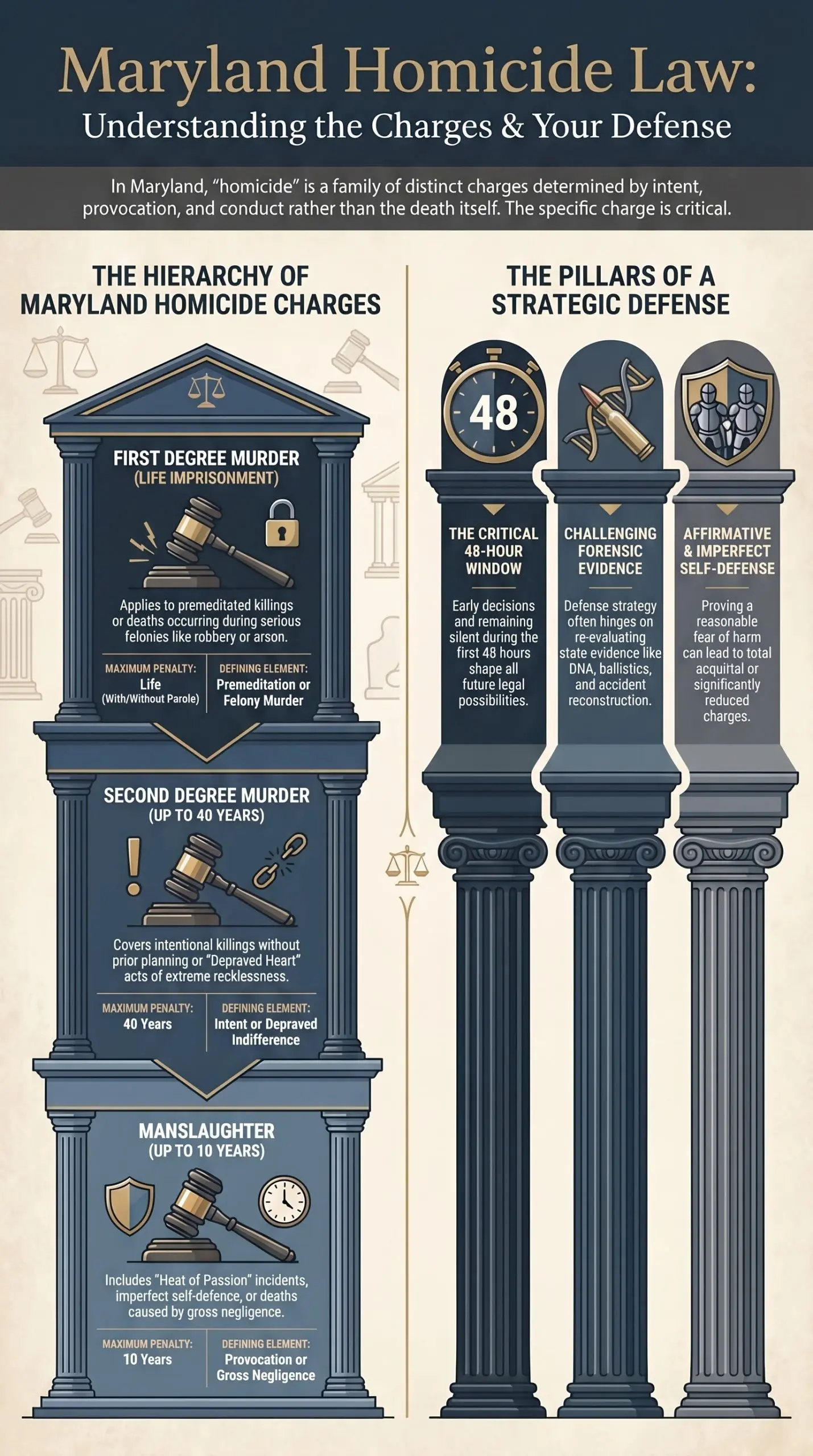
Table of Contents
- Maryland’s Homicide Framework and Calvert County Prosecution
- First Degree Murder: Premeditation, Planning, and Special Circumstances
- Felony Murder: Deaths During Other Serious Crimes
- Second Degree Murder: Intent Without Premeditation and Depraved Heart
- Voluntary Manslaughter: Heat of Passion and Imperfect Self Defense
- Involuntary Manslaughter: Gross Negligence and Legal Duty
- Vehicular Homicide: Drunk Driving, Drug Impaired, and Grossly Negligent Operation
- Child Abuse, Vulnerable Adult, and Domestic Homicide
- The Calvert County Circuit Court Process and Evidence Issues
- Defense Strategy, Self Defense, and Working with Haskell and Dyer
- Summary
- References
1. Maryland’s Homicide Framework and Calvert County Prosecution
Maryland homicide law lives in the Criminal Law Article, Title 2 (Homicide). The statute recognizes several distinct categories, each with its own definition, penalty range, and defense landscape. Understanding the framework starts with understanding that “homicide” is not a single charge but a family of charges that the state can choose among based on what the facts will support.
The Five Main Homicide Categories
Maryland criminal law recognizes five primary homicide categories:
- First degree murder under Criminal Law § 2-201, carrying life imprisonment with or without the possibility of parole
- Second degree murder under Criminal Law § 2-204, carrying up to 40 years
- Voluntary manslaughter under Criminal Law § 2-207, carrying up to 10 years
- Involuntary manslaughter under Criminal Law § 2-207, carrying up to 10 years
- Vehicular and vessel homicide offenses under Criminal Law § 2-501 through § 2-506, with penalty ranges that depend on the specific offense and whether intoxication was involved
How Calvert County Handles These Cases
Serious homicide cases in Calvert County proceed in the Circuit Court for Calvert County in Prince Frederick. These are the most complex criminal cases the local court system handles. A typical homicide prosecution involves:
- Months of pretrial investigation and discovery
- Extensive forensic evidence, including autopsy, DNA, ballistics, and digital data
- Grand jury indictment in most serious cases
- Multiple pretrial hearings on motions
- Substantial expert witness involvement on both sides
- Jury trials that often run one to three weeks or longer
- Sentencing hearings with substantial evidentiary records
- Almost inevitable appellate review on any conviction
Why the Situation Matters More Than the Death Itself
The same death can support five very different charges depending on the circumstances. A shooting during a fight might be first degree murder if there was planning, second degree if there was intent without premeditation, voluntary manslaughter if the shooter acted in heat of passion with adequate provocation, involuntary manslaughter if the shooting was grossly negligent rather than intentional, or a complete acquittal if the shooting was justified self defense. The prosecution’s charging decision and the defense’s theory of the case often hinge on these distinctions.
The first rule for anyone under investigation: Do not talk to law enforcement without counsel present. Not to investigators, not to friendly sounding officers, not to detectives offering to “hear your side.” Statements made before counsel arrives become the core of most homicide prosecutions. The right to remain silent is not just a technicality. It is the single most important protection at the earliest stage of a serious case.
For broader context on how Calvert County prosecutors approach serious felony charges, see our article on why not to plead guilty in Calvert County without reviewing the case first.
2. First Degree Murder: Premeditation, Planning, and Special Circumstances
First degree murder is the most serious charge Maryland law recognizes. Under Maryland Criminal Law § 2-201, a killing qualifies as first degree murder when it is:
- Deliberate, premeditated, and willful, meaning the defendant formed an intent to kill and had enough time to reflect on that intent
- Committed by lying in wait for the victim
- Committed by poison
- Committed during certain enumerated felonies (covered in the next chapter as felony murder)
The Penalty Exposure
First degree murder in Maryland carries:
- Life imprisonment without the possibility of parole, or
- Life imprisonment with the possibility of parole after serving a minimum term
Maryland no longer has the death penalty; it was abolished in 2013. But life without parole is the most severe sentence available under current state law, and the state pursues it aggressively in qualifying cases.
What Premeditation Actually Requires
Premeditation sounds like it requires long planning. In practice, Maryland courts have held that premeditation can be formed in a matter of seconds. The state does not need to prove weeks or months of scheming. It needs to prove that the defendant formed an intent to kill and had some period of time, however brief, to reflect on that intent before acting.
This legal standard makes the premeditation question a central battleground in many first degree murder cases. The same facts can support or undermine premeditation depending on how they are presented:
- Supporting premeditation: Bringing a weapon to the confrontation, stated threats beforehand, pattern of behavior, attempts to conceal evidence afterward
- Undermining premeditation: Instantaneous response to provocation, chaotic nature of the incident, lack of any preparation, signs of emotional rather than rational action
Classic First Degree Scenarios
Cases most clearly supporting first degree murder charges include:
- A defendant who planned a killing in advance, acquired a weapon for the purpose, and carried out the plan
- A defendant who lay in wait for a specific victim to arrive
- A deliberate execution style act
- A poisoning over time with intent to kill
- A killing for hire, with a contract murder theory
Defense Approaches
Defense strategy in first degree murder cases typically focuses on:
- Challenging the identification of the defendant as the actor
- Challenging premeditation and pressing for reduction to second degree murder
- Self defense if the evidence supports it
- Mental state defenses including mental health impairments that affected the capacity to form intent
- Alibi or reasonable doubt about the defendant’s participation
- Evidentiary challenges to physical evidence, statements, or witness credibility
3. Felony Murder: Deaths During Other Serious Crimes
Maryland’s felony murder rule is one of the most consequential provisions in the state’s criminal code. It allows the state to charge first degree murder when a death occurs during the commission of certain enumerated serious felonies, even without classic premeditation.
The Qualifying Felonies
Maryland Criminal Law § 2-201 identifies specific felonies that can support felony murder charges. These include (but are not limited to):
- Arson in the first degree
- Burglary in the first, second, or third degree
- Carjacking or armed carjacking
- Robbery
- Rape or sexual offense in the first or second degree
- Escape in the first degree
- Certain child abuse offenses
- Other specifically listed felonies
A death during the commission of (or attempt to commit) any of these felonies can be charged as first degree murder. The state does not have to prove intent to kill. It only has to prove the underlying felony and that the death occurred during its commission.
Who Can Be Charged Under Felony Murder
Felony murder liability can extend beyond the person who directly caused the death. Accomplices in the underlying felony can face felony murder charges for deaths that occurred during the joint criminal enterprise, even if they did not personally cause or intend the death.
Common felony murder scenarios include:
- A robbery that escalates, resulting in the death of the victim
- A burglary where someone inside the home is killed
- A carjacking where the driver is dragged or struck
- An arson where a person inside the structure dies
- Any enumerated felony that produces a death, whether intended or not
A point often misunderstood: Felony murder does not require that the defendant wanted anyone to die. A robbery gone wrong where a cashier dies of a heart attack during the incident has been charged as felony murder in some jurisdictions. The theory is that participation in the underlying felony creates liability for any resulting death. Defense strategy must address both the underlying felony and the causal chain to the death.
Defense Strategies Against Felony Murder
Defending felony murder cases typically involves:
- Challenging participation in the underlying felony. If the state cannot prove the felony, it cannot prove felony murder.
- Challenging the causal connection between the felony and the death
- Pushing for conviction on lesser included offenses rather than first degree murder
- Identifying accomplice liability limits. Not every participant in a broader activity is criminally responsible for every consequence.
- Presenting the full context to show that the death was not a foreseeable consequence of the alleged conduct
4. Second Degree Murder: Intent Without Premeditation and Depraved Heart
Second degree murder is Maryland’s catch-all murder category. Under Criminal Law § 2-204, “a murder that is not in the first degree under § 2-201 of this subtitle is in the second degree.” Second degree murder encompasses several different types of killings that share one key feature: malice aforethought without premeditation.
Intentional Killings Without Premeditation
The most common second degree scenario is an intentional killing that happened too quickly or too impulsively to qualify as premeditated first degree murder. Classic examples include:
- A fight that escalates to deadly violence
- A shooting during a sudden argument
- A stabbing after an unexpected confrontation
- An attack in response to provocation that falls short of heat of passion
- An intentional killing where the state cannot prove planning
The state must prove the defendant intended to kill or to inflict grievous bodily harm, but does not have to prove the prior reflection required for first degree murder.
Depraved Heart Murder
Maryland also recognizes second degree murder based on extremely reckless conduct that shows a depraved indifference to human life. Under this theory, no specific intent to kill is required. What is required is conduct so dangerous, so wanton, that it demonstrates a depraved heart.
Classic depraved heart examples include:
- Firing a gun into a crowd
- Handling a loaded weapon in a grossly reckless manner
- Creating conditions that present a clear, deadly risk to others
- Engaging in conduct so dangerous that death is highly probable
The difference between depraved heart second degree murder and involuntary manslaughter (based on gross negligence) is often a matter of degree. Depraved heart requires conduct that goes beyond gross negligence into a realm of wanton, callous disregard.
The Penalty Range
Second degree murder in Maryland carries up to 40 years in prison. Sentencing depends on the specific facts, the defendant’s history, and any applicable sentencing enhancements.
Defense Approaches
Defense strategies in second degree murder cases often focus on:
- Reducing the charge to manslaughter through heat of passion or imperfect self defense
- Challenging intent and arguing for lesser included offenses
- Self defense as a complete defense
- Challenging the characterization of conduct as depraved heart versus ordinary recklessness
- Identification and causation challenges as in any homicide case
For related context on how the use of a weapon can affect charging decisions, see the broader framework in our Calvert County Assault and Battery Defense complete guide, which addresses related concepts at the assault level.
5. Voluntary Manslaughter: Heat of Passion and Imperfect Self Defense
Voluntary manslaughter is what Maryland law calls an intentional killing that would otherwise be murder but is reduced because of specific mitigating circumstances. Under Criminal Law § 2-207, voluntary manslaughter carries up to 10 years in prison, substantially less than the exposure for murder.
Heat of Passion
Maryland recognizes heat of passion as a mitigating factor that reduces murder to voluntary manslaughter. The elements require:
- Legally adequate provocation. The provocation must be sufficient to cause a reasonable person to lose self-control. Words alone are generally not enough. Serious physical assault, mutual combat, or discovering a spouse in the act of adultery are classic examples of adequate provocation.
- Actual loss of self-control. The defendant must have actually been acting in the heat of passion, not with deliberation.
- No reasonable cooling off period. The killing must have occurred before a reasonable person would have had time to regain control.
- Causal connection. The provocation must have actually triggered the killing.
Cases involving sudden violent fights, mutual combat, or severe provocation that led to immediate deadly response can support heat of passion arguments. The analysis is fact specific and requires careful development of the circumstances.
Imperfect Self Defense
Imperfect self defense is another mitigating doctrine that can reduce murder to voluntary manslaughter. The theory applies when the defendant actually believed force was necessary to defend against imminent harm, but either the belief was unreasonable or the force used was excessive.
A full self defense claim, if accepted, results in complete acquittal. Imperfect self defense is the fallback: even if the jury decides the defendant’s belief was unreasonable or the force was excessive, the killing is reduced to voluntary manslaughter rather than remaining as murder.
Common imperfect self defense scenarios include:
- A defender who honestly feared imminent harm but whose fear was not reasonable under the circumstances
- A defender who responded with deadly force where non-deadly force would have been proportional
- A defender who initiated the original confrontation and therefore cannot claim full self defense but can claim imperfect
A strategic reality: Imperfect self defense is often the most important alternative theory in a homicide case where full self defense may not succeed. Juries that will not fully acquit based on self defense may nonetheless find the defendant acted in honest fear, reducing the conviction from murder to voluntary manslaughter. The difference in exposure can be decades of prison time.
Defense Development
Building a voluntary manslaughter theory requires:
- Careful development of the provocation evidence
- Expert testimony where appropriate on perception under stress, reasonable fear, or battered person syndrome
- Attention to the sequence of events and timing
- Challenges to any state evidence suggesting deliberation or planning
- Jury instructions that properly frame the mitigating doctrines
6. Involuntary Manslaughter: Gross Negligence and Legal Duty
Involuntary manslaughter covers deaths that were not intentional but resulted from conduct that was grossly negligent or that violated a legal duty. Maryland’s involuntary manslaughter framework addresses deaths caused by reckless conduct, violations of legal duty, and, as a subset, certain unlawful acts.
Gross Negligence Manslaughter
Maryland involuntary manslaughter includes killings caused by grossly negligent conduct. The standard is not ordinary negligence or even substantial negligence. It is wanton or reckless disregard for human life.
Examples may include:
- Reckless firearm handling that results in a death
- Dangerous conduct around vulnerable people (children, elderly)
- Outrageously dangerous behavior in situations where death was a foreseeable risk
- Criminal negligence in caring for someone who depended on the defendant
The line between gross negligence involuntary manslaughter and depraved heart second degree murder is one of degree. The state may charge the more serious offense when the conduct rises to the level of depraved indifference, and the less serious offense when it does not.
Legal Duty Manslaughter
A homicide can arise from an omission where the defendant had a legal duty to act and failed to do so. Maryland appellate decisions recognize legal duty involuntary manslaughter as a valid theory in appropriate cases.
Examples may include:
- A parent failing to obtain medical care for a dying child
- A caregiver failing to act when their charge was in crisis
- A person with contractual responsibility to provide care failing to do so
- A person whose own prior conduct created the danger and who failed to mitigate
The theory requires that the defendant had a legal duty (not merely a moral one) and that the breach of duty caused the death.
The Penalty Range
Involuntary manslaughter in Maryland carries up to 10 years in prison. Sentencing depends on the specific circumstances, the degree of recklessness or culpability involved, and the defendant’s history.
Defense Approaches
Defense strategies in involuntary manslaughter cases typically include:
- Challenging the characterization of conduct as grossly negligent rather than ordinarily careless
- Challenging causation between the conduct and the death
- Challenging duty in legal duty cases
- Presenting alternative explanations for what happened
- Expert testimony on the reasonableness or unreasonableness of the conduct
7. Vehicular Homicide: Drunk Driving, Drug Impaired, and Grossly Negligent Operation
Maryland treats fatal crashes as a distinct category of homicide law. The specific statutes in Criminal Law § 2-501 through § 2-506 address different scenarios where operation of a vehicle (or vessel) results in death.
Homicide by Motor Vehicle or Vessel While Under the Influence
When a driver or operator is under the influence of alcohol or drugs and causes a fatal crash, Maryland law provides for specific homicide charges with enhanced penalties. The specific charges depend on:
- Whether the driver was “under the influence” (a higher level of impairment) or merely “impaired” (a lower level)
- Blood alcohol concentration
- Presence of controlled substances
- The specific conduct contributing to the crash
Maximum penalties under these statutes can reach multiple years, with combined charges producing substantial exposure.
Manslaughter by Vehicle or Vessel
Even without alcohol or drugs, Maryland Criminal Law § 2-209 addresses manslaughter by vehicle or vessel based on grossly negligent operation. The state must prove that the defendant’s operation was grossly negligent and that this negligence caused the death.
Examples may include:
- Extreme speeding in dangerous conditions
- Aggressive driving with wanton disregard for other drivers
- Racing on public roads
- Disregarding traffic signals in ways that created foreseeable fatal risk
- Grossly negligent operation of a boat or other vessel
The Overlap with DUI Defense
DUI related fatal crashes often produce multiple charges: the homicide charges, DUI charges, and related traffic offenses. For related reading on DUI and traffic defense generally, see our cornerstone: One Traffic Stop in Calvert County Can Change Everything.
Defense Strategies for Vehicular Homicide
Defense approaches in vehicular homicide cases often include:
- Challenging the impairment evidence. Field sobriety tests, breath tests, and blood tests all have specific legal requirements and scientific vulnerabilities
- Accident reconstruction. The state’s theory of how the crash happened may not match what the physical evidence actually shows
- Causation challenges. The state must prove that the defendant’s conduct (not some other factor) caused the death
- Challenging the “gross negligence” characterization in non-DUI cases
- Fourth Amendment issues related to the stop, search, and evidence collection
- Expert testimony from accident reconstruction specialists, toxicologists, and medical experts
Something to understand about vehicular homicide: These cases involve their own expert discipline. Accident reconstruction, toxicology, forensic pathology, and vehicle dynamics all come into play. A defense built on experienced counsel who knows how to challenge this specialized evidence can produce very different outcomes from a defense that treats it as just another criminal case.
8. Child Abuse, Vulnerable Adult, and Domestic Homicide
Maryland law treats deaths involving specific victim populations with particular seriousness. These cases often carry additional statutory provisions, enhanced penalties, and overlapping charging theories.
Child Abuse Resulting in Death
When a death involves abuse or severe neglect of a child, Maryland law allows both homicide charges and specific child abuse charges to be pursued. The statutory framework addresses:
- Fatal beatings of a child
- Starvation or deliberate withholding of food and care
- Abandonment leading to death
- Unsafe living conditions that caused the death
- Failure to obtain necessary medical care
These cases often involve first degree or second degree murder theories overlapping with child abuse charges. The prosecution can pursue multiple charging theories in parallel, seeking conviction on whichever theory the evidence supports.
Vulnerable Adult Abuse or Neglect Resulting in Death
Maryland has specific statutes addressing deaths caused by abuse or neglect of vulnerable adults. When a caregiver, household member, or family member’s conduct toward a vulnerable adult results in death, additional charges under these provisions can apply alongside other homicide theories.
Examples may include:
- Neglect of an elderly person in the defendant’s care
- Failure to provide care to an incapacitated adult family member
- Abuse of a person with disabilities that results in death
- Financial exploitation that contributed to a death through neglect
Domestic and Family Homicide
Homicides within families, between partners, or in household disputes often produce complex charging decisions. The same death can be charged very differently depending on:
- Prior threats or history of violence
- Statements made before, during, or after the incident
- Injuries suggesting one-sided versus mutual combat
- Weapons involved and how they were introduced
- Third-party witnesses or evidence
- Surveillance video or audio recordings
- Digital communications before and after the incident
The state may argue premeditation based on prior threats, argue heat of passion based on immediate provocation, argue self defense issues either way, or proceed on reckless conduct theories. The defense must address every theory the state might advance.
Defense Considerations
Defense strategies in these special victim category cases often involve:
- Medical expert testimony challenging the cause of death theory
- Historical evidence about the relationship and prior interactions
- Alternative cause of death theories in medical neglect cases
- Self defense and battered person considerations in domestic cases
- Mental health and capacity issues where applicable
- Expert testimony on child development or adult vulnerability as relevant
For related reading on domestic violence defense generally, see our article on common situations where protective orders are necessary.
9. The Calvert County Circuit Court Process and Evidence Issues
Homicide cases are the most complex criminal cases the Calvert County Circuit Court handles. Understanding the process helps families and defendants navigate what is almost always a year or longer journey from charge to resolution.
Investigation and Charging
Serious homicide cases typically involve extensive pre-charging investigation. Law enforcement gathers:
- Physical evidence from the scene
- Autopsy and medical examiner findings
- Witness statements
- Video and audio evidence (body cam, security cameras, dash cam)
- Digital evidence (phones, social media, email, GPS)
- Ballistics and forensic evidence
- DNA and biological evidence
- Controlled buy or surveillance evidence in certain cases
Charging often happens by grand jury indictment in serious homicide cases, which provides a prosecutor screening function and produces the formal charge.
Arraignment and Bail
After charging, the defendant is arraigned in Circuit Court. For homicide charges, bail is often denied or set at amounts that keep the defendant in custody pending trial. Defense counsel can challenge detention, present alternatives like home confinement with monitoring, and work on reducing pretrial incarceration when possible.
Discovery
Maryland Rules require substantial discovery in serious criminal cases. The state must disclose its evidence, witnesses, expert reports, and exculpatory information. Discovery in homicide cases can run to thousands of pages, hundreds of hours of video, and multiple expert reports. Careful review of discovery is where defense strategies are built.
Pretrial Motions
Homicide defenses typically involve extensive motions practice:
- Motions to suppress physical evidence, statements, or identification evidence
- Motions to exclude expert testimony that does not meet scientific reliability standards
- Motions in limine to exclude specific categories of evidence at trial
- Motions to compel discovery when the state has not fully disclosed
- Motions to change venue in high-profile cases
- Motions regarding jury instructions that will frame the legal issues
Each motion has legal standards, factual support requirements, and strategic implications. Experienced defense counsel knows which motions to file, when, and with what supporting evidence.
Trial
Homicide trials typically run one to three weeks or longer. Jury selection can take days. The state presents its case, the defense presents its case, and closing arguments and jury instructions follow. The jury deliberates and returns a verdict. A complex homicide trial can involve dozens of witnesses, hundreds of exhibits, and detailed cross-examination on technical and factual issues.
Sentencing
If the defendant is convicted, sentencing is a separate proceeding where the court considers:
- The specific facts of the offense
- The defendant’s prior record
- Victim impact evidence
- Mitigation evidence from the defense
- Expert and character witness testimony
- Pre-sentence investigation reports
For first degree murder, Maryland law provides specific sentencing procedures and considerations that affect whether parole is available.
Appeal
Serious homicide convictions are almost always appealed. The Appellate Court of Maryland reviews the trial for legal errors. Successful appeals can result in new trials or, less commonly, outright reversals of convictions.
10. Defense Strategy, Self Defense, and Working with Haskell and Dyer
Homicide defense requires depth in every dimension of criminal defense practice. Strategy must address the statutory framework, the specific facts, the physical evidence, the witness testimony, the procedural posture, the jury dynamics, and the long-term consequences for the defendant and their family. Here is how our firm approaches these cases.
The Pre-Charge Stage
Where possible, experienced defense counsel should be engaged before charges are filed. The benefits include:
- Preventing the defendant from making statements that will be used at trial
- Participating in pre-charge negotiations with the State’s Attorney when appropriate
- Gathering defense evidence before it disappears or becomes harder to access
- Building relationships with potential witnesses while memories are fresh
- Identifying experts who will need to be retained
- Advising family members about how to support the defendant without creating legal problems
The Self Defense Framework
Self defense is often the most important affirmative defense in homicide cases. Maryland requires:
- The defendant reasonably believed they were in imminent danger of death or serious bodily harm
- The force used was reasonably necessary to prevent that harm
- The defendant was not the aggressor
- The defendant had a duty to retreat (with specific exceptions, including home defense) where retreat was reasonably possible
A successful self defense claim results in complete acquittal. Even where full self defense is not accepted, imperfect self defense may reduce murder to voluntary manslaughter.
The Defense Investigation
A serious homicide defense requires investigation that parallels, sometimes exceeds, the state’s investigation. This typically includes:
- Visiting and documenting the scene
- Identifying and interviewing witnesses the state has not developed
- Retaining expert witnesses including forensic pathologists, accident reconstruction specialists, ballistics experts, and mental health professionals
- Subpoenaing records the state has not accessed
- Analyzing physical evidence through defense retained experts
- Developing the defendant’s background and mitigating circumstances
Mental State and Mental Health Issues
Many homicide cases involve mental state questions. Mental health conditions affecting the capacity to form specific intent, medication issues, trauma history, and other factors can all be relevant to:
- Challenging the premeditation or intent elements of the charge
- Not criminally responsible pleas in appropriate cases
- Mitigation at sentencing
- Arguments for reduced charges
These considerations require qualified mental health professionals and careful legal analysis to deploy effectively.
Plea Negotiations
Not every homicide case goes to trial. Sometimes the best outcome comes through negotiated resolution. But plea negotiations in homicide cases require:
- Full understanding of the state’s evidence and likely trial outcome
- Careful evaluation of the defendant’s priorities (minimum sentence, parole eligibility, specific charges, collateral consequences)
- Experienced negotiation with the State’s Attorney
- Specific structuring of any agreement to protect the defendant’s interests
A defense attorney who cannot credibly try the case cannot effectively negotiate it. Plea leverage comes from demonstrated trial capability.
What Sets Our Practice Apart
Our firm has defended serious criminal cases, including the most serious, throughout Southern Maryland for years. A few principles guide our work:
- Every case gets a full defense. Even in cases where the evidence looks difficult, we build the strongest possible defense from whatever the facts allow.
- We bring experience to the courtroom. Homicide cases require trial skill. We have it.
- We work with experts. Forensic pathology, ballistics, accident reconstruction, psychology. The right expert on the right issue changes the case.
- We understand the local courts. Prince Frederick has its own character, its own judges, its own prosecutors. Familiarity matters.
- We communicate with families. These cases are terrifying for families. We keep clients and their loved ones informed throughout.
- The 24/7 hotline is real. If you or someone you love is facing a homicide investigation or charge, call now.
Under Investigation or Charged? Call Now.
Homicide cases demand immediate, experienced defense. Every statement matters. Every piece of evidence matters. Every day matters. The first consultation is free, and the 24/7 hotline is always open.
📞 Call 301-627-5844
Send a Secure Message
24/7 Criminal Defense Hotline: 240-687-0179
Learn more about our Criminal Defense practice.
Summary
Maryland homicide law, found primarily in Title 2 of the Criminal Law Article, recognizes first degree murder, second degree murder, voluntary manslaughter, involuntary manslaughter, and vehicular homicide as the primary charge categories. First degree murder requires premeditation or qualifies through the felony murder rule involving certain enumerated felonies like robbery, arson, carjacking, and rape. It carries life imprisonment with or without parole. Second degree murder covers intentional killings without premeditation and depraved heart killings showing extreme reckless disregard, carrying up to 40 years. Voluntary manslaughter is an intentional killing reduced by heat of passion with adequate provocation or imperfect self defense, carrying up to 10 years. Involuntary manslaughter covers gross negligence deaths and legal duty violations. Vehicular homicide statutes address fatal crashes, with enhanced penalties when drugs or alcohol are involved. Special statutes address deaths involving child abuse, vulnerable adult abuse or neglect, and specific domestic contexts. Every serious homicide case in Calvert County moves through the Circuit Court in Prince Frederick, involves extensive discovery and motion practice, and takes months or years to reach trial. Self defense remains the most important affirmative defense when the facts support it, with imperfect self defense as a fallback that can reduce murder to voluntary manslaughter. The defense that starts in the first hours after an incident, that engages experts, that challenges physical evidence and witness credibility, and that addresses every alternative charging theory is the defense that changes outcomes. These cases cannot be handled casually. Experienced counsel matters more here than in any other type of case.
Ready for a free consultation? Call Haskell and Dyer at 301-627-5844, use the 24/7 hotline at 240-687-0179, or contact us here.
References
Maryland General Assembly. (2024). Criminal Law Article, Title 2: Homicide. Maryland Code. https://mgaleg.maryland.gov/
Maryland General Assembly. (2024). Criminal Law Article § 2-201: Murder in the first degree. Maryland Code. https://mgaleg.maryland.gov/
Maryland General Assembly. (2024). Criminal Law Article § 2-204: Murder in the second degree. Maryland Code. https://mgaleg.maryland.gov/
Maryland General Assembly. (2024). Criminal Law Article § 2-207: Manslaughter. Maryland Code. https://mgaleg.maryland.gov/
Maryland General Assembly. (2024). Criminal Law Article § 2-209: Manslaughter by vehicle or vessel. Maryland Code. https://mgaleg.maryland.gov/
Maryland General Assembly. (2024). Criminal Law Article §§ 2-501 through 2-506: Homicide by motor vehicle or vessel offenses. Maryland Code. https://mgaleg.maryland.gov/
Maryland General Assembly. (2024). Criminal Law Article, Title 3, Subtitle 6: Crimes Against Vulnerable Adults. Maryland Code. https://mgaleg.maryland.gov/
Maryland General Assembly. (2024). Criminal Law Article § 3-601: Child abuse. Maryland Code. https://mgaleg.maryland.gov/
Maryland Judiciary. (2024). Circuit Court for Calvert County. Maryland Courts. https://www.courts.state.md.us/circuit
Maryland Judiciary. (2024). Maryland Pattern Jury Instructions, Criminal. Maryland State Bar Association. https://www.msba.org/
Maryland Office of the Chief Medical Examiner. (2024). Forensic services and protocols. Maryland Department of Health. https://health.maryland.gov/
Maryland Office of the Public Defender. (2024). Capital and serious felony defense resources. Office of the Public Defender. https://www.opd.state.md.us/
Maryland State Bar Association. (2023). Consumer’s guide to criminal law in Maryland. Maryland State Bar Association. https://www.msba.org/
National Association of Criminal Defense Lawyers. (2024). Homicide defense practice resources. NACDL. https://www.nacdl.org/
United States Department of Justice. (2024). Federal homicide statistics and Maryland state data. Bureau of Justice Statistics. https://bjs.ojp.gov/
The information provided in this article is for general informational purposes only and does not constitute legal advice. Contacting The Law Offices of Haskell and Dyer does not create an attorney client relationship until a formal agreement is signed. For legal advice specific to your situation, please contact our office directly.