
Bottom Line Up Front
Maryland is one of the most heavily regulated firearms states in the country, and St. Mary’s County prosecutors apply the framework rigorously. A handgun found in a glove compartment during a routine traffic stop on Route 235 in California can produce a wear, carry, or transport charge under Criminal Law § 4-203, with mandatory minimum incarceration on the table. A firearm carried onto school property, into a government building, or into a sensitive place under Maryland’s post Bruen framework can produce additional felony exposure. A gun used during another offense (an assault, a robbery, a drug distribution case) carries a separate use of a firearm in a crime of violence count under § 4-204 with its own mandatory minimum that runs on top of the underlying sentence. The defense begins with a careful read of how the firearm came to be in the location it was found and ends with a strategy that protects both the criminal exposure and the firearm rights themselves.
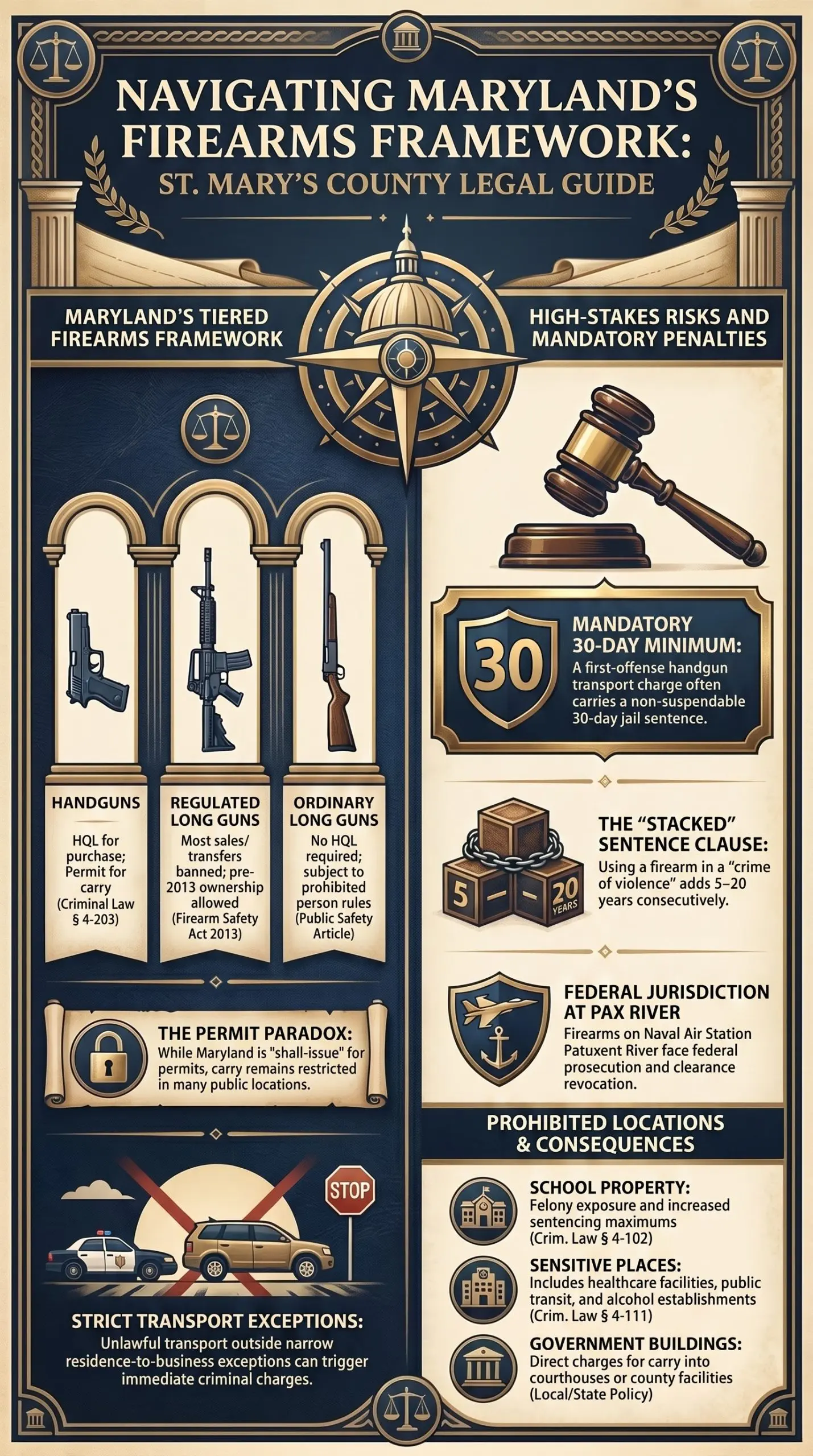
Table of Contents
- Maryland’s Tiered Firearms Framework
- Wear, Carry, or Transport: The Charge That Hides Mandatory Minimum Time
- The HQL and the Wear and Carry Permit After Bruen
- Possession by Prohibited Persons: Federal and State Disqualifications
- Use of a Firearm in a Crime of Violence: The Stacked Sentence
- School Property, Government Buildings, and Sensitive Places
- The Firearm Safety Act and the Regulated Long Gun Question
- Hunting, Sporting Use, and Lawful Possession in Rural St. Mary’s
- PAX River, Federal Property, and Concurrent Jurisdiction
- Defending the Case: From Stop to Disposition in Leonardtown
- Frequently Asked Questions
St. Mary’s County has a long history with firearms. The hunting culture in the western and northern parts of the county runs deep, with deer, turkey, and waterfowl seasons drawing landowners and visiting hunters across Mechanicsville, Loveville, Bushwood, Chaptico, Avenue, and the smaller communities along the Potomac and Wicomico Rivers. Sport shooting, agricultural pest control on the working farms, and home defense in the rural and waterfront communities all reflect a population that has historically owned firearms responsibly and lawfully.
The legal framework that governs all of that activity, however, has changed dramatically over the past decade. Maryland’s Firearm Safety Act of 2013 reshaped the regulatory environment for handguns and regulated long guns. The 2022 Supreme Court decision in New York State Rifle & Pistol Association v. Bruen forced a wholesale rewrite of Maryland’s wear and carry permit framework. The General Assembly’s 2023 response defined a new category of sensitive places where carry remains restricted. Meanwhile, federal disqualifications under 18 U.S.C. § 922(g) continue to attach automatically to certain criminal dispositions, often without the defendant fully understanding the consequence at the time of the plea.
The result is a regulatory environment where lawful gun owners can find themselves charged for conduct they reasonably believed was permitted, and where defendants charged with unrelated crimes can find weapons counts stacked on top with their own mandatory minimums. This article walks through the full Maryland firearms framework as it applies in St. Mary’s County, including the procedural defense considerations specific to cases prosecuted at the Leonardtown courthouse. The goal is not to substitute legal counsel; it is to give people facing weapons charges (or family members of someone facing them) the framework needed to understand the stakes early enough to defend the case effectively.
1. Maryland’s Tiered Firearms Framework
Maryland regulates firearms by category. Three categories matter for almost every weapons case: handguns, regulated firearms (a Maryland-specific term that includes handguns and certain other firearms designated by statute), and ordinary long guns. Each category carries different rules for purchase, transport, and carry, and a single firearm sometimes fits more than one category at once.
Handguns are governed primarily by the Criminal Law Article. Wear, carry, or transport of a handgun is regulated under § 4-203, with detailed exceptions and a separate permit framework. Use of a handgun in a crime of violence is regulated under § 4-204, with mandatory minimum sentences that stack on top of the underlying offense. The term “handgun” reaches pistols, revolvers, and any firearm with a barrel less than sixteen inches that is intended to be fired with one hand.
Regulated firearms are defined in the Public Safety Article and include handguns plus a list of specific long guns and assault weapons designated by the General Assembly. Possession of a regulated firearm is restricted to persons who have completed a Handgun Qualification License course, are not within a prohibited category, and have lawfully acquired the weapon through the Maryland State Police background check process.
Ordinary long guns (rifles and shotguns that fall outside the regulated firearm definition) are subject to less restrictive purchase and transport rules. They are still subject to use-in-crime enhancements, prohibited person rules, school property restrictions, and the federal disqualifications that apply to all firearms.
The category determines the charge. A pistol found in a glove compartment during a Route 235 traffic stop in California produces a different charge from a hunting rifle found in a locked case in the back of a truck on MD 234 outside Loveville. Both are firearms. Only the first one is governed by § 4-203.
2. Wear, Carry, or Transport: The Charge That Hides Mandatory Minimum Time
Criminal Law § 4-203 prohibits a person from wearing, carrying, or transporting a handgun, whether concealed or open, on or about the person, in a vehicle, or otherwise. The statute has a long list of exceptions, but the core prohibition reaches almost every situation in which a handgun is moved outside the home. The penalty structure escalates quickly with prior history and with aggravating circumstances.
A first offense under § 4-203 is a misdemeanor punishable by up to 3 years’ incarceration. The statute imposes a mandatory minimum of thirty days of incarceration in many cases, which the court cannot suspend below the statutory floor. A second offense, a third offense, or a first offense aggravated by certain circumstances (carrying on school property, carrying with the intent to injure, or other defined factors) raises the maximum and the mandatory minimum significantly.
The exceptions are detailed. A person with a valid Maryland Wear and Carry Permit may carry under the conditions of the permit. A person transporting a handgun between defined locations (residence, place of business, repair shop, gun show, hunting location) may transport when the weapon is unloaded and stored according to the statutory requirements. A person at his place of business may possess a handgun without a wear and carry permit, subject to other rules. The exceptions are real, but they are also narrowly drawn, and conduct that falls a few feet outside an exception falls fully within the prohibition.
The Calvert County analog of this charge is walked through in detail in our Calvert County weapons charges defense guide. The legal analysis is identical across the Patuxent. The local prosecutorial practices at the State’s Attorney’s Office for St. Mary’s County and at the State’s Attorney’s Office for Calvert County are similar but not identical, and counsel familiar with both is helpful for clients who travel and work across the bridge.
3. The HQL and the Wear and Carry Permit After Bruen
Maryland requires a Handgun Qualification License under Public Safety Article § 5-117 before most residents can purchase a handgun. The HQL requires a fingerprint based background check, completion of an approved firearms safety course, and renewal at defined intervals. The HQL is not a carry permit; it is a licensing prerequisite that must be obtained before the regulated firearm transaction can be completed.
The Wear and Carry Permit under § 5-303 is the separate authorization that allows a person to carry a handgun on or about the person in public. Before 2022, Maryland’s permit framework required the applicant to demonstrate a “good and substantial reason” to carry, and the Maryland State Police denied the majority of applications under that standard. The Supreme Court’s decision in New York State Rifle & Pistol Association v. Bruen in 2022 struck down “may issue” frameworks of that type and required that permit issuance be governed by objective criteria.
The Maryland State Police adjusted in response, and the General Assembly enacted the Gun Safety Act of 2023, which retained an objective permitting structure but defined extensive sensitive places where carry remains prohibited even with a permit. The result is that Maryland is now a “shall issue” jurisdiction for applicants who meet the objective criteria, but the places where carry is actually permitted are sharply limited by statute.
A permit is not a license to carry anywhere. A Maryland Wear and Carry Permit holder who carries into a sensitive place defined by the 2023 act, into a private business that posts a no-carry sign, or onto property where carry is otherwise prohibited can still face § 4-203 charges. The permit is a defense to the wear and carry prohibition only when the carry occurs in a permitted location.
Reciprocity with other states is limited. Maryland does not recognize most out of state carry permits. A driver passing through St. Mary’s County with a handgun lawfully carried under a Virginia permit, a West Virginia permit, or a permit from any non-reciprocal state can face § 4-203 charges if stopped. Drivers traveling through Maryland with handguns should review the federal Firearm Owners Protection Act safe-passage provisions and Maryland’s specific transport rules carefully before entering the state.
Charged With a Weapon Crime in St. Mary’s County?
Mandatory minimum sentences cannot be suspended below the statutory floor. The defense begins at the charging document and runs through every motion, hearing, and negotiation. Haskell & Dyer represents accused individuals throughout St. Mary’s County.
Main Office: 301-627-5844
24/7 Hotline: 240-687-0179
4. Possession by Prohibited Persons: Federal and State Disqualifications
Both federal and Maryland law prohibit firearm possession by persons in defined disqualifying categories. The federal prohibitions live primarily in 18 U.S.C. § 922(g) and reach felons, persons subject to certain protective orders, persons convicted of misdemeanor crimes of domestic violence under the Lautenberg Amendment, persons adjudicated as a mental defective or committed to a mental institution, persons unlawfully using or addicted to controlled substances, persons dishonorably discharged from the armed forces, and several other categories.
Maryland’s parallel state prohibitions live in Public Safety Article § 5-133 and Criminal Law § 4-203, and they overlap with the federal categories while extending in some directions. Maryland prohibits regulated firearm possession by persons under twenty one in many circumstances, by persons with certain juvenile adjudications, and by persons with specific prior convictions. Possession by a prohibited person under either framework is a serious offense; the federal version carries a maximum of 10 years of incarceration per count under § 924(a)(8).
The disqualification rules produce some of the most painful weapons cases prosecutors charge. A person who pleaded guilty years earlier to a misdemeanor that he believed had no firearm consequence later finds himself in possession of a hunting rifle inherited from a family member. A federal contractor at PAX River loses a clearance after a domestic case and only later realizes that the disposition triggered § 922(g)(9). A long time sport shooter receives a possession charge after a search of a residence based on an unrelated investigation.
The Lautenberg Amendment is a particularly common surprise. A misdemeanor crime of domestic violence under federal law triggers a permanent firearm prohibition that does not require the conviction to have been labeled “domestic violence” in the Maryland charging document. Any second degree assault conviction (and, in some readings, even a Probation Before Judgment disposition) involving an alleged victim within the federal relationship definition can disqualify the defendant from firearm possession for life.
5. Use of a Firearm in a Crime of Violence: The Stacked Sentence
Criminal Law § 4-204 imposes a separate, stacked mandatory minimum sentence on any person who uses a firearm in the commission of a crime of violence. The statute reaches not only the defendant who personally fired the weapon but the defendant who used a firearm in the course of committing the underlying offense. The sentence under § 4-204 runs consecutively to the sentence imposed for the underlying crime, and it cannot be suspended below the statutory minimum.
The “crime of violence” trigger is defined in the statute and includes assault in the first degree, robbery, carjacking, kidnapping, burglary in the first or second degree, voluntary manslaughter, and several other offenses. Second degree assault is not generally a § 4-204 trigger, but second degree assault on law enforcement under § 3-203(c), a felony, can be. The list grew under successive General Assembly sessions and continues to evolve.
The practical effect of § 4-204 is to add five to twenty years to a conviction for a qualifying underlying offense, with the sentence running on top of the underlying sentence and with the minimum served in full before any parole eligibility on the underlying offense begins. Cases that involve both a serious underlying charge and a § 4-204 enhancement can produce sentences that approach or exceed the maximum for the underlying offense alone.
The defense in stacked cases often focuses on whether the firearm was actually used in the commission of the offense, as the statute requires. Mere possession is not enough. The State must prove that the firearm was used in a way that furthered the underlying crime. The line between “had a firearm during the offense” and “used a firearm in the offense” is often where the defense lives.
6. School Property, Government Buildings, and Sensitive Places
Maryland prohibits the possession of firearms on school property under Criminal Law § 4-102. The statute reaches public and private schools (preschool through twelfth grade), school grounds, and school-sponsored activities, and the prohibition applies whether or not the carrier holds a wear and carry permit. The penalty structure escalates with the type of weapon and the circumstances, with handguns producing more serious exposure than long guns.
Government buildings are governed by a separate framework. Many state and county facilities, including the courthouses in Leonardtown and across Maryland, prohibit firearm possession through statutes, regulations, or posted policies. A wear and carry permit is not a defense to entering a courthouse with a handgun. Drivers stopped on a courthouse property after carrying inadvertently can face § 4-203 charges with the additional aggravating factor of the location.
Maryland’s 2023 sensitive places legislation, codified in part in § 4-111 of the Criminal Law Article, defines an extensive list of locations where wear and carry is prohibited even by permit holders. The list includes places where alcohol or cannabis is sold for on-site consumption, healthcare facilities, public transit, demonstrations, government buildings, and several other categories. Carrying into a sensitive place can produce charges even for an otherwise lawful permit holder.
The sensitive places framework is recent and evolving. The definitions and exceptions have been the subject of litigation since enactment, and federal courts have issued partial preliminary rulings on portions of the statute. Counsel handling current cases reviews the latest decisions, because the boundaries of the prohibition are not yet settled in every detail.
7. The Firearm Safety Act and the Regulated Long Gun Question
The Firearm Safety Act of 2013 reshaped Maryland’s regulatory approach to firearms. The statute banned the sale and transfer of designated assault long guns and certain copycat weapons, restricted magazine capacity to ten rounds for new acquisitions, expanded the definition of “regulated firearm” to include the banned long guns, and added the Handgun Qualification License requirement for handgun purchases. The Act’s provisions have been the subject of litigation in federal and state courts, and several portions have been clarified through subsequent legislation.
The practical implication for St. Mary’s County residents is that purchase of a regulated long gun (the AR pattern rifles, AK pattern rifles, and similar weapons listed in the Act) is generally prohibited unless the firearm was lawfully owned before the effective date of the ban or fits a defined exception. Possession by lawful pre-ban owners remains permitted. Sale, transfer, or transport into the state by a non-resident produces serious exposure.
The magazine capacity restriction applies to new acquisitions of magazines holding more than ten rounds. Possession of pre-ban magazines is generally permitted. Use of a high-capacity magazine in connection with a crime can produce additional counts under § 4-305.
Hunting long guns (bolt-action rifles, pump and semi-automatic shotguns within standard configurations, and similar firearms used for traditional sporting purposes) generally fall outside the regulated firearm definition and are subject to less restrictive rules. The lines between regulated and unregulated long guns are not always intuitive, and counsel reviews the specific firearm involved in any case.
8. Hunting, Sporting Use, and Lawful Possession in Rural St. Mary’s
St. Mary’s County’s hunting and sporting culture remains active across the rural communities. Deer season produces a steady seasonal pattern of firearm transport in trucks across MD 5, MD 234, MD 6, and the smaller roads connecting Mechanicsville, Loveville, Bushwood, Avenue, Chaptico, Coltons Point, Tall Timbers, Drayden, and the surrounding agricultural and waterfront properties. Turkey and waterfowl seasons add their own rhythms. Most of this activity proceeds without legal incident.
The lawful transport rules are detailed. Long guns transported between residence, hunting location, gun show, repair shop, and certain other defined locations may be transported lawfully when the weapon is unloaded and the ammunition is separated according to the statutory requirements. Handguns are subject to additional rules under § 4-203, including the requirement that they be in a holster on the person of a permitted carrier or in a locked container away from ammunition during transport.
The cases that arise in hunting context typically involve one of three patterns. The first is a traffic stop while transporting a firearm in a manner that fell outside the statutory exception. The second is possession by a hunter who lost the right to possess due to a prior disqualifying event he did not fully understand. The third is conduct on hunting property that produced a separate criminal charge (an assault, a property dispute) with the firearm as a charged element.
Hunting transport rules are not intuitive. A driver returning from a deer hunt with a rifle in the back seat, ammunition in the glove compartment, and a hunting license in the wallet may be in compliance with the rules. The same driver who stops to grab dinner on the way home, leaving the rifle in the vehicle while inside the restaurant, may have stepped out of the exception. Counsel familiar with the specific transport requirements reviews the route, the storage method, and the timing of stops.
9. PAX River, Federal Property, and Concurrent Jurisdiction
Naval Air Station Patuxent River occupies a significant portion of southern St. Mary’s County. The base operates under federal jurisdiction, and firearm possession on the installation is governed by Department of Defense and Department of the Navy regulations rather than Maryland law alone. Service members, civilian employees, and contractors face independent regulatory frameworks for any firearm activity on the base.
Stops conducted by base police or federal authorities within the installation produce federal citations, prosecuted in the United States District Court for the District of Maryland in Greenbelt rather than the Maryland courts in Leonardtown. The substantive firearm rules incorporate Maryland law in some respects but proceed under federal procedure. Defendants in federal cases face different sentencing matrices, different discovery rules, and different plea structures from those in Maryland court.
The collateral consequences of federal firearm cases are particularly severe for the PAX River workforce. Active duty service members face Uniform Code of Military Justice exposure independent of the criminal case. Civilian contractors face base access reviews that often end employment regardless of the criminal disposition. Security clearance holders face mandatory self reporting under DoD reporting requirements, with administrative consequences that can suspend or revoke clearance even before the criminal case resolves.
For drivers traveling to or from PAX, the boundary between federal jurisdiction (inside the gate) and Maryland jurisdiction (outside the gate) is not always obvious from the road. Counsel reviews the precise stop location and the chain of custody on any seized firearm to identify the proper forum and the available defenses.
10. Defending the Case: From Stop to Disposition in Leonardtown
The path of a St. Mary’s County weapons case from charge to disposition tracks the broader criminal procedure framework with several specific defense considerations. The fact pattern at the stop or the search dictates much of what follows. A handgun discovered during a vehicle search after a Route 235 traffic stop is a different case from a firearm seized during a residential search warrant in Hollywood, which is in turn different from a firearm seized at the booking desk after an arrest at the St. Mary’s County Detention Center.
Fourth Amendment analysis is central to almost every weapons case. The lawfulness of the stop, the scope of the consent (if any was given), the existence of probable cause to search, the validity of any warrant, the bounds of the search incident to arrest, and the inventory search exceptions all become litigation points. Suppression of the firearm because of an unlawful search ends the weapons case before it begins. A successful motion to suppress is sometimes the difference between a case that goes to trial and a case that gets dismissed.
Discovery review focuses on the body camera footage, the dashboard camera footage, the dispatch audio, the property receipt for the seized firearm, the chain of custody documentation, the testing or examination reports prepared by the Maryland State Police firearms unit, and any prior history records reviewed by the State. Defense counsel reviews each piece for inconsistencies, gaps, and challenges.
The negotiation phase involves the same considerations that apply across criminal practice, with weapons-specific overlays. Whether a particular plea structure preserves any portion of the defendant’s firearm rights, whether the disposition triggers federal § 922(g) prohibitions, and whether mandatory minimums constrain the available outcomes all factor into the strategy. Cases that resolve with non firearm charges (where the State agrees to drop a § 4-203 count in exchange for a plea on a different charge) preserve more of the defendant’s life going forward than cases that resolve with weapons convictions.
Defense That Protects the Case and the Rights Behind It
Whether the case is a glove compartment handgun on Route 235, a § 4-204 enhancement on top of an underlying assault, a federal citation issued at the PAX River main gate, or a possession case stemming from a prior disqualification, Haskell & Dyer represents accused individuals across St. Mary’s County.
Main Office: 301-627-5844
24/7 Hotline: 240-687-0179
Frequently Asked Questions
Can I keep a handgun in my car while driving through St. Mary’s County?
Generally no, unless you hold a valid Maryland Wear and Carry Permit and the location of carry is permitted under the 2023 sensitive places framework, or you fall within one of the narrow transport exceptions in Criminal Law § 4-203 (such as transporting between residence and place of business, residence and gun show, or residence and repair shop with the firearm unloaded and stored according to the statutory rules). An out of state permit generally does not cover Maryland.
What is the Handgun Qualification License and do I need one to own a gun I already have?
The Handgun Qualification License under Public Safety Article § 5-117 is required to purchase, rent, or receive a regulated firearm in Maryland after the effective date of the requirement. Lawful owners who acquired their handguns before the HQL requirement, or who acquired through a path that did not require the HQL at the time, are generally not required to obtain one retroactively. The HQL is a purchase prerequisite, not a possession prerequisite.
I have a Virginia carry permit. Can I carry in Maryland?
Maryland does not currently have reciprocity with Virginia for carry permit purposes. A driver entering Maryland from Virginia carrying under a Virginia permit can face § 4-203 charges if stopped. The federal Firearm Owners Protection Act provides limited safe-passage protection for travelers passing through a state, but the conditions are narrow and require unloaded transport with secured storage. Drivers who plan to stop, stay overnight, or work in Maryland should not rely on safe-passage alone.
Will a DUI conviction prevent me from getting a Wear and Carry Permit?
A single DUI conviction is not necessarily disqualifying, but the Maryland State Police review the applicant’s full history when evaluating the objective criteria. Multiple DUI convictions, recent DUI activity, or DUI dispositions accompanied by violent or weapons related conduct can produce permit denials. Counsel reviews the application strategy carefully and addresses the permit question as part of any DUI defense planning. For the broader Maryland DUI framework, see our St. Mary’s County DUI and traffic defense guide.
A handgun was found in my car during a traffic stop on Route 235. What do I do?
First, contact counsel immediately. Do not give a statement to the deputy or the State’s Attorney’s Office about the firearm beyond confirming basic identifying information. The lawfulness of the stop, the scope of the search, and the chain of custody for the seized firearm are all litigation points that experienced counsel reviews early. The case may be defensible on Fourth Amendment grounds, on a transport exception, or on the specifics of how the firearm came to be in the vehicle.
I am a federal contractor at PAX River. Can I bring my personally owned firearm onto the installation?
No, generally not without specific authorization. Naval Air Station Patuxent River prohibits personally owned firearms on the installation outside of narrowly defined circumstances (typically related to authorized hunting on designated portions of the base, by approved personnel, under specific procedures). A contractor who brings a personal firearm onto the base outside of those procedures faces both federal criminal exposure and immediate base access consequences.
Does a Probation Before Judgment disposition trigger the federal firearm prohibition?
The answer depends on the underlying charge and the relationship between the parties. Federal courts have read the Lautenberg Amendment and related § 922(g) provisions inconsistently as applied to Maryland PBJ dispositions. Conservative defense planning treats any PBJ on a domestic-relationship assault as potentially triggering § 922(g)(9), and any PBJ on a felony charge as potentially triggering § 922(g)(1). Counsel reviews the specific case before recommending PBJ as a strategy in firearm-sensitive contexts.
Can I get my firearm rights restored after a felony conviction?
Restoration is procedurally available under Maryland law for some categories of disqualifying offenses, generally requiring a waiting period and a successful petition. Federal restoration is significantly more difficult and is functionally unavailable for many federal disqualifications under current law. Counsel reviews the specific disqualification at issue and the realistic restoration paths before advising on the strategy.
Closing Thoughts
St. Mary’s County combines a strong tradition of lawful firearm ownership with one of the most regulated firearms environments in the country. The combination produces cases that often catch responsible gun owners by surprise. A driver who carried a handgun every day in his glove compartment for a decade can suddenly face a § 4-203 charge after one Route 235 traffic stop. A long time hunter can find himself charged with possession by a prohibited person years after a misdemeanor conviction he never connected to firearm rights. A federal contractor at PAX can lose base access after a single domestic case that triggers the Lautenberg Amendment.
The legal framework rewards careful navigation. Mandatory minimums on § 4-203 cases cannot be suspended below the statutory floor. § 4-204 enhancements run consecutively to underlying sentences. Federal disqualifications attach by operation of law without any Maryland court finding. PBJ does not always provide the protection defendants expect. The cases that end well are the ones where counsel addresses the firearm consequences from the first conversation, not as an afterthought at sentencing.
Haskell & Dyer represents accused individuals across St. Mary’s County, including residents of Leonardtown, Lexington Park, California, Great Mills, Hollywood, Mechanicsville, Charlotte Hall, Park Hall, Ridge, Piney Point, Callaway, Loveville, Chaptico, Bushwood, Avenue, Coltons Point, St. Inigoes, Tall Timbers, Drayden, and Valley Lee. The firm understands the local courts, prosecutors, and law enforcement agencies, and it builds defenses that account for both the criminal and the collateral consequences of every charge.
References
18 U.S.C. § 922(g) (2024). Unlawful acts: Possession of firearms and ammunition by prohibited persons. Washington, DC: U.S. Government Publishing Office.
18 U.S.C. § 924 (2024). Penalties for violations. Washington, DC: U.S. Government Publishing Office.
Firearm Owners Protection Act, 18 U.S.C. § 926A (2024). Interstate transportation of firearms. Washington, DC: U.S. Government Publishing Office.
Maryland Code Annotated, Criminal Law Article § 4-101 (2024). Dangerous weapons: Definitions and penalties. Annapolis, MD: General Assembly of Maryland.
Maryland Code Annotated, Criminal Law Article § 4-102 (2024). Deadly weapons on school property. Annapolis, MD: General Assembly of Maryland.
Maryland Code Annotated, Criminal Law Article § 4-111 (2024). Firearms in sensitive places. Annapolis, MD: General Assembly of Maryland.
Maryland Code Annotated, Criminal Law Article § 4-203 (2024). Wearing, carrying, or transporting handgun. Annapolis, MD: General Assembly of Maryland.
Maryland Code Annotated, Criminal Law Article § 4-204 (2024). Use of firearm in commission of crime of violence. Annapolis, MD: General Assembly of Maryland.
Maryland Code Annotated, Criminal Law Article § 4-301 to § 4-306 (2024). Assault weapons and detachable magazines. Annapolis, MD: General Assembly of Maryland.
Maryland Code Annotated, Public Safety Article § 5-101 (2024). Definitions: Regulated firearms. Annapolis, MD: General Assembly of Maryland.
Maryland Code Annotated, Public Safety Article § 5-117 (2024). Handgun Qualification License. Annapolis, MD: General Assembly of Maryland.
Maryland Code Annotated, Public Safety Article § 5-133 (2024). Restrictions on possession of regulated firearms. Annapolis, MD: General Assembly of Maryland.
Maryland Code Annotated, Public Safety Article § 5-303 (2024). Wear and Carry Permit. Annapolis, MD: General Assembly of Maryland.
Maryland General Assembly. (2013). Firearm Safety Act of 2013, Chapter 427. Annapolis, MD: Author.
Maryland General Assembly. (2023). Gun Safety Act of 2023, Senate Bill 1. Annapolis, MD: Author.
New York State Rifle & Pistol Association v. Bruen, 597 U.S. 1 (2022). Supreme Court of the United States.
U.S. Department of Defense. (2023). Personnel security clearance reporting requirements: DoD Directive 5220.6. Arlington, VA: Author.
Legal Disclaimer: This article provides general information about Maryland firearms law and is not legal advice. Reading it does not create an attorney client relationship with Haskell & Dyer or any of its attorneys. Maryland firearms law is subject to ongoing legislative and judicial change, and the application of any statute, regulation, or court rule depends on the specific facts of an individual case. Statutes and case decisions are cited as in effect at the time of writing and may have been amended or modified since publication. If you have been charged with a weapons offense, a related criminal offense, or any other crime in St. Mary’s County or anywhere in southern Maryland, you should consult with a qualified attorney about the facts of your case.
For a confidential consultation, call Haskell & Dyer at 301-627-5844 or our 24/7 hotline at 240-687-0179.