
Bottom Line Up Front
Maryland is one of the most heavily regulated firearms states in the country, and Calvert County prosecutors enforce that framework aggressively. A handgun found in a glove compartment during a routine traffic stop on Route 4 can produce wear/carry/transport charges that carry mandatory minimum exposure. A firearm brought onto school property can produce felony charges with enhanced penalties. A gun used during another offense (robbery, assault, drug distribution) carries a separate use-of-a-firearm-in-a-crime-of-violence charge with its own mandatory minimum sentence that runs on top of the underlying crime. Maryland’s handgun permit framework requires a specific permit before carrying, wearing, or transporting a handgun, and even recent changes to permit availability did not eliminate Maryland’s restrictions on where firearms can be carried. Restricted locations include schools, certain government buildings, places of public accommodation, and many sensitive venues. Prohibited possession charges (for people with disqualifying convictions, protective orders, or other firearm disabilities) carry substantial exposure under both state and federal law. Illegal purchases, straw purchases, and improper transfers each incur specific charges. Every one of these cases involves complex factual and legal issues: whether the stop was lawful, whether the search was valid, whether the person actually had “possession,” whether the weapon meets the statutory definition, whether a permit exception applies, and whether any of Maryland’s specific exemptions apply. This guide walks through all 10 main situational categories that lead to Calvert County weapons charges, the defenses that actually work, and how to protect your rights, your record, and your firearm when a charge is filed.
Call The Law Offices of Haskell and Dyer for a free consultation at 📞 301-627-5844 or the 24/7 criminal defense hotline at 240-687-0179.
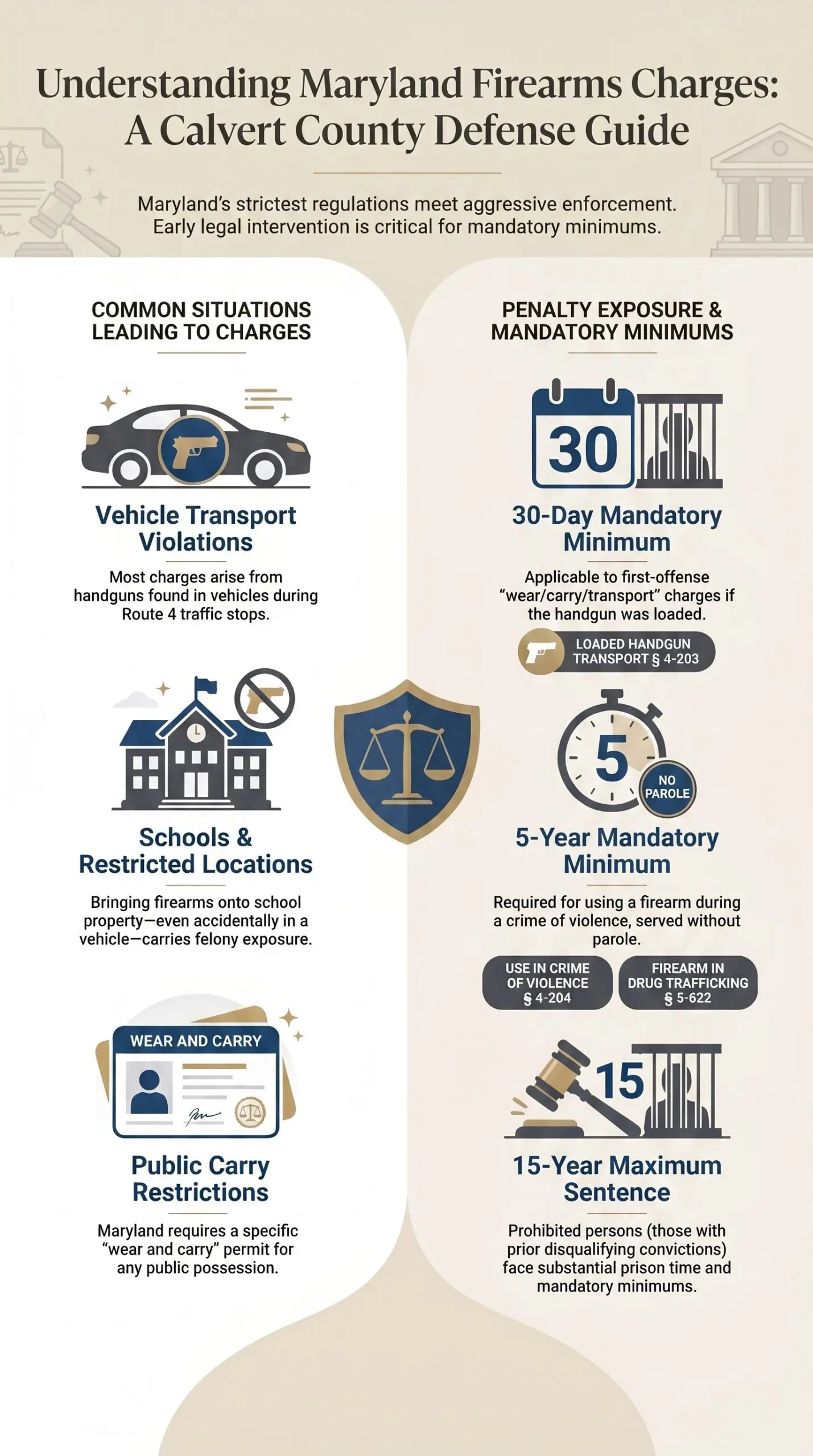
Table of Contents
- Maryland’s Weapons Law Framework and Calvert County Prosecution
- Handgun in a Vehicle During a Traffic Stop
- Carrying a Handgun on Your Person in Public
- Firearms on School Property
- Firearms on Private Property Without Permission
- Prohibited Possession and Firearm Disabilities
- Use of a Firearm in a Crime of Violence
- Illegal Transportation and Loaded-Firearm Transport Rules
- Illegal Purchases, Straw Purchases, and Improper Transfers
- Defense Strategy, Domestic Incidents, Sensitive Locations, and Working with Haskell and Dyer
- Summary
- References
1. Maryland’s Weapons Law Framework and Calvert County Prosecution
Maryland’s firearms statutes live primarily in two places: the Criminal Law Article (covering criminal penalties) and the Public Safety Article (covering regulated firearm and handgun permit requirements). Together they create one of the strictest firearm frameworks in the country.
The Main Statutory Sources
- Criminal Law Article Title 4, Subtitle 2 — handgun-specific offenses including wear, carry, transport, and use charges
- Criminal Law Article Title 4, Subtitle 1 — dangerous weapons generally
- Criminal Law § 4-203 — wearing, carrying, or transporting a handgun (the most commonly charged weapons offense)
- Criminal Law § 4-204 — use of a handgun in a crime of violence or felony (mandatory minimums)
- Public Safety Article § 5-133 — prohibited possession of regulated firearms
- Public Safety Article § 5-117.1 — handgun qualification license requirement for purchase
- Public Safety Article § 5-305 — handgun permit (wear and carry)
- Criminal Law § 4-102 — firearms in schools
- Criminal Law § 5-622 — firearm use during drug trafficking crimes
The Common Charges
- Wear, carry, or transport a handgun (§ 4-203) — most common handgun charge
- Wear, carry, or transport a handgun in a vehicle (§ 4-203(a)(1)(ii))
- Use of a handgun in a crime of violence (§ 4-204)
- Possession of a regulated firearm by a prohibited person (§ 5-133)
- Illegal purchase or transfer of a regulated firearm (§ 5-124 and related)
- Firearm on school property (§ 4-102)
- Possession of a firearm in a drug trafficking crime (§ 5-622)
Penalty Exposure
Weapons charges produce substantial exposure. Key examples:
- First offense § 4-203 — up to 3 years with a mandatory minimum of 30 days if the firearm was loaded
- Repeat § 4-203 offenses — escalating mandatory minimums and longer maximum sentences
- § 4-204 use in crime of violence — mandatory minimum of 5 years without parole, up to 20 years, consecutive to the underlying crime
- § 5-133 prohibited possession — up to 15 years with mandatory minimums depending on prior history
- § 4-102 school firearm — up to 3 years with mandatory minimums in certain cases
- § 5-622 firearm in drug trafficking — mandatory minimum 5 years without parole, up to 20 years
How Calvert County Handles These Cases
Weapons cases in Calvert County proceed through:
- The District Court for Calvert County in Prince Frederick for misdemeanor weapons charges
- The Circuit Court for Calvert County in the same building for felony charges
- Aggressive charging practices by the State’s Attorney’s Office
- Substantial use of mandatory minimum charges when weapons are involved
- Regular stacking of firearms charges alongside underlying offenses
The mandatory minimum reality: Many weapons charges carry mandatory minimum sentences that a judge cannot suspend. A first-offense wear/carry/transport of a loaded handgun includes a 30-day mandatory minimum. Use of a firearm in a crime of violence carries a 5-year mandatory minimum without parole, consecutive to any other sentence. Defense strategy must address both the underlying charge and the mandatory minimum exposure.
For a broader context on how Calvert County prosecutors approach serious charges, see our article Don’t Plead Guilty in Calvert County Without Reading This First.
2. Handgun in a Vehicle During a Traffic Stop
The most common weapons charge in Calvert County arises from traffic stops. A deputy on Route 4, Route 2/4, or an intersection pulls a vehicle over for a speeding violation, equipment issue, or other traffic matter. During the stop, a firearm is discovered. Charges follow.
The Typical Scenario
- Traffic stop in Prince Frederick, Dunkirk, Huntingtown, or along the Route 4 corridor
- Deputy observes a handgun in plain view (on the passenger seat, in an open glove compartment, visible near the console)
- OR deputy conducts a search (pursuant to consent, probable cause, or inventory) and finds a firearm
- OR a passenger discloses a firearm’s presence during the stop
- The driver or passenger is charged under § 4-203 with wear/carry/transport of a handgun in a vehicle
The Legal Framework
Maryland Criminal Law § 4-203 prohibits wearing, carrying, or transporting a handgun “whether concealed or open” without lawful authorization. The statute specifically addresses handguns in vehicles. Exceptions include:
- A person holding a valid Maryland wear and carry permit
- Transport between the person’s residence and certain authorized locations (like a firing range)
- Handgun transport for repair or sale to a licensed dealer
- Transport to or from property owned or leased by the person
- Specific law enforcement and military exceptions
The transport exemption has specific requirements: the handgun must be unloaded, in a case or in the trunk (or other area not readily accessible), and the route must be direct between authorized points.
The Permit Issue
Maryland requires a wear and carry permit for general carry. While permit eligibility has changed in recent years following U.S. Supreme Court decisions, Maryland retains substantial restrictions. Holders of valid permits still face limits on:
- Carrying in restricted locations (schools, certain government buildings, places of public accommodation)
- Carrying on private property without permission
- Carrying while intoxicated
- Carrying when specific conditions disqualify the holder
Fourth Amendment Issues
Traffic stop weapons cases typically involve substantial Fourth Amendment questions:
- Was the initial stop legally justified?
- Did the officer have probable cause to search?
- Was consent to search voluntary and within scope?
- Was the plain view observation actually in plain view?
- Did the frisk or Terry search exceed permitted scope?
- Were questions about firearms asked under custodial conditions requiring Miranda?
Successful Fourth Amendment challenges can produce suppression of the firearm, which often ends the case. For related reading on traffic stop defense generally, see our Calvert County DUI and traffic defense complete guide.
The Loaded vs. Unloaded Distinction
Whether the firearm was loaded affects penalty significantly. A loaded handgun produces a 30-day mandatory minimum in addition to other exposure. Defense counsel addresses whether the state can actually prove the firearm was loaded at the relevant moment.
Defense Strategies
- Fourth Amendment challenges to the stop and any search
- Permit exemption analysis
- Transport exemption analysis
- Possession challenges in multi-occupant vehicles
- Loaded status challenges
- Miranda and voluntariness challenges to statements
- Strategic resolution targeting reduced charges
3. Carrying a Handgun on Your Person in Public
Charges for wearing or carrying a handgun on the person, rather than in a vehicle, come from encounters at gas stations, stores, parking lots, and other public spaces. The core statute is the same § 4-203, but the factual context and available defenses differ.
Common Scenarios
- Concealed handgun detected during a pat-down or encounter
- Visible handgun observed on a person’s belt, pocket, or clothing
- Handgun detected after a complaint from a third party
- Handgun discovered during a response to an unrelated call
- Handgun found after a fall, medical event, or other encounter where police become involved
The Permit Requirement
Maryland requires a wear and carry permit to carry a handgun on the person in public. Even after permit eligibility changes, Maryland maintains:
- The permit application and issuance process
- Training and qualification requirements
- Background check requirements
- Specific locational restrictions for permit holders
Carrying without a valid permit, even openly, violates § 4-203 unless a specific exception applies.
The Restricted Location Problem
Even valid permit holders face restrictions. Maryland law restricts firearms in:
- Schools and school grounds
- Certain government buildings
- Places of public accommodation (businesses open to the public) unless permission is granted
- Healthcare facilities
- Places of worship in certain circumstances
- Establishments serving alcohol
- Public demonstrations and gatherings
- Certain sensitive locations added by recent Maryland legislation
A permit holder who carries into a restricted location can face the same charges as someone carrying without a permit.
Critical for permit holders: Having a Maryland wear and carry permit does not create universal carry authorization. The permit is always limited by location restrictions. Defense counsel regularly defends permit holders who entered restricted areas without realizing the law.
The Terry Stop Issue
Police frequently encounter concealed handguns during Terry stops — brief investigative detentions with a pat-down for weapons. Fourth Amendment issues in these cases often focus on:
- Whether the officer had reasonable suspicion for the stop
- Whether the officer had reasonable belief that the person was armed and dangerous
- Whether the pat-down was limited to weapons
- Whether the scope of the pat-down was reasonable
Defense Strategies
- Fourth Amendment challenges to the stop and frisk
- Permit and exception analysis
- Restricted location challenges (was the defendant actually in a restricted area?)
- Possession challenges when ownership of the firearm is disputed
- Strategic resolution for legally-owning defendants with technical violations
4. Firearms on School Property
Maryland Criminal Law § 4-102 specifically prohibits firearms on school property. The statute reaches public schools, private schools, and certain related locations. Charges in this area carry enhanced penalties and additional complications.
The Statutory Framework
Section 4-102 prohibits bringing firearms onto:
- Public school buildings
- Private school buildings
- School grounds including parking lots
- Public or private school-sponsored events
- Related educational property in certain circumstances
The prohibition applies regardless of whether the person holds a handgun permit. Federal law (the Gun-Free School Zones Act) extends the restriction to 1,000 feet of school property in many circumstances.
Common Scenarios
- A parent arrives at a Calvert County public school with a handgun in the vehicle, perhaps forgotten after a hunting trip or other lawful use
- A student brings a firearm to school
- A visitor arrives at a school event with a firearm
- A person is found with a firearm near school grounds in the 1,000-foot federal zone
- A parent transporting their child to school or a sports event has a firearm in the vehicle
Penalty Exposure
School firearm charges can reach 3 years of state exposure plus federal prosecution exposure. Some circumstances produce mandatory minimums. Cases involving students can also produce juvenile court proceedings.
The Unaware Parent Scenario
A common and painful scenario: a parent with a lawful handgun transports their child to school, forgetting the handgun is in the vehicle (often stored for hunting, shooting, or concealed carry purposes). The handgun is discovered during a search related to another matter, or disclosed by the parent when they remember. Charges follow despite the complete absence of harmful intent.
Defense counsel in these cases often works to:
- Establish the complete lack of intent to bring the firearm into school
- Present mitigation evidence about the defendant’s character
- Negotiate resolution that avoids conviction
- Protect the defendant’s ability to maintain firearms ownership going forward
For parents of students: Before you drive to a Calvert County school for pickup, dropoff, a school event, or parent-teacher conferences, verify that no firearms are in your vehicle. A handgun legitimately left in your glove compartment from a concealed-carry drive becomes a felony exposure when you drive into a school parking lot.
Student and Juvenile Cases
When a student brings a firearm to school, the case often proceeds in juvenile court. For the juvenile framework, see our cornerstone: Calvert County Juvenile Offense Defense: The Complete Guide. Firearms cases involving students can trigger transfer to adult court in certain circumstances.
Defense Strategies
- Fourth Amendment challenges to the search that discovered the firearm
- Intent challenges in parent-transport scenarios
- Fact challenges about the exact location of the firearm
- Mitigation development
- Strategic resolution targeting reduced charges and protecting firearms ownership
- Federal prosecution risk management
- Juvenile court coordination where applicable
5. Firearms on Private Property Without Permission
Maryland restricts carrying firearms onto private property without the owner’s permission. This restriction applies even to people who otherwise hold valid permits and are authorized to carry.
The Statutory Framework
Under Maryland law, carrying a firearm onto private property without express permission from the owner or occupant can produce charges. The framework addresses:
- Residential property
- Business property not open to the public
- Posted property
- Private land including farms and rural property
- Property owned by others during disputes or visits
Common Scenarios
- Carrying a firearm into a dispute at another person’s home
- Bringing a firearm onto posted land during a property dispute
- Entering a business that has posted no-firearms signs
- Visiting a friend or family member while carrying without asking permission
- Hunting on property without permission
- Domestic incidents where the firearm was brought into another person’s residence
The Permission Question
Express permission can be verbal or written, but it must be specific. Defense counsel analyzes:
- Was permission actually given?
- Was the permission valid (given by an authorized person)?
- Was the permission specific to firearms, or general property access?
- Were signs posted that would affect the analysis?
- What did the defendant reasonably believe about authorization?
The Domestic Context
Firearms on private property charges often arise during domestic disputes. Someone brings a firearm to a former partner’s home during an argument. Or returns to a shared residence after a separation while carrying. The firearm charge combines with potential assault, protective order violation, and other charges. For related reading, see our article on common situations where protective orders are necessary.
Defense Strategies
- Permission analysis (explicit or implied)
- Property status challenges
- Factual investigation of the specific circumstances
- Companion charge review (assault, protective order violations)
- Firearms surrender negotiation during pendency
- Record-protective resolution where possible
6. Prohibited Possession and Firearm Disabilities
Some of the most serious weapons charges in Maryland involve prohibited possession: people who have a disqualifying history or status attempting to possess regulated firearms.
The Statutory Framework
Maryland Public Safety § 5-133 prohibits possession of a regulated firearm by people in specific disqualifying categories:
- Conviction of a “disqualifying crime” including felonies and certain misdemeanors
- Conviction of a crime of violence
- Conviction of a common-law crime carrying more than 2 years exposure
- Being subject to a protective order (certain orders)
- Being a fugitive from justice
- Habitual drunkard or addict status under the statute
- Mental health commitments meeting statutory criteria
- Being under 21 for handguns
Federal law under 18 U.S.C. § 922(g) adds additional prohibited categories that often overlap with state prohibitions.
The Penalty Structure
- Prohibited possession under § 5-133(b) — up to 5 years, with mandatory minimums depending on the disqualifying conviction
- Prohibited possession with prior crime of violence conviction — mandatory minimum 5 years without parole, up to 15 years
- Federal § 922(g) prosecution — up to 10 years with enhanced Armed Career Criminal Act exposure in qualifying cases
Common Scenarios
- Person with prior felony conviction found in possession during unrelated stop
- Person under protective order found with firearm
- Person with recent commitment found with firearm
- Person under 21 with handgun
- Person whose disqualifying conviction was from decades ago, sometimes out of state
The Disqualification Question
Defense counsel carefully examines whether the defendant is actually prohibited:
- Does the prior conviction actually disqualify under Maryland law?
- Has the defendant received restoration of rights?
- Is the protective order actually in effect at the relevant time?
- Does the commitment meet statutory criteria?
Sometimes defendants are charged as prohibited possessors when their actual status does not produce prohibition.
A common trap: Many people with old criminal records from years or decades ago do not realize they are prohibited from firearm possession. Out-of-state convictions, youthful offender convictions, and older Maryland convictions all can produce current prohibitions that the person did not know about. Defense counsel evaluates the full background before accepting the prohibition charge at face value.
The Federal Overlap
Prohibited possession cases often have federal exposure under 18 U.S.C. § 922(g). Federal prosecution carries:
- Sentencing guidelines that typically produce substantial prison terms
- Armed Career Criminal Act enhancement (15-year mandatory minimum) for defendants with three qualifying priors
- No parole (federal sentences are served to near-full term)
- Federal prison placement
Defense Strategies
- Status and disqualification challenges
- Possession challenges (constructive vs. actual possession)
- Fourth Amendment challenges
- Federal prosecution risk management
- Strategic resolution accounting for both state and federal exposure
7. Use of a Firearm in a Crime of Violence
When a firearm is used, displayed, or threatened during another alleged crime, Maryland law adds substantial additional exposure through Criminal Law § 4-204 (use in a crime of violence) and § 5-622 (firearm in drug trafficking crimes).
The Statutory Framework
§ 4-204 Use in a Crime of Violence
- Applies when a firearm is used in the commission of a “crime of violence” (defined to include murder, robbery, rape, carjacking, and certain other offenses)
- Mandatory minimum 5 years without parole for first offense
- Mandatory minimum 10 years for second offense
- Up to 20 years maximum
- Sentence must be consecutive to the underlying offense
§ 5-622 Firearm in Drug Trafficking
- Applies when a firearm is used or possessed during drug trafficking
- Mandatory minimum 5 years without parole
- Up to 20 years
- Consecutive to the underlying drug charge
How These Charges Get Added
- A theft becomes robbery when force is used, and a weapon turns it into armed robbery with § 4-204
- An assault charge triggers § 4-204 when a firearm was used or displayed
- Drug distribution or manufacturing charges trigger § 5-622 when a firearm is accessible
- Carjacking inherently involves § 4-204 in most cases
- Domestic disputes that produce assault charges can trigger § 4-204 if a firearm was involved
The Mandatory Minimum Reality
These charges carry mandatory minimums a judge cannot suspend. Even if the defendant would otherwise receive probation on the underlying charge, § 4-204 or § 5-622 produces mandatory prison time. The defense must address both the underlying charge and the firearm enhancement.
For related reading on the underlying offenses, see our cornerstones:
- Calvert County Assault and Battery Defense
- Calvert County Drug Crimes Defense
- Calvert County Theft and Robbery Defense
The “Use” Question
Courts have interpreted “use” broadly. It includes:
- Firing the weapon
- Pointing or brandishing the weapon
- Displaying the weapon as a threat
- Verbally threatening with a weapon that was present
- Having the weapon accessible during the commission (in some drug cases)
Defense counsel pushes back on the “use” characterization in cases where the firearm’s presence was coincidental or where the state’s theory stretches the statute.
The defense priority in these cases: Beating the firearm enhancement is often more important than beating the underlying charge. A conviction on robbery with the firearm enhancement may produce 15 years; a conviction on the same robbery without the firearm produces substantially less. Sometimes defense strategy focuses on convincing the state to drop the firearm enhancement even if other charges survive.
Defense Strategies
- Challenge to the “use” characterization
- Challenge to possession of the firearm during the alleged incident
- Challenge to the underlying crime of violence or drug charge
- Identification challenges
- Fourth Amendment challenges
- Strategic negotiation to separate the firearm enhancement from the underlying charge
8. Illegal Transportation and Loaded-Firearm Transport Rules
Maryland has specific rules about how firearms can be transported. Violating these rules produces charges under § 4-203 and related provisions.
The Transport Rules
To transport a handgun lawfully without a wear and carry permit, the transport must:
- Be between specifically authorized points (home, range, repair shop, dealer, property owned by the transporter)
- Follow a direct route
- Keep the firearm unloaded
- Store the firearm in a case, in the trunk, or in another manner not readily accessible to occupants
Any deviation from these rules can support a wear/carry/transport charge.
Common Violations
- Transporting a loaded handgun
- Handgun accessible to driver or passengers during transport
- Deviating from direct route (stopping for shopping, meals, or other purposes)
- Transporting to unauthorized destinations
- Transporting without proper casing or storage
The “Knowing” Transport Issue
Some cases involve defendants who did not realize a firearm was in the vehicle:
- Firearms left by family members
- Firearms left from previous authorized use
- Firearms in borrowed or shared vehicles
- Firearms hidden by other occupants
The state must prove knowing possession or transport. Defense counsel can challenge knowledge in appropriate cases.
The Multi-Occupant Vehicle Problem
When multiple people are in a vehicle with a firearm, attribution becomes central. The state may charge all occupants under constructive possession theory, but defense counsel can challenge:
- Whether each occupant actually had knowledge of the firearm
- Whether each occupant had the ability to exercise control
- Whether the state can identify which occupant actually owned or possessed the firearm
- Whether constructive possession actually extends to the charged occupant
Defense Strategies
- Transport exemption analysis
- Knowing possession challenges
- Multi-occupant attribution challenges
- Loaded status challenges (for mandatory minimum exposure)
- Fourth Amendment challenges
- Route and destination challenges
- Strategic resolution targeting reduced charges
9. Illegal Purchases, Straw Purchases, and Improper Transfers
Maryland and federal law both regulate firearms purchases and transfers. Violations produce specific charges separate from possession or use offenses.
The Regulatory Framework
Maryland Requirements
- Handgun Qualification License (HQL) required before purchase of a regulated firearm under § 5-117.1
- Background check through state police for regulated firearm transfers
- Waiting period requirements
- Dealer-facilitated transfers required for most regulated firearm transactions
Federal Requirements
- Federal firearms license (FFL) required for commercial dealers
- Form 4473 and NICS background check at FFL transfers
- Prohibited possessor rules applying to all transfers
- Interstate transfer restrictions
Common Violations
Straw Purchases
Someone with a clean background purchases a firearm on behalf of someone who is prohibited or who wants to avoid the background check. Both parties face charges:
- The straw purchaser for false statements on the purchase form
- The actual user for prohibited possession (if applicable)
- Both for conspiracy
- Federal exposure for false statements on Form 4473
Private Transfer Violations
Maryland restricts private transfers of regulated firearms, generally requiring them to go through licensed dealers. Informal gun sales between individuals, trades, and gifts can all produce charges.
False Statements on Purchase Forms
Providing false information on HQL applications, Form 4473, or other required documents is a separate offense with substantial exposure, including federal charges.
Interstate Transfer Violations
Buying a firearm in another state and bringing it to Maryland without following transfer requirements can produce federal and state charges.
A common misunderstanding: Maryland’s private transfer restrictions are stricter than federal law. Conduct that is legal in another state (a casual sale between friends at a gun show) may be illegal in Maryland. Defense counsel often encounters defendants who did not realize the conduct was prohibited under Maryland law.
Federal Prosecution Risk
Firearm purchase and transfer cases often attract federal prosecution. Federal charges typically produce:
- Substantial sentencing guidelines
- Mandatory minimums in some qualifying circumstances
- Federal prison (no parole)
- Restitution and financial penalties
Defense Strategies
- Intent and knowledge challenges
- Documentation review for specific requirements
- Fourth Amendment challenges to searches that produced evidence
- Straw purchase analysis (who actually intended to possess the firearm?)
- Federal prosecution risk management
- Cooperation analysis where the case involves others
- Strategic resolution to minimize record and sentencing impact
10. Defense Strategy, Domestic Incidents, Sensitive Locations, and Working with Haskell and Dyer
Weapons defense in Maryland requires attention to both the immediate charges and the broader consequences: mandatory minimums, federal exposure, firearm ownership restrictions going forward, employment and licensing issues, and the complications that arise when firearms charges connect to other allegations.
Domestic Incident Weapons Cases
A significant category of weapons charges arises when police respond to domestic calls and discover firearms. Common scenarios:
- Firearm discovered during a welfare check
- Firearm found after a domestic argument produced a 911 call
- Firearm discovered in a residence where a protective order subject lives
- Firearm found after a family member reported concern
- Firearm involved in or mentioned during an assault allegation
These cases often produce:
- The underlying weapons charge (possession, transport, prohibited status)
- Additional charges for assault, threatening behavior, or protective order violation
- Protective order proceedings that require firearm surrender
- Civil consequences in family court
Defense counsel must coordinate across the criminal case, any family law matter, and any protective order proceedings.
Sensitive Location Restrictions
Maryland has added sensitive location restrictions limiting where firearms can be carried even by permit holders:
- Schools and school grounds
- Preschools and child care facilities
- Healthcare facilities
- Public demonstration areas
- Stadiums, amusement parks, and certain recreational venues
- Government buildings (various types)
- Establishments serving alcohol for on-premises consumption
- Places of public accommodation (businesses open to the public) unless permission is granted
- State-owned parks and recreation areas in certain circumstances
- Private property without express permission
Carrying into a sensitive location produces the same exposure as carrying without a permit at all, even for permit holders.
The Firearm Surrender Issue
Weapons charges often require firearm surrender during the case pendency. Surrender occurs:
- As a condition of pretrial release
- Under protective order requirements
- Under bail restrictions
- As part of negotiated resolution
How firearms are surrendered, where they are held, and whether they can be returned after the case matters significantly. Defense counsel works to:
- Arrange surrender in ways that preserve firearm ownership rights where possible
- Transfer firearms to qualified third parties rather than to law enforcement
- Document the surrender process
- Plan for return or transfer at case conclusion
The Future Firearm Ownership Question
Conviction on many weapons charges creates lifetime firearm disabilities under state and federal law. Defense strategy must consider:
- Which dispositions preserve the ability to own firearms going forward
- Whether PBJ or diversion protects firearm ownership
- Whether federal law disabilities apply even if state law does not
- Restoration of rights options for disabled individuals
For many defendants, preserving firearm ownership matters as much as the immediate case outcome.
The Employment and Licensing Angle
Weapons convictions affect:
- Security clearances and government employment
- Professional licensing in many fields (healthcare, education, finance)
- Concealed carry permit eligibility
- Hunting license eligibility in some circumstances
- Military service eligibility and status
- Law enforcement and corrections employment
Federal Prosecution Risk Management
Many weapons cases can be prosecuted federally, state-only, or jointly. Factors affecting federal prosecution:
- Prior criminal history (particularly under ACCA)
- Specific federal interest (firearms in drug trafficking, armed robbery of federally insured institutions)
- Interstate commerce connections
- ATF and FBI investigative involvement
- Coordination between federal and state prosecutors
Defense counsel experienced in both state and federal defense can sometimes shape which forum handles the case.
What Sets Our Practice Apart
The Law Offices of Haskell and Dyer handles Calvert County weapons defense with specific attention to:
- Full case analysis. Every weapons case involves Fourth Amendment, statutory, and factual questions that deserve full evaluation.
- Mandatory minimum management. Beating or limiting mandatory minimums is often the central defense objective.
- Future firearm ownership protection. We build resolutions that preserve firearm rights where possible.
- Federal exposure analysis. We evaluate federal prosecution risk and position cases accordingly.
- Multi-track coordination. Criminal defense, protective orders, family court, employment, and licensing all can need parallel attention.
- Local knowledge. Prince Frederick courts have their own rhythms, prosecutors, and judges. Familiarity matters.
- Trial capability. Experienced trial counsel produces better negotiation leverage.
Weapons Charge in Calvert County?
Maryland’s firearms laws are unforgiving, and mandatory minimums are real. The first consultation is free, and the 24/7 hotline is always open.
📞 Call 301-627-5844
Send a Secure Message
24/7 Criminal Defense Hotline: 240-687-0179
Learn more about our Criminal Defense practice.
Summary
Maryland’s firearms law framework, primarily in the Criminal Law Article Title 4 Subtitle 2 and the Public Safety Article, establishes one of the strictest firearms regulatory systems in the country. The most common Calvert County weapons charge is wear, carry, or transport of a handgun under § 4-203, which carries up to 3 years with a 30-day mandatory minimum for loaded handguns. Use of a firearm in a crime of violence under § 4-204 carries a 5-year mandatory minimum without parole consecutive to the underlying offense. Prohibited possession under § 5-133 can reach 15 years. Firearm use in drug trafficking under § 5-622 carries its own 5-year mandatory minimum. The ten most common situations producing Calvert County weapons charges include handgun-in-vehicle traffic stops along Route 4, carrying a handgun on the person in public, firearms on school property, firearms on private property without permission, prohibited possession, use of a firearm in crimes of violence, illegal transport of loaded firearms, illegal purchases and straw purchases, domestic incident weapons discoveries, and carry in Maryland’s expanding list of sensitive locations. Every case involves Fourth Amendment questions, statutory exemption analysis, mandatory minimum exposure, and future firearm ownership implications. Defense strategy must address the specific charge, companion charges, federal exposure, and long-term collateral consequences. These cases are defended through search and seizure challenges, statutory exemption analysis, possession challenges, knowing-conduct defenses, and strategic resolution targeting minimum exposure and maximum future protection.
Ready for a free consultation? Call Haskell and Dyer at 301-627-5844, use the 24/7 hotline at 240-687-0179, or contact us here.
References
Maryland General Assembly. (2024). Criminal Law Article § 4-203: Wearing, carrying, or transporting handgun. Maryland Code. https://mgaleg.maryland.gov/
Maryland General Assembly. (2024). Criminal Law Article § 4-204: Use of handgun or antique firearm in commission of crime. Maryland Code. https://mgaleg.maryland.gov/
Maryland General Assembly. (2024). Criminal Law Article § 4-102: Deadly weapons on school property. Maryland Code. https://mgaleg.maryland.gov/
Maryland General Assembly. (2024). Criminal Law Article, Title 4, Subtitle 1: Weapon Crimes. Maryland Code. https://mgaleg.maryland.gov/
Maryland General Assembly. (2024). Criminal Law Article § 5-622: Firearm use during drug trafficking crimes. Maryland Code. https://mgaleg.maryland.gov/
Maryland General Assembly. (2024). Public Safety Article § 5-117.1: Handgun Qualification License. Maryland Code. https://mgaleg.maryland.gov/
Maryland General Assembly. (2024). Public Safety Article § 5-133: Restrictions on possession of regulated firearms. Maryland Code. https://mgaleg.maryland.gov/
Maryland General Assembly. (2024). Public Safety Article § 5-305: Handgun Permit. Maryland Code. https://mgaleg.maryland.gov/
Maryland State Police. (2024). Handgun Qualification License and Handgun Permit information. Licensing Division. https://mdsp.maryland.gov/
United States Code. (2024). 18 U.S.C. § 922: Unlawful acts. Federal firearms statute. https://www.congress.gov/
United States Code. (2024). 18 U.S.C. § 924: Penalties, including Armed Career Criminal Act. Federal firearms statute. https://www.congress.gov/
Bureau of Alcohol, Tobacco, Firearms and Explosives. (2024). Federal firearms law reference and Form 4473. ATF. https://www.atf.gov/
Maryland Judiciary. (2024). District Court for Calvert County. Maryland Courts. https://www.courts.state.md.us/district
Maryland Judiciary. (2024). Circuit Court for Calvert County. Maryland Courts. https://www.courts.state.md.us/circuit
Maryland Office of the Public Defender. (2024). Firearms defense resources. Office of the Public Defender. https://www.opd.state.md.us/
Maryland State Bar Association. (2023). Consumer’s guide to criminal law in Maryland. Maryland State Bar Association. https://www.msba.org/
National Association of Criminal Defense Lawyers. (2024). Firearms defense practice resources. NACDL. https://www.nacdl.org/
The information provided in this article is for general informational purposes only and does not constitute legal advice. Contacting The Law Offices of Haskell and Dyer does not create an attorney client relationship until a formal agreement is signed. For legal advice specific to your situation, please contact our office directly.