

Bottom Line Up Front
A theft or robbery charge in Calvert County is far more than a momentary embarrassment. Maryland’s theft statute, consolidated in Criminal Law Article § 7-104, covers everything from shoplifting a tube of lipstick at a Prince Frederick store to taking thousands of dollars in tools from a construction site, and the penalty tier is set entirely by the value of what was allegedly taken. The same statute that produces a 90-day misdemeanor for under-$100 cases produces a 20-year felony for cases over $100,000. Robbery charges under § 3-402 and armed robbery under § 3-403 sit on top of this framework and apply whenever force or threat is alleged, carrying up to 15 or 20 years even when the dollar value would otherwise support only a misdemeanor. Add related charges like theft scheme, unauthorized use, credit card fraud, burglary, and receiving stolen property, and a single incident can generate multiple counts that stack at sentencing. Every conviction, even a misdemeanor shoplifting, produces a “crime of moral turpitude” on the record that affects employment, licensing, security clearances, housing applications, and immigration status. Some charges are defended through factual innocence. Many are defended through challenges to intent, value, identification, or procedural issues. Others are resolved through first-offender programs, PBJ, or diversion that preserves the client’s record. This guide walks through all ten of the main situational categories that produce Calvert County theft and robbery cases, the defenses that actually work, and how to protect a record from one bad moment or one false accusation.
Call The Law Offices of Haskell and Dyer for a free consultation at 📞 301-627-5844 or the 24/7 criminal defense hotline at 240-687-0179.
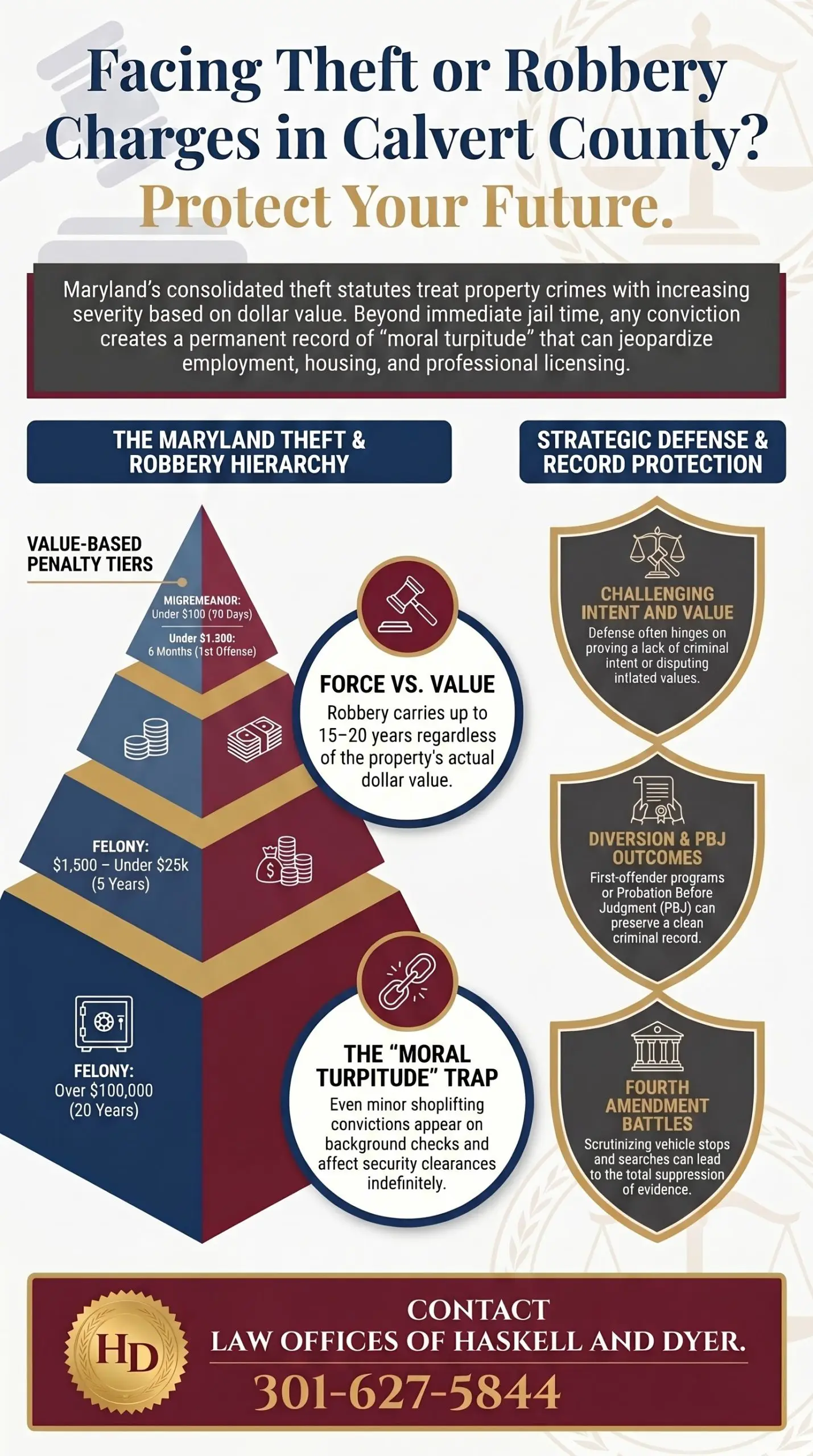
Table of Contents
- Maryland’s Theft and Robbery Framework and Calvert County Prosecution
- Shoplifting from a Retail Store
- Workplace Theft from Coworkers, Job Sites, and Offices
- Package Theft and Residential Property Cases
- Theft Inside the Home: Family Members and Roommates
- Debit and Credit Card Misuse
- Vehicle and Traffic Stop Theft Disputes
- Robbery, Armed Robbery, and Force-Based Charges
- Construction Site, Marina, and Equipment Theft
- Defense Strategy, Record Protection, and Working with Haskell and Dyer
- Summary
- References
1. Maryland’s Theft and Robbery Framework and Calvert County Prosecution
Maryland consolidated its theft statutes decades ago into a single provision, Criminal Law § 7-104, that covers what used to be separate crimes: larceny, embezzlement, fraudulent conversion, false pretenses, and receiving stolen property. The statute now treats all of these as a single offense called theft, graded by the value of the property taken or obtained.
The Theft Value Tiers
Under § 7-104, the penalty depends almost entirely on the value involved:
- Under $100 — misdemeanor, maximum 90 days
- $100 to under $1,500 — misdemeanor, maximum 6 months for first offense, increased for subsequent offenses
- $1,500 to under $25,000 — felony, maximum 5 years
- $25,000 to under $100,000 — felony, maximum 10 years
- $100,000 or more — felony, maximum 20 years
In addition to incarceration, theft convictions carry fines, restitution obligations, and long-term consequences beyond the sentence itself.
Robbery and Armed Robbery
Robbery under Maryland Criminal Law § 3-402 is the taking of property by force or threat of force. It carries up to 15 years, regardless of the property’s value. Armed robbery under § 3-403 adds the element of using or displaying a weapon and carries up to 20 years.
Robbery is not a value-based crime. A robbery for a $20 bill and a robbery for $20,000 in cash carry the same statutory maximum. The distinguishing element is the use of force or threat, not the amount taken.
Related Charges
A single theft or robbery incident can generate multiple related charges:
- Theft scheme under § 7-103 for multiple thefts combined into one pattern
- Unauthorized use of a motor vehicle under § 7-203
- Credit card crimes under §§ 8-204 through 8-209
- Burglary in the first through fourth degrees under §§ 6-202 through 6-205 when the theft involved breaking and entering
- Rogue and vagabond under § 6-206
- Malicious destruction of property under § 6-301
- Conspiracy and attempt charges for incomplete or joint offenses
How Calvert County Handles These Cases
Misdemeanor theft cases in Calvert County typically proceed in the District Court for Calvert County in Prince Frederick. Felony cases move to the Circuit Court for Calvert County in the same building. A typical theft prosecution moves through:
- Initial charging, often by citation for minor theft or by warrant/indictment for serious cases
- Initial appearance and bail hearing where liberty is at stake
- Discovery exchange where the state produces evidence
- Pretrial motions to suppress evidence or challenge charges
- Plea negotiations with the State’s Attorney’s Office
- Trial by judge or jury depending on the charge level and defendant’s election
- Sentencing with probation, incarceration, restitution, or diversion outcomes
A point often misunderstood: Even a misdemeanor shoplifting conviction counts as a crime involving moral turpitude. It appears on background checks, affects employment applications, can disqualify from professional licensing, and in some cases creates immigration consequences. The “minor” misdemeanor can do major long-term damage. That is why first-offender and diversion outcomes often matter more than a technical “not guilty” at trial.
For broader context on how Calvert County prosecutors approach criminal cases, see our article Don’t Plead Guilty in Calvert County Without Reading This First.
2. Shoplifting from a Retail Store
Shoplifting is the most common theft charge in Calvert County. Cases arise from Prince Frederick retail locations like the Calvert Village Shopping Center area, Dunkirk’s commercial strip along Route 4, Chesapeake Beach retail, and stores throughout the county. Most shoplifting allegations involve concealment of merchandise inside a store followed by an attempt to leave without paying.
The Legal Framework
Shoplifting is typically charged as theft under § 7-104 rather than a separate statute. The value of the merchandise determines the charge tier. A $50 cosmetics theft is a 90-day misdemeanor. A $200 clothing theft is a 6-month misdemeanor. A $1,500 electronics theft crosses into felony territory.
What the State Must Prove
The state must establish beyond a reasonable doubt:
- The defendant took or controlled the specific merchandise
- The defendant intended to deprive the owner of the property permanently
- The merchandise had the alleged value
- The defendant’s conduct matches one of the theft definitions
Common Evidence
- Surveillance video from in-store cameras
- Loss prevention officer observation testimony
- Recovered merchandise
- Inventory and receipt records establishing value
- Any admissions or statements the defendant made
- The defendant’s conduct on video (concealment, leaving the store, attempted return of merchandise)
Loss Prevention Tactics
Most large retailers use trained loss prevention officers. These personnel often:
- Observe suspected shoplifting from concealed positions or via camera
- Wait until the suspect passes the final point of sale before approaching
- Take the suspect to a back office for questioning
- Obtain written or verbal admissions
- Call police only after completing their internal process
Statements made to loss prevention officers are typically admissible because they are private actors, not government agents. Defense counsel evaluates exactly what was said and under what circumstances.
If you are stopped by a loss prevention officer: You are not required to answer questions, write statements, or sign anything. You may identify yourself and ask if you are free to leave. Anything you say in the back office will likely be used against you. Polite silence until you can consult with counsel is the strongest move.
Defense Approaches
- Intent challenges in cases involving forgotten items in carts, confused return attempts, or distraction-related incidents
- Value challenges to keep charges in the lowest tier when the state has inflated the claimed value
- Identification challenges when video is unclear or the accused is misidentified
- Fourth Amendment challenges to searches conducted by police after the initial stop
- First-offender diversion programs that result in dismissal after completion
- Probation Before Judgment (PBJ) disposition that avoids a formal conviction
- Civil demand letter analysis: retailers often send demand letters seeking civil damages; these are separate from the criminal case and should not be paid without legal advice
3. Workplace Theft from Coworkers, Job Sites, and Offices
Workplace theft allegations arise when someone is accused of taking money, equipment, or personal items from a coworker, an employer, a job site, an office, or a commercial vehicle. These cases often start as internal investigations before becoming criminal matters.
Common Scenarios
- Cash allegedly taken from a coworker’s purse or locker
- Tools or equipment missing from a job site trailer
- Office equipment or electronics taken from a workplace
- Inventory missing from a retail or warehouse employer
- Equipment missing from a company vehicle
- Expense account or petty cash allegations
- Materials taken home from job sites
The Intent Element
Workplace theft cases often turn on intent. Did the employee take the item to steal it, or did they take it home with permission (explicit or implicit), for temporary work use, or as a result of a misunderstanding about company practice? The difference between criminal intent and honest borrowing is often the central issue.
The Embezzlement Dimension
When an employee with authorized access to funds or property allegedly diverts them for personal use, the conduct may be charged under the consolidated theft statute even though it was historically called embezzlement. These cases often involve:
- Bookkeeping records
- Bank and financial records
- Email and digital communications
- Prior audits or discovery of the alleged shortage
- Forensic accounting analysis
The Employment Consequence
A workplace theft allegation almost always produces immediate employment consequences. Suspension, termination, and civil claims often move faster than the criminal case. Defense counsel should coordinate with employment counsel where appropriate and advise on what (if anything) the client should say during any internal investigation.
An early decision that matters: Do not give a written statement to HR or an internal investigator without counsel. Your employer’s investigators work for your employer, not for you. Statements made during the internal process routinely become evidence in the criminal case that follows.
Defense Approaches
- Intent challenges focused on the authorized-access distinction
- Forensic accounting review of alleged shortages
- Examination of company policies and whether they were clearly communicated
- Identification of other potential sources of the alleged loss
- Restitution negotiation where appropriate to resolve the matter
- Diversion and PBJ where available
- Coordination with employment defense counsel
4. Package Theft and Residential Property Cases
Package theft from porches has become a frequent charge in Calvert County as more residents receive daily deliveries and as doorbell and porch cameras capture what happens when packages go missing. Cases arise in neighborhoods throughout the county: subdivisions in Prince Frederick and Huntingtown, the twin beach communities, Solomons, Lusby, and Dunkirk.
The Legal Framework
Package theft is charged under the general theft statute § 7-104. The value of the contents determines the tier. Cases involving multiple addresses can be combined under a theft scheme charge under § 7-103, which allows the state to aggregate values across incidents for a higher-tier charge.
The Video Evidence Reality
Modern package theft cases typically involve video. Ring, Nest, Arlo, and similar doorbell cameras capture clear images. Neighbors’ cameras often capture arrivals and departures. Home security systems record movement in driveways and front yards. Defense counsel must address the video evidence directly:
- Is the identification of the defendant clear, or is it one of several similar-looking people?
- Does the video actually show the alleged taking?
- What is the timeline of the video relative to the delivery confirmation?
- Does metadata support or undermine the state’s theory?
The Vehicle Connection
Many package theft cases involve vehicle identification. Cameras catch license plates, vehicle colors, and identifying features. Defense analysis often focuses on:
- Whether the vehicle identification is accurate
- Who was actually driving at the time
- Whether the vehicle was borrowed, loaned, or stolen
- GPS or location data that places or excludes the defendant
Defense Approaches
- Video identification challenges with expert support where applicable
- Alibi evidence from GPS, cell phone data, or witness testimony
- Fourth Amendment challenges to vehicle stops or searches
- Challenge to theft scheme aggregation that improperly combines unrelated incidents
- Restitution-focused resolution where appropriate
- Diversion options for first-time offenders
5. Theft Inside the Home: Family Members and Roommates
Some of the most contentious theft cases in Calvert County arise inside households. A domestic argument, a breakup, a financial dispute, or a roommate conflict leads to allegations that one person took cash, jewelry, firearms, credit cards, electronics, or other valuables belonging to another person in the home.
The Legal Reality
Maryland’s theft statute does not exempt household members. A theft between spouses, between parents and adult children, between siblings, or between roommates is legally the same as a theft from a stranger. What typically matters is:
- Whether the defendant had authorization or a reasonable belief of authorization
- Whether the property was jointly owned or solely owned by the alleged victim
- Whether the alleged taking was a genuine dispute about ownership versus a clear taking of another’s property
- The surrounding circumstances including any conflict that produced the allegation
Common Household Theft Scenarios
- Jewelry missing after a breakup or divorce
- Cash missing from a shared living space
- Firearms taken during a household conflict (which produces additional firearms charges)
- Credit cards used without permission
- Electronics missing after a roommate moves out
- Family heirlooms contested during estate disputes
- Cash or tools from a family-owned business
The Authorization Defense
Many household theft cases involve credible claims of authorization. Long-term relationships often produce informal property sharing. Spouses often use each other’s cards, cash, and accounts. Roommates often borrow from each other. When the relationship ends badly, what was routine sharing can be retrospectively reframed as theft.
Defense counsel develops:
- History of prior similar conduct that was accepted
- Communications (text, email, social media) reflecting the property-sharing arrangement
- Witness testimony from others who observed the relationship
- Financial records showing joint account activity or mutual benefit
- Any written agreements or informal understandings
For anyone facing household theft allegations: Do not contact the complaining party directly to discuss the allegations, even to try to resolve the matter. Unauthorized contact can produce additional charges if a protective order exists or gets filed. Work through counsel. And preserve every communication you have with the complainant; the messages often contain the strongest evidence of the actual property-sharing arrangement.
Defense Approaches
- Authorization and reasonable belief challenges
- Communications evidence establishing shared property norms
- Witness development from family members or friends
- Challenge to ownership claims on disputed property
- Coordination with family court counsel where divorce or custody matters are involved
- Strategic negotiation focused on record protection
6. Debit and Credit Card Misuse
Credit and debit card cases are common in Calvert County. They involve everything from using a found card to buy gas, to continuing to use a family member’s card after authorization ended, to more serious identity theft and fraud schemes.
The Charge Structure
Credit card misuse is addressed through a combination of statutes:
- Credit card counterfeiting under § 8-205
- Theft of credit card under § 8-204
- Misuse of credit card under § 8-206
- Fraudulent receipt of money or property via credit card under § 8-207
- Identity fraud under § 8-301 in more serious cases
- General theft under § 7-104 for the value of goods or services obtained
A single incident involving an unauthorized card purchase can produce multiple charges for the same conduct.
Common Scenarios
- Using a found card to make purchases
- Continuing to use a family member’s card after a relationship ends
- Using an employer’s card for personal purchases
- Using a deceased relative’s card during estate disputes
- Taking a card from a roommate’s room to make purchases
- Using skimmed or counterfeit cards
- Online purchases with stolen card numbers
The Evidence Profile
Card cases typically involve extensive documentary evidence:
- Transaction records from banks and card issuers
- Surveillance video from merchants
- Point-of-sale system records
- Shipping records for online purchases
- Cell phone records placing the defendant at transaction locations
- Social media and digital communications
- Physical evidence of the cards themselves
Defense Approaches
- Authorization defenses when the defendant had a reasonable belief of permission
- Identification challenges when surveillance video or transaction attribution is disputed
- Intent challenges in cases involving genuine misunderstanding about authorized use
- Fourth Amendment challenges to device searches and bank record subpoenas
- Restitution-focused resolution to resolve the matter with minimum record impact
- Diversion and PBJ for first-offense cases
7. Vehicle and Traffic Stop Theft Disputes
Some theft cases arise from disputes about items inside vehicles. A tool borrowed and never returned. A phone left in a car that the driver kept. A wallet that went missing after a passenger got out. Or an argument during or after a traffic stop that escalates into theft allegations.
The Passenger Context
When multiple people are in a vehicle and items go missing, the state’s theft case has to address attribution. Was the defendant the person who took the item, or could another passenger have taken it? Was the item always in the vehicle, or did the defendant bring it? The state’s circumstantial case often has holes that defense counsel can develop.
The Traffic Stop Scenario
Theft allegations during or after a traffic stop typically involve:
- Property inside the vehicle that the driver claims the officer took or mishandled
- Property inside the vehicle that another occupant disputes ownership of
- Items exchanged between vehicles that one party later reports as theft
- Items taken from a tow yard or impound lot after a stop
The Unauthorized Use Charge
Maryland Criminal Law § 7-203 addresses unauthorized use of a motor vehicle. This is distinct from theft and applies when someone used a vehicle without permission but without intent to permanently deprive the owner. Unauthorized use is a misdemeanor with lesser exposure than motor vehicle theft.
The distinction between unauthorized use and motor vehicle theft often matters significantly:
- A son borrows his father’s car without permission and returns it: unauthorized use
- A person takes a car intending to keep or sell it: theft
- A valet takes a car on a joyride: unauthorized use
Defense Approaches
- Multiple-occupant attribution challenges
- Chain of custody challenges for items at tow yards or impound lots
- Intent challenges distinguishing unauthorized use from theft
- Authorization defenses when the defendant had reasonable belief of permission
- Cross-examination on the complainant’s account
- Physical evidence challenges
8. Robbery, Armed Robbery, and Force-Based Charges
Robbery is the most serious category of property crime in Maryland. Under Criminal Law § 3-402, robbery is the taking of property from another person by force or threat of force. Under § 3-403, armed robbery is robbery committed with a dangerous weapon. Both carry substantial exposure: 15 years for robbery, 20 years for armed robbery.
What Turns Theft Into Robbery
Robbery requires:
- A taking of property
- From the person or presence of another
- By force or threat of force
The force or threat must be used to accomplish the taking. A taking without force is theft. A theft that becomes confrontational after the fact (for example, the victim catches the thief and a struggle ensues) can still sometimes be charged as robbery depending on the specific sequence.
Common Scenarios
- Purse or wallet snatching in a parking lot where the victim resists
- Phone theft on a boardwalk or sidewalk with physical force
- A demand for money or property accompanied by threat
- An attempted theft where the defendant used force to escape with property
- Home invasion robbery
- Commercial robbery of stores, gas stations, or businesses
- Drug transaction robberies that turn violent
Armed Robbery Elements
Armed robbery requires the use or display of a dangerous weapon. This can include:
- Firearms (actual or displayed)
- Knives or edged weapons
- Other objects used as weapons
- Objects that appeared to be weapons even if they were not
Maryland case law has addressed “apparent” weapon scenarios where the defendant claimed to have a weapon they did not actually have. These cases can support armed robbery charges depending on how the threat was communicated.
The sentencing gap matters: A theft that the state charges as robbery carries 15 years instead of months. Armed robbery carries 20 years and often draws consecutive sentences for related firearms charges. Pushing a robbery case down to ordinary theft, when the facts support it, can transform the case from a prison sentence to a probation outcome.
Companion Charges
Robbery cases typically include companion charges:
- Assault in the first or second degree under §§ 3-202 and 3-203
- Use of a firearm in a crime of violence
- Wearing, carrying, or transporting a firearm
- Conspiracy to commit robbery
- Reckless endangerment
- False imprisonment when victims were restrained
For the broader Maryland assault framework, see our Calvert County Assault and Battery Defense complete guide.
Defense Approaches
- Challenging the force element and pushing for reduction to theft
- Challenging the weapon element in armed robbery cases
- Identification challenges through eyewitness reliability analysis
- Surveillance and digital evidence analysis
- Alibi development where applicable
- Accomplice liability challenges in multi-defendant cases
- Expert witness testimony on eyewitness identification reliability
9. Construction Site, Marina, and Equipment Theft
Calvert County’s construction activity and waterfront economy produce their own category of theft cases. Construction sites, marinas, boat yards, and commercial storage facilities are frequent theft targets. When someone is charged with these offenses, the allegations often involve high-value items and multiple counts.
Common Targets
- Construction sites — copper wire, tools, materials, trailers, small equipment
- Marinas and boat yards — marine electronics, outboard motors, fishing gear, boat equipment
- Commercial storage facilities — stored business inventory, equipment, supplies
- Agricultural operations — tools, equipment, fuel, materials
- Company vehicles — tools, equipment, and cargo left in work vehicles
The Value Aggregation Problem
These cases often involve multiple items taken from one location or multiple incidents across different locations. The state frequently uses the theft scheme provision under § 7-103 to aggregate values into higher penalty tiers. A series of small thefts that would each be misdemeanors can combine into a single felony theft scheme charge.
The Burglary Overlap
When the theft involves entering a locked structure, vehicle, or fenced area, burglary charges often apply alongside theft:
- Burglary in the third degree under § 6-204 for breaking and entering with intent to commit theft
- Burglary in the fourth degree under § 6-205 for breaking and entering without more
- Motor vehicle theft under § 7-105 for vehicles themselves
- Rogue and vagabond under § 6-206 for possession of tools for criminal purposes
The Evidence Profile
Site and marina theft cases typically involve:
- Surveillance video from site or marina cameras
- GPS and telematics data from vehicles
- Scrap yard records for copper, catalytic converters, and other metal theft cases
- Pawn shop and secondhand dealer records
- Online marketplace listings that may match stolen items
- Physical evidence from the scene
- Cell phone location data
The Scrap Yard and Pawn Shop Trail
Maryland requires scrap dealers, pawn shops, and certain secondhand dealers to maintain transaction records. When stolen items appear in these records, the state has a paper trail directly to the defendant. Defense analysis often examines:
- Whether the items in the records are actually the stolen items
- Whether the defendant knew the items were stolen
- Whether the transaction records were properly maintained
- Whether the identification procedures were reliable
Defense Approaches
- Theft scheme aggregation challenges
- Video identification analysis
- Challenge to knowledge of stolen status in receiving cases
- Fourth Amendment challenges to searches
- Chain of custody challenges for physical evidence
- Alibi and location evidence
- Accomplice liability challenges in multi-defendant cases
- Restitution-focused resolution where appropriate
10. Defense Strategy, Record Protection, and Working with Haskell and Dyer
Theft and robbery defense in Maryland requires attention to both the immediate charge and the long-term consequences. A good defense is not just about winning the case; it is about preserving the client’s record, protecting their employment and housing, and avoiding the collateral damage that a theft conviction can cause for decades.
The Intent Focus
Maryland’s theft statute requires proof of intent to deprive the owner of property. Many defenses start with intent:
- Forgetting merchandise in a cart or on the bottom of a cart
- Misunderstandings about return procedures
- Reasonable belief of authorization
- Distraction-related incidents
- Borrowing with intention to return
- Property disputes that genuinely were not theft
The state must prove beyond a reasonable doubt that the defendant acted with criminal intent. This element is often the most vulnerable part of the state’s case.
Value Challenges
Because Maryland’s theft statute is value-tiered, challenging the claimed value can change the charge level significantly:
- Retail price versus actual value of merchandise
- Depreciated value of used items
- Value disputes in unique or custom items
- Theft scheme aggregation challenges
A theft that the state charges as a $1,600 felony may actually support a $1,400 misdemeanor, moving the case from felony prison exposure to misdemeanor probation.
First-Offender and Diversion Outcomes
Maryland offers several pathways for first-offense theft cases:
- Diversion programs that dismiss the charges upon completion of conditions
- Probation Before Judgment (PBJ) that avoids a formal conviction
- Nolle prosequi resolutions where the state drops the charges
- Stet dispositions that place the case on inactive status
Each of these outcomes protects the client’s record differently. Defense counsel should evaluate which outcome best serves the client’s long-term interests, not just the immediate case.
The Fourth Amendment Battleground
Many theft cases involve searches of vehicles, homes, phones, or stored property. Fourth Amendment challenges can produce:
- Suppression of physical evidence found in improper searches
- Suppression of statements obtained after constitutional violations
- Suppression of derivative evidence found because of the initial violation
- Complete case dismissal in some circumstances
Defense counsel scrutinizes every search, every stop, and every warrant application.
Restitution and Civil Coordination
Theft cases often involve restitution demands from victims and parallel civil claims. Coordinating the criminal defense with civil exposure, particularly in workplace and household cases, protects the client across both tracks. Restitution payments made appropriately and at the right time can sometimes substantially resolve the matter.
Expungement Considerations
Maryland law allows expungement of certain theft-related records after specific waiting periods. Some outcomes (like PBJ or dismissal) are eligible for earlier expungement. Some misdemeanor convictions become eligible after years. Defense counsel should advise on the long-term record cleanup options throughout the case, not just at the end.
What Sets Our Practice Apart
The Law Offices of Haskell and Dyer has defended theft and robbery cases throughout Southern Maryland for years. Our approach:
- Every case gets a full defense. Even first-time shoplifting cases can produce lifetime record consequences if handled poorly.
- We focus on record protection. The goal is not just to win the immediate case but to protect the client’s long-term life.
- We know the local courts. Prince Frederick has its own rhythms, its own prosecutors, and its own judges. Local familiarity matters.
- We engage early. Pre-charge intervention, where possible, sometimes prevents charges from being filed at all.
- We challenge the evidence. Video identification, intent, value, and procedural issues all get examined in every case.
- We coordinate with other counsel. Employment, family court, immigration, and licensing implications often need parallel attention.
Theft or Robbery Charge in Calvert County?
The stakes go beyond the immediate case. Your record, your job, and your future all matter. The first consultation is free, and the 24/7 hotline is always open.
📞 Call 301-627-5844
Send a Secure Message
24/7 Criminal Defense Hotline: 240-687-0179
Learn more about our Criminal Defense practice.
Summary
Maryland’s theft statute at Criminal Law § 7-104 consolidates what used to be separate property crimes into a single offense graded by the value of what was taken, with misdemeanor exposure below $1,500 and felony exposure rising from 5 years to 20 years as the value increases. Robbery under § 3-402 and armed robbery under § 3-403 apply whenever force or threat is used, carrying 15 and 20 years regardless of value. The ten most common situations that produce Calvert County theft and robbery cases include shoplifting from retail stores in Prince Frederick, Dunkirk, and Chesapeake Beach; workplace theft from coworkers and job sites; package theft from residential porches; household theft between family members and roommates; debit and credit card misuse; vehicle and traffic stop theft disputes; robbery and armed robbery involving force or weapons; and construction site, marina, and equipment theft. Every charge, even misdemeanor shoplifting, produces a crime of moral turpitude on the record that affects employment, licensing, housing, and immigration. Defense strategy focuses on intent challenges, value disputes, identification analysis, Fourth Amendment issues, and first-offender outcomes like diversion and PBJ that protect the record. Restitution, civil coordination, and expungement planning all matter alongside the immediate defense. These cases reward experienced counsel who understand both the courtroom and the long-term consequences.
Ready for a free consultation? Call Haskell and Dyer at 301-627-5844, use the 24/7 hotline at 240-687-0179, or contact us here.
References
Maryland General Assembly. (2024). Criminal Law Article § 7-104: Theft. Maryland Code. https://mgaleg.maryland.gov/
Maryland General Assembly. (2024). Criminal Law Article § 7-103: Theft scheme. Maryland Code. https://mgaleg.maryland.gov/
Maryland General Assembly. (2024). Criminal Law Article § 7-105: Motor vehicle theft. Maryland Code. https://mgaleg.maryland.gov/
Maryland General Assembly. (2024). Criminal Law Article § 7-203: Unauthorized use of motor vehicle. Maryland Code. https://mgaleg.maryland.gov/
Maryland General Assembly. (2024). Criminal Law Article § 3-402: Robbery. Maryland Code. https://mgaleg.maryland.gov/
Maryland General Assembly. (2024). Criminal Law Article § 3-403: Robbery with dangerous weapon. Maryland Code. https://mgaleg.maryland.gov/
Maryland General Assembly. (2024). Criminal Law Article §§ 6-202 through 6-206: Burglary and related offenses. Maryland Code. https://mgaleg.maryland.gov/
Maryland General Assembly. (2024). Criminal Law Article §§ 8-204 through 8-209: Credit card crimes. Maryland Code. https://mgaleg.maryland.gov/
Maryland General Assembly. (2024). Criminal Law Article § 8-301: Identity fraud. Maryland Code. https://mgaleg.maryland.gov/
Maryland General Assembly. (2024). Criminal Procedure Article § 6-220: Probation before judgment. Maryland Code. https://mgaleg.maryland.gov/
Maryland General Assembly. (2024). Criminal Procedure Article, Title 10, Subtitle 1: Expungement of records. Maryland Code. https://mgaleg.maryland.gov/
Maryland Judiciary. (2024). District Court for Calvert County. Maryland Courts. https://www.courts.state.md.us/district
Maryland Judiciary. (2024). Circuit Court for Calvert County. Maryland Courts. https://www.courts.state.md.us/circuit
Maryland Office of the Public Defender. (2024). Theft and property crime defense resources. Office of the Public Defender. https://www.opd.state.md.us/
Maryland State Bar Association. (2023). Consumer’s guide to criminal law in Maryland. Maryland State Bar Association. https://www.msba.org/
National Association of Criminal Defense Lawyers. (2024). Property crime defense practice resources. NACDL. https://www.nacdl.org/
United States Department of Justice. (2024). Property crime statistics and Maryland state data. Bureau of Justice Statistics. https://bjs.ojp.gov/
The information provided in this article is for general informational purposes only and does not constitute legal advice. Contacting The Law Offices of Haskell and Dyer does not create an attorney client relationship until a formal agreement is signed. For legal advice specific to your situation, please contact our office directly.