

Bottom Line Up Front
White collar investigations almost always begin quietly. A CPA reviews the books and finds discrepancies. A compliance officer notices an anomaly. A bank files a suspicious activity report. A tip comes in to a regulator. Federal agents make a “friendly” phone call asking to “clear up a few questions.” By the time a Calvert County resident realizes they are the target of a white collar investigation, the government has often been working the case for months. Documents have been gathered. Witnesses have been interviewed. Forensic accountants have been retained. The first decision that matters, the decision that shapes everything that follows, is whether to engage experienced defense counsel immediately or to try to “just explain things” to investigators. That decision, made in the first hours after contact, often determines whether the case ends quietly at the investigation stage or proceeds to federal indictment with decades of exposure. Maryland white collar cases span state charges under the theft statute and related provisions and federal charges under mail fraud, wire fraud, tax offenses, identity fraud, money laundering, and many other statutes. Federal exposure almost always exceeds state exposure, often by decades. Parallel civil exposure, professional licensing consequences, immigration implications for non-citizens, and the reputational damage of a public charge all run alongside the criminal case. Defense strategy must address every dimension simultaneously. This guide walks through the top issues and challenges in Calvert County white collar defense, the major charge categories, the strategies that actually work at each stage, and how to protect a career, a record, and a future when a white collar investigation arrives.
Call The Law Offices of Haskell and Dyer for a confidential consultation at 📞 301-627-5844 or the 24/7 criminal defense hotline at 240-687-0179.
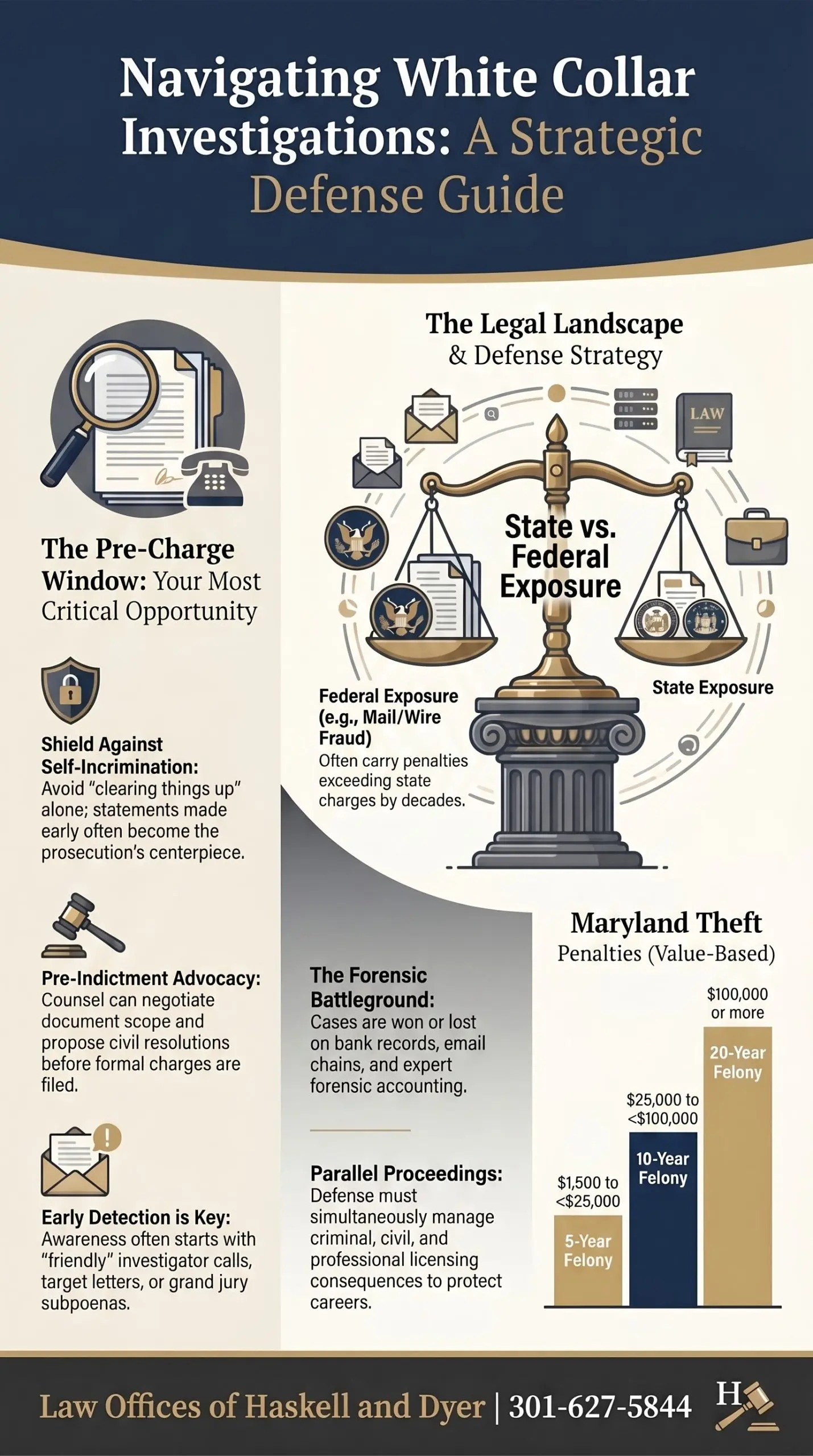
Table of Contents
- Maryland and Federal White Collar Framework
- The Pre-Charge Window and Target Letters
- Embezzlement, Fraudulent Conversion, and Workplace Theft
- Identity Theft, Credit Card Fraud, and Financial Scams
- Tax Offenses, Evasion, and Failure to File
- Healthcare Fraud and Medical Professional Cases
- Mail Fraud, Wire Fraud, and Federal Prosecution
- Money Laundering, Structuring, and Banking Charges
- Public Corruption, Bribery, and Government Contractor Cases
- Defense Strategy, Parallel Proceedings, and Working with Haskell and Dyer
- Summary
- References
1. Maryland and Federal White Collar Framework
“White collar crime” is a category, not a single statute. It describes offenses typically involving deception, financial gain, and professional or business settings, rather than violence or traditional street-level conduct. Calvert County white collar cases draw from a wide range of Maryland and federal statutes.
The Main Maryland Statutes
- Criminal Law § 7-104 — consolidated theft statute covering embezzlement, fraudulent conversion, and false pretenses
- Criminal Law § 7-103 — theft scheme, aggregating multiple acts into one pattern
- Criminal Law § 8-301 — identity fraud
- Criminal Law §§ 8-204 through 8-209 — credit card crimes
- Criminal Law Title 8, Subtitle 6 — insurance fraud
- Criminal Law §§ 8-601 through 8-607 — counterfeiting and document fraud
- Criminal Law § 9-203 — perjury
- Criminal Law § 9-305 — obstruction of justice
- Tax-General Article — state tax offenses including evasion and failure to file
- Business Regulation Article — various regulatory and professional offenses
The Main Federal Statutes
- 18 U.S.C. § 1341 — mail fraud (the white collar Swiss Army knife)
- 18 U.S.C. § 1343 — wire fraud
- 18 U.S.C. § 1344 — bank fraud
- 18 U.S.C. § 1349 — conspiracy to commit fraud offenses
- 18 U.S.C. § 1028 and § 1028A — identity theft (with mandatory 2-year consecutive sentence for aggravated identity theft)
- 18 U.S.C. §§ 1956 and 1957 — money laundering
- 31 U.S.C. §§ 5324 and related — structuring cash transactions
- 26 U.S.C. §§ 7201, 7202, 7203, 7206 — federal tax offenses
- 42 U.S.C. § 1320a-7b — healthcare fraud (federal Anti-Kickback Statute)
- 18 U.S.C. § 1347 — federal healthcare fraud
- 18 U.S.C. § 666 — theft or bribery involving federal programs
- 15 U.S.C. §§ 78j(b) and 78ff — securities fraud
- 18 U.S.C. §§ 201 and 666 — federal bribery
How Calvert County Handles These Cases
State white collar cases in Calvert County proceed through the District Court (misdemeanors) or Circuit Court (felonies) in Prince Frederick. Federal cases move to the U.S. District Court for the District of Maryland, with Southern Maryland cases typically handled in the Greenbelt division.
Investigations are typically led by agencies depending on the conduct:
- Calvert County Sheriff’s Office Financial Crimes Unit for local cases
- Maryland State Police for certain cases
- FBI for federal fraud, public corruption, and complex cases
- IRS Criminal Investigation Division for tax cases
- Secret Service for certain financial and counterfeit cases
- Department of Health and Human Services OIG for healthcare cases
- Social Security Administration OIG for benefits fraud
- Postal inspectors for mail fraud
- State and federal regulatory agencies (SEC, FINRA, state insurance commissioner, state bar, medical board)
The Investigation Signature
White collar investigations often share signatures that distinguish them from other criminal investigations:
- Months or years of pre-charge investigation
- Grand jury subpoenas for documents and testimony
- Search warrants executed at business locations
- Parallel civil proceedings running alongside criminal investigation
- Cooperating witnesses from within the organization
- Forensic accounting analysis as core evidence
- Substantial document production requirements
- Extended pretrial periods before resolution
The defining feature of white collar defense: Document-intensive investigation, document-intensive discovery, document-intensive trial. Cases rise and fall on bank records, accounting entries, email chains, billing records, contracts, and other paper and digital evidence. Defense counsel experienced in managing large document productions and working with forensic accounting experts has a substantial advantage.
For broader context on how prosecutors approach serious cases, see our article Don’t Plead Guilty in Calvert County Without Reading This First.
2. The Pre-Charge Window and Target Letters
White collar defense is different from most criminal defense because so much of the case develops before charges are filed. The pre-charge window, the period between when a target learns about the investigation and when charges are filed (if ever), is where experienced defense counsel can have the greatest impact.
How Targets Learn About Investigations
People learn they are under white collar investigation through:
- Grand jury subpoenas delivered to them, their business, or their bank
- Target letters from federal prosecutors formally advising them of target status
- Subject letters indicating they are a person of interest but not the target
- Interview requests from federal agents or state investigators
- Search warrants executed at their home or business
- Freezes or seizures of accounts or assets
- Civil investigative demands in parallel civil matters
- Notice from their employer about an internal investigation
- Subpoenas to witnesses that the target learns about
- Media reports about an ongoing investigation
What Experienced Counsel Does Pre-Charge
Protect Against Self-Incrimination
The most important immediate step is shielding the target from statements. Federal agents are skilled interviewers. Even innocent targets often make statements during early interviews that become the centerpiece of subsequent prosecution. Counsel communicates with agents and prosecutors on the client’s behalf, preventing direct client statements unless and until protected by formal agreements.
Respond to Subpoenas Strategically
Grand jury subpoenas require responses but the scope, timing, and manner of response matter significantly. Counsel can:
- Negotiate the scope of document production
- Assert applicable privileges (attorney-client, work product, Fifth Amendment)
- Negotiate extensions
- Identify records that may support the defense
- Coordinate production to protect the client
Engage With the Prosecutor
Pre-charge advocacy with the prosecutor can sometimes prevent charges, reduce charges, or shape how charges are eventually brought. This advocacy can include:
- Presenting defense theories and evidence
- Identifying weaknesses in the government’s case
- Proposing declinations
- Proposing deferred prosecution agreements
- Proposing civil resolution instead of criminal prosecution
- Negotiating pre-indictment pleas for reduced charges
Engage Forensic and Expert Resources
White collar defense typically requires:
- Forensic accountants to review financial records
- Industry experts who understand the specific practice area
- Technology experts for digital evidence
- Valuation experts for disputed transaction values
Retaining experts early gives the defense the same depth as the government’s investigation team.
The most important first decision: Do not respond to agents, prosecutors, or investigators without counsel. Do not “clear things up” in a quick phone call. Do not attend a “friendly interview.” The government is not calling to help you; they are calling because they have decided you may have criminal exposure. Engage counsel and communicate through counsel.
3. Embezzlement, Fraudulent Conversion, and Workplace Theft
The most common white collar charge in Calvert County is embezzlement-type conduct, now charged under Maryland’s consolidated theft statute § 7-104. Cases typically involve employees, officers, or trusted agents who allegedly diverted employer funds or property for personal use.
The Statutory Framework
Maryland consolidated embezzlement, fraudulent conversion, false pretenses, and larceny into a single theft offense. The penalty depends on the value involved:
- Under $100 — 90-day misdemeanor
- $100 to under $1,500 — 6-month misdemeanor (first offense)
- $1,500 to under $25,000 — 5-year felony
- $25,000 to under $100,000 — 10-year felony
- $100,000 or more — 20-year felony
Theft scheme under § 7-103 aggregates multiple acts. For the broader theft framework, see our cornerstone: Calvert County Theft and Robbery Defense: The Complete Guide.
Common Scenarios
- Bookkeepers or accountants diverting funds from employer accounts
- Cashiers or retail employees misappropriating cash or inventory
- Corporate officers using company funds for personal expenses
- Contractors billing for work not performed
- Financial advisors misappropriating client funds
- Property managers retaining rents for personal use
- Caregivers or fiduciaries of elderly or disabled persons misappropriating their assets
- Nonprofit officers diverting organizational funds
- Family business disputes that produce embezzlement allegations
The Intent and Authorization Question
Many embezzlement-type cases turn on whether the defendant had authorization (explicit or implicit) to use the funds or property, or whether the conduct crossed into unauthorized diversion:
- Were the transactions consistent with authorized practice?
- Did the defendant have signing authority or access rights that covered the conduct?
- Were supervisors or owners aware of similar transactions that were accepted?
- Were the records kept in ways that suggested concealment or normal business practice?
- Were taxes reported appropriately on questioned payments?
The Forensic Accounting Battleground
Embezzlement cases almost always involve forensic accounting evidence. The government’s forensic accountants identify alleged shortages and build the prosecution theory. Defense counsel retains independent forensic accountants who often reach different conclusions by:
- Identifying accounting errors that the government miscategorized as missing funds
- Finding authorized transactions that explain apparent shortages
- Documenting that the defendant was not the only person with access
- Analyzing the specific methodology used to identify alleged losses
- Presenting alternative explanations consistent with the defense theory
The Parallel Civil Case
Employers almost always pursue parallel civil claims. Coordinating civil and criminal defense matters. Restitution payments made appropriately can sometimes support case resolution, but uncoordinated civil settlements can damage the criminal defense.
Defense Strategies
- Intent and authorization analysis
- Forensic accounting review
- Access and control analysis (who else could have taken the funds?)
- Company policy and practice investigation
- Restitution negotiation where appropriate
- Diversion and PBJ pursuit for first-offense cases
- Coordination with employment and civil defense counsel
- Strategic resolution focused on record and career protection
4. Identity Theft, Credit Card Fraud, and Financial Scams
Identity theft and related financial crimes are among the fastest-growing categories of white collar prosecution in Maryland. Charges can include state identity fraud under Criminal Law § 8-301, federal aggravated identity theft under 18 U.S.C. § 1028A (with its mandatory 2-year consecutive sentence), credit card crimes under state and federal statutes, and various fraud offenses.
Common Scenarios
- Using another person’s personal information to open credit accounts
- Filing false tax returns using stolen Social Security numbers
- Fraudulent unemployment claims using stolen identities
- Online financial scams and advance-fee frauds
- Romance scams that produce fraud charges
- Phishing and data theft schemes
- Skimming operations at gas pumps, ATMs, or retail
- Synthetic identity fraud using combined real and fabricated information
- Medical identity theft in healthcare settings
- Business email compromise schemes
The Federal Aggravated Identity Theft Problem
Federal 18 U.S.C. § 1028A is one of the most consequential federal statutes in modern white collar practice. When certain predicate offenses involve the use of another person’s identification, § 1028A adds a mandatory 2-year consecutive sentence that cannot be suspended or run concurrent with anything else.
Predicate offenses include:
- Bank fraud
- Mail and wire fraud
- Certain other fraud offenses
- Identity fraud
- Specific immigration offenses
The recent Supreme Court decision in Dubin v. United States narrowed § 1028A’s application, requiring that the use of the identity be “at the crux” of the underlying fraud rather than merely incidental. Defense counsel now has additional arguments in many § 1028A cases.
Why § 1028A matters so much: A predicate fraud offense might carry probation-eligible sentencing guidelines exposure. Adding § 1028A produces a mandatory 2 years. Federal prosecutors often use § 1028A as negotiation leverage, offering to drop it in exchange for specific pleas. Defense counsel experienced in § 1028A can sometimes eliminate the charge through pretrial litigation.
The Intent Question
Identity theft cases require specific intent. Defense counsel addresses:
- Whether the defendant actually used the specific identifying information
- Whether the defendant knew the information belonged to another actual person
- Whether the defendant had authorization from the person whose information was used
- Whether the defendant was involved in the scheme or was a bystander
Defense Strategies
- Intent and knowledge challenges
- Fourth Amendment challenges to device searches and document seizures
- § 1028A predicate analysis and Dubin arguments
- Forensic analysis of digital evidence
- Restitution negotiation
- Federal prosecution risk management
- Cooperation analysis where beneficial
- Strategic resolution with attention to immigration and licensing consequences
5. Tax Offenses, Evasion, and Failure to File
Tax cases are distinct from other white collar matters. They involve specialized statutes, specialized investigative agencies (primarily IRS Criminal Investigation), and specialized defense requirements. Both Maryland and federal tax systems produce criminal exposure for willful noncompliance.
The Federal Tax Framework
- 26 U.S.C. § 7201 — Tax evasion (5-year felony)
- 26 U.S.C. § 7202 — Willful failure to collect or pay over tax (5-year felony, typically employment taxes)
- 26 U.S.C. § 7203 — Willful failure to file or pay (1-year misdemeanor per year)
- 26 U.S.C. § 7206 — False return or false document (3-year felony)
- 26 U.S.C. § 7212 — Obstructing administration of internal revenue laws
The Maryland Tax Framework
Maryland tax offenses appear in the Tax-General Article and address state income tax, sales tax, and other state taxes. Cases include willful failure to file, filing false returns, and failure to remit collected taxes.
Common Scenarios
- Business owners who stopped filing returns when cash flow got tight
- Employees who failed to file personal returns over multiple years
- Self-employed professionals whose business and personal finances were blurred
- Contractors paid in cash who did not report income accurately
- Business operators who collected payroll taxes but did not remit them
- Estates with unreported income or improper estate tax filings
- Foreign account non-disclosure (FBAR and related)
- Trust and shell structures that failed to file
- Cryptocurrency gains that were not reported
The “Willfulness” Requirement
Federal tax crimes require willfulness, which has been interpreted by courts to require a specific intent to violate a known legal duty. This is a much higher standard than ordinary criminal intent and provides significant defense opportunities:
- Defendants who genuinely did not know they were required to file
- Defendants who relied on professional advice
- Defendants with cognitive or health issues affecting awareness
- Defendants whose failures were the result of neglect rather than deliberate evasion
The willfulness element is often the central battleground in tax defense.
The Voluntary Disclosure Option
The IRS Criminal Investigation has a Voluntary Disclosure Practice that can, in appropriate cases, allow taxpayers with unreported income or unfiled returns to come forward before criminal investigation begins. Successful voluntary disclosure can resolve the matter civilly rather than criminally. Strict requirements apply:
- The disclosure must be truthful and complete
- It must be timely (before investigation begins)
- The taxpayer must cooperate fully
- Taxes, interest, and penalties must be paid
Voluntary disclosure is not available after an investigation has begun, and attempting disclosure after investigation typically makes things worse.
If you are behind on taxes and worried about criminal exposure: Consult with tax defense counsel before any other action. Do not file amended returns without guidance. Do not contact the IRS directly. Do not discuss the situation with your accountant without attorney-client privilege coverage (accountant-client privilege does not extend to criminal tax matters in federal cases). Early strategic action can often resolve the matter civilly rather than criminally.
Defense Strategies
- Willfulness challenges
- Reliance on professional advice defenses
- Voluntary disclosure pursuit where still available
- Forensic accounting to identify legitimate deductions and adjustments
- Statute of limitations analysis
- Negotiation for civil rather than criminal resolution
- Restitution and payment plan negotiation
- Strategic consideration of plea implications for professional licensing
6. Healthcare Fraud and Medical Professional Cases
Healthcare is one of the most heavily regulated industries, and healthcare fraud is one of the most aggressively prosecuted categories of white collar crime. Medical professionals, healthcare administrators, billing staff, and patients can all face healthcare fraud exposure.
The Statutory Framework
- Federal Anti-Kickback Statute (42 U.S.C. § 1320a-7b) — prohibits remuneration for referrals involving federal healthcare programs
- Stark Law (42 U.S.C. § 1395nn) — physician self-referral restrictions
- Federal Healthcare Fraud (18 U.S.C. § 1347) — general healthcare fraud statute
- False Claims Act (31 U.S.C. § 3729) — primarily civil but with criminal components
- Mail and Wire Fraud applied to healthcare billing
- Maryland state healthcare fraud provisions in the Health-General Article
- Controlled substances offenses when prescription practices are challenged
Common Scenarios
- Billing for services not provided
- Upcoding (billing for more expensive services than provided)
- Unbundling (billing separately for services that should be combined)
- Kickbacks for patient referrals
- Physician investment in entities receiving referrals
- Prescription fraud (prescribing without medical necessity or for diversion)
- Medical identity theft
- Insurance fraud schemes
- Durable medical equipment schemes
- Home health fraud
- Medicaid and Medicare fraud
- Qui tam whistleblower cases that become criminal matters
The Professional Licensing Dimension
Healthcare fraud cases affect professional licenses through:
- Maryland Board of Physicians action
- Maryland Board of Pharmacy action for pharmacists
- Maryland Board of Nursing action for nurses
- DEA registration revocation for controlled substance prescribers
- Medicare and Medicaid program exclusion
- Private insurer network exclusions
- Hospital privilege consequences
These collateral consequences often matter more than the criminal outcome itself. A physician convicted of healthcare fraud typically cannot practice again, regardless of the sentence imposed. Defense strategy must coordinate criminal defense with licensing defense throughout.
Defense Strategies
- Intent and knowledge analysis (did the defendant actually know the practice was improper?)
- Industry custom and practice evidence
- Compliance program analysis showing good-faith efforts
- Expert witnesses on specific healthcare practice areas
- Billing code interpretation challenges
- Medical necessity analysis
- Coordination with licensing defense counsel
- Strategic resolution protecting professional livelihood
7. Mail Fraud, Wire Fraud, and Federal Prosecution
Federal mail fraud (18 U.S.C. § 1341) and wire fraud (18 U.S.C. § 1343) are the most frequently charged white collar offenses in federal court. Their broad statutory reach makes them applicable to a vast range of fraudulent conduct, and federal prosecutors often use them as catchall charges in complex cases.
The Statutory Elements
Both statutes require:
- A scheme or artifice to defraud
- Intent to defraud (specific intent)
- Use of the mails (for mail fraud) or interstate wires (for wire fraud) in furtherance of the scheme
The “wire” element is satisfied by almost any electronic communication: email, phone calls, text messages, website use, wire transfers, credit card processing. In modern commerce, essentially every fraud scheme involves wire activity, making § 1343 broadly applicable.
Penalty Exposure
- Up to 20 years for most mail and wire fraud offenses
- Up to 30 years when affecting a financial institution
- Substantial fines and restitution
- Federal sentencing guidelines that often produce multi-year sentences based on loss amount
The Loss Amount Battleground
Federal sentencing in fraud cases is driven largely by “loss amount” under U.S. Sentencing Guideline § 2B1.1. Loss amount drives the offense level, which drives the guideline range. Defense counsel contests loss amount because:
- A $50,000 loss produces one guideline range
- A $500,000 loss produces a substantially higher range
- A $3.5 million loss produces substantially higher still
- Loss calculations can often be challenged through specific offset arguments, credit-against-loss analysis, and methodology challenges
The Conspiracy Overlay
Fraud cases typically include conspiracy charges under 18 U.S.C. § 1349. Conspiracy charges:
- Allow broader evidence admission
- Extend the statute of limitations
- Allow joint and several liability for co-conspirator conduct
- Can reach participants who did not directly commit the underlying fraud
Why federal fraud defense is distinct: Federal fraud cases have their own rhythm. Long investigations. Grand jury practice. Extensive discovery. Detention hearings for some defendants. Sentencing that is driven by guidelines rather than statutory maximums. Defense counsel experienced in federal practice approach these cases differently from state court work, and the difference shows in outcomes.
Defense Strategies
- Intent and knowledge challenges
- Loss amount contests at every stage
- Scheme characterization challenges
- Mailing or wire element challenges
- Cooperation evaluation where beneficial
- Forensic review of financial and digital evidence
- Industry expert support
- Strategic plea negotiation based on guideline calculations
- Sentencing mitigation including 3553(a) factors
8. Money Laundering, Structuring, and Banking Charges
Money laundering and structuring are often added charges in fraud cases, but they can also stand alone. These offenses carry substantial penalties and often trigger federal prosecution even in cases that might otherwise stay in state court.
The Statutory Framework
Money Laundering
- 18 U.S.C. § 1956 — concealment money laundering and transactional money laundering involving proceeds of specified unlawful activity (up to 20 years)
- 18 U.S.C. § 1957 — monetary transactions of more than $10,000 with criminally derived property (up to 10 years)
Structuring
- 31 U.S.C. § 5324 — structuring cash transactions to evade reporting requirements (up to 5 years, 10 years for aggravated structuring)
Common Scenarios
- Depositing cash in amounts just under $10,000 to avoid currency transaction reports
- Using multiple accounts or multiple banks to conceal transaction size
- Complex transactions designed to disguise fund origins
- Real estate purchases with criminally derived proceeds
- Shell company transactions
- International wire transfers disguising source
- Cryptocurrency transactions designed to launder proceeds
- Business transactions inflated or invented to move money
The “Knowledge” Question
Money laundering charges require that the defendant knew the funds represented proceeds of unlawful activity. Defense counsel addresses:
- Whether the defendant actually knew about the underlying criminal activity
- Whether the defendant’s role involved processing that would have disclosed the source
- Whether “willful blindness” arguments apply
- Whether specific transactions actually had the characteristics alleged
The Innocent Structuring Problem
Some structuring cases involve defendants who genuinely did not know their cash deposit patterns violated federal law. Small business owners depositing daily cash receipts, people depositing cash for legitimate reasons (privacy concerns, dislike of large deposits), or people who structured because they thought it was practical rather than for evasion purposes all can face charges. Defense counsel examines the specific knowledge element and intent.
Defense Strategies
- Knowledge and intent challenges
- Forensic tracing of funds
- Underlying crime challenges
- Structuring intent analysis
- Fourth Amendment challenges to bank record subpoenas in some cases
- Civil forfeiture parallel proceeding management
- Cooperation evaluation where beneficial
- Strategic resolution accounting for forfeiture exposure
9. Public Corruption, Bribery, and Government Contractor Cases
Cases involving public officials, government contractors, and the intersection between business and government produce their own distinct category of white collar exposure. Calvert County sees these cases in connection with local government, state contracts, federal contractors working in the region (particularly related to Patuxent River Naval Air Station), and certain professional settings.
The Statutory Framework
- Federal bribery (18 U.S.C. § 201) — bribery of public officials
- Federal program bribery (18 U.S.C. § 666) — theft or bribery affecting federal program recipients
- Honest services fraud (18 U.S.C. § 1346) — corruption prosecutions through mail and wire fraud
- Federal kickback statutes in specific contracting contexts
- Maryland misconduct in office common law offense
- Maryland bribery under Criminal Law § 9-201 and related
- Defense procurement statutes for cases involving DoD contracts
- Ethics regulations from applicable state and federal agencies
Common Scenarios
- Local officials accepting gifts or payments from vendors
- Procurement officers directing contracts based on personal benefit
- Campaign finance violations that become criminal
- Government contractors providing improper benefits to officials
- Defense contractors inflating costs or billing improperly
- Grant recipients misusing federal or state grant funds
- Conflicts of interest that escalate to criminal conduct
- Whistleblower cases that develop into prosecution
The Patuxent River Area
Calvert County sits across the Patuxent from Patuxent River Naval Air Station. The region has substantial defense contracting activity. Cases involving:
- Defense contractor fraud
- Procurement violations
- Bribery of defense officials
- Security clearance issues
- Technology transfer violations
can produce substantial exposure with specialized federal agencies involved (Defense Criminal Investigative Service, Naval Criminal Investigative Service, FBI).
The Recent Supreme Court Developments
Recent Supreme Court decisions have narrowed certain public corruption prosecutions:
- McDonnell v. United States narrowed the definition of “official act” in bribery cases
- Snyder v. United States clarified the scope of § 666 regarding gratuities vs. bribery
Defense counsel experienced in public corruption can leverage these developments in appropriate cases.
Defense Strategies
- Intent challenges (legitimate business vs. corrupt intent)
- Official act and quid pro quo analysis
- Gratuity vs. bribery distinction
- Campaign finance distinction from personal gain
- First Amendment considerations where applicable
- Cooperation evaluation where beneficial
- Parallel proceedings coordination (ethics, licensing, civil)
- Reputation and career protection strategy
10. Defense Strategy, Parallel Proceedings, and Working with Haskell and Dyer
White collar defense is not a single track. It requires coordinating criminal defense with parallel proceedings that often matter as much as the criminal case itself. Here is how our firm approaches these cases.
The Parallel Proceedings Reality
White collar cases typically produce simultaneous proceedings:
- Criminal case in state or federal court
- Regulatory proceedings with agencies (SEC, state insurance, medical boards, bar association)
- Civil litigation brought by employers, victims, or other private parties
- Employment proceedings including termination and noncompete disputes
- Professional licensing proceedings that can revoke the ability to practice
- Civil forfeiture actions that can freeze or seize assets
- Immigration proceedings for non-citizens
- Tax proceedings if tax issues are connected
- Congressional or legislative investigations in some public cases
Coordinating across all proceedings is essential. What happens in one forum affects every other. Statements made to regulators can become criminal evidence. Civil discovery can expose defense strategy. Immigration proceedings have their own timelines that may force criminal decisions.
The Cooperation Decision
In many white collar cases, the government seeks cooperation from less culpable participants against more culpable ones. Cooperation decisions involve careful analysis of:
- Whether substantial cooperation is actually available
- What the government wants in return and whether the defendant has it to give
- How cooperation affects sentencing exposure
- Whether proffer protection or immunity is available
- The risks of cooperation (retaliation, disclosure, other parties’ responses)
- The effect on parallel proceedings
Cooperation decisions require experienced counsel who understands federal cooperation mechanics and who can negotiate effective protection.
The Forensic Team
Strong white collar defense typically includes:
- Forensic accountants to review financial records
- Digital forensic experts for device and communications evidence
- Industry experts relevant to the specific practice area
- Valuation experts for disputed transaction amounts
- Tax specialists where tax issues are implicated
- Regulatory experts for specific industries
These specialists are as important as the legal team.
The Sentencing Mitigation Priority
In many white collar cases, the defense cannot achieve outright acquittal on every charge. Sentencing mitigation then becomes the central defense priority. Mitigation work includes:
- Restitution and voluntary remedy actions
- Character and community evidence
- Rehabilitation evidence (counseling, treatment, restorative actions)
- Employment and family circumstances
- Health and age considerations
- Cooperation and acceptance of responsibility
- Expert testimony on specific defendant circumstances
- 18 U.S.C. § 3553(a) presentations in federal cases
Strong mitigation can produce substantial sentence reductions even when guidelines suggest otherwise.
The Record Protection Priority
A white collar conviction affects:
- Future employment, particularly in financial, healthcare, legal, and government fields
- Professional licenses
- Security clearances
- Board membership and fiduciary roles
- Immigration status
- Firearms ownership
- Voting and civil rights
- Civil liability exposure
Every strategic decision should consider long-term record implications alongside immediate case outcomes.
What Sets Our Practice Apart
The Law Offices of Haskell and Dyer handles Calvert County white collar defense with attention to:
- Pre-charge engagement. When possible, we intervene before charges are filed. Many cases that would otherwise produce indictment can be shaped into civil resolution, declination, or reduced charges through early advocacy.
- Full forensic defense. We retain qualified experts across every relevant discipline.
- Parallel proceedings coordination. We address criminal, civil, regulatory, and professional issues together rather than in isolation.
- Federal practice experience. White collar cases often go federal. We handle federal practice with the same depth as state work.
- Career protection focus. For professionals facing white collar charges, the career matters. We build strategies that preserve professional futures where possible.
- Trial capability. Cases that cannot be resolved favorably through negotiation require trial. We try cases when that is the right answer.
- Discretion. White collar matters often demand confidentiality. We provide it.
Under Investigation or Charged With a White Collar Offense?
The pre-charge window is the most important window in a white collar case. Call in confidence. The first consultation is free, and the 24/7 hotline is always open.
📞 Call 301-627-5844
Send a Secure Message
24/7 Criminal Defense Hotline: 240-687-0179
Learn more about our Criminal Defense practice.
Summary
White collar defense in Calvert County spans state charges under Maryland’s consolidated theft statute and related provisions and federal charges under mail fraud, wire fraud, identity theft, money laundering, tax offenses, healthcare fraud, and public corruption statutes. Federal exposure almost always exceeds state exposure, often by decades, and federal prosecution proceeds through the U.S. District Court for the District of Maryland. The pre-charge window, the period between when a target learns about the investigation and when charges are filed, is where experienced defense counsel can have the greatest impact by protecting against self-incrimination, managing subpoena responses, engaging with prosecutors, and retaining forensic experts. Embezzlement and workplace theft cases turn on intent, authorization, and forensic accounting analysis. Identity theft cases face the mandatory 2-year consecutive federal aggravated identity theft statute, though recent Supreme Court decisions have narrowed its reach. Tax cases hinge on the willfulness element and can sometimes be resolved through voluntary disclosure. Healthcare fraud cases intersect with professional licensing consequences that often matter more than the criminal outcome. Mail fraud and wire fraud are the federal government’s broadly applicable white collar tools, with loss amount driving federal sentencing. Money laundering and structuring add substantial exposure to underlying cases. Public corruption cases have been narrowed by recent Supreme Court decisions but remain aggressively prosecuted. Every case demands parallel proceedings coordination across criminal, civil, regulatory, professional licensing, and sometimes immigration tracks. Defense strategy must address every dimension simultaneously: challenging the case, protecting the record, preserving the career, managing forfeiture exposure, and positioning for sentencing mitigation. These are not cases to handle without experienced counsel familiar with both state and federal practice.
Ready for a confidential consultation? Call Haskell and Dyer at 301-627-5844, use the 24/7 hotline at 240-687-0179, or contact us here.
References
Maryland General Assembly. (2024). Criminal Law Article § 7-104: Theft. Maryland Code. https://mgaleg.maryland.gov/
Maryland General Assembly. (2024). Criminal Law Article § 8-301: Identity fraud. Maryland Code. https://mgaleg.maryland.gov/
Maryland General Assembly. (2024). Criminal Law Article §§ 8-204 through 8-209: Credit card crimes. Maryland Code. https://mgaleg.maryland.gov/
Maryland General Assembly. (2024). Criminal Law Article, Title 8, Subtitle 6: Insurance fraud. Maryland Code. https://mgaleg.maryland.gov/
Maryland General Assembly. (2024). Tax-General Article: State tax offense provisions. Maryland Code. https://mgaleg.maryland.gov/
United States Code. (2024). 18 U.S.C. § 1341: Frauds and swindles (mail fraud). Federal fraud statute. https://www.congress.gov/
United States Code. (2024). 18 U.S.C. § 1343: Wire fraud. Federal fraud statute. https://www.congress.gov/
United States Code. (2024). 18 U.S.C. § 1344: Bank fraud. Federal fraud statute. https://www.congress.gov/
United States Code. (2024). 18 U.S.C. § 1028A: Aggravated identity theft. Federal statute. https://www.congress.gov/
United States Code. (2024). 18 U.S.C. §§ 1956 and 1957: Money laundering. Federal statutes. https://www.congress.gov/
United States Code. (2024). 31 U.S.C. § 5324: Structuring transactions to evade reporting requirements. Federal statute. https://www.congress.gov/
United States Code. (2024). 26 U.S.C. §§ 7201, 7202, 7203, 7206: Federal tax crimes. Internal Revenue Code. https://www.congress.gov/
United States Code. (2024). 18 U.S.C. § 1347: Healthcare fraud. Federal statute. https://www.congress.gov/
United States Code. (2024). 42 U.S.C. § 1320a-7b: Criminal penalties for acts involving federal healthcare programs (Anti-Kickback Statute). Federal statute. https://www.congress.gov/
United States Code. (2024). 18 U.S.C. §§ 201 and 666: Federal bribery and program bribery. Federal statutes. https://www.congress.gov/
United States Sentencing Commission. (2024). Guidelines Manual § 2B1.1: Theft, property destruction, and fraud. USSC. https://www.ussc.gov/
Internal Revenue Service Criminal Investigation. (2024). Voluntary Disclosure Practice. IRS. https://www.irs.gov/compliance/criminal-investigation
Maryland Judiciary. (2024). Circuit Court for Calvert County. Maryland Courts. https://www.courts.state.md.us/circuit
United States District Court for the District of Maryland. (2024). Greenbelt Division information. U.S. Courts. https://www.mdd.uscourts.gov/
Department of Justice. (2024). Criminal Division Fraud Section resources. DOJ. https://www.justice.gov/criminal-fraud
National Association of Criminal Defense Lawyers. (2024). White collar defense practice resources. NACDL. https://www.nacdl.org/
The information provided in this article is for general informational purposes only and does not constitute legal advice. Contacting The Law Offices of Haskell and Dyer does not create an attorney client relationship until a formal agreement is signed. For legal advice specific to your situation, please contact our office directly.