

Bottom Line Up Front
In Calvert County, an “assault and battery” arrest is almost always charged under Maryland’s assault statutes. Battery is not a separate crime in Maryland. It is folded into the assault framework. The most common charge is second-degree assault, a misdemeanor that still carries up to ten years in prison. More serious cases become first-degree assault, a felony with up to twenty-five years. Special categories exist for assaults on officers, firefighters, and EMTs. Reckless endangerment often piggybacks on these charges. Every one of these cases moves through the Prince Frederick courthouse. The stakes are high, the rules are specific, and the decisions you make in the first few days shape everything that follows.
Call The Law Offices of Haskell and Dyer for a free consultation at 📞 301-627-5844 or the 24/7 criminal defense hotline at 240-687-0179.
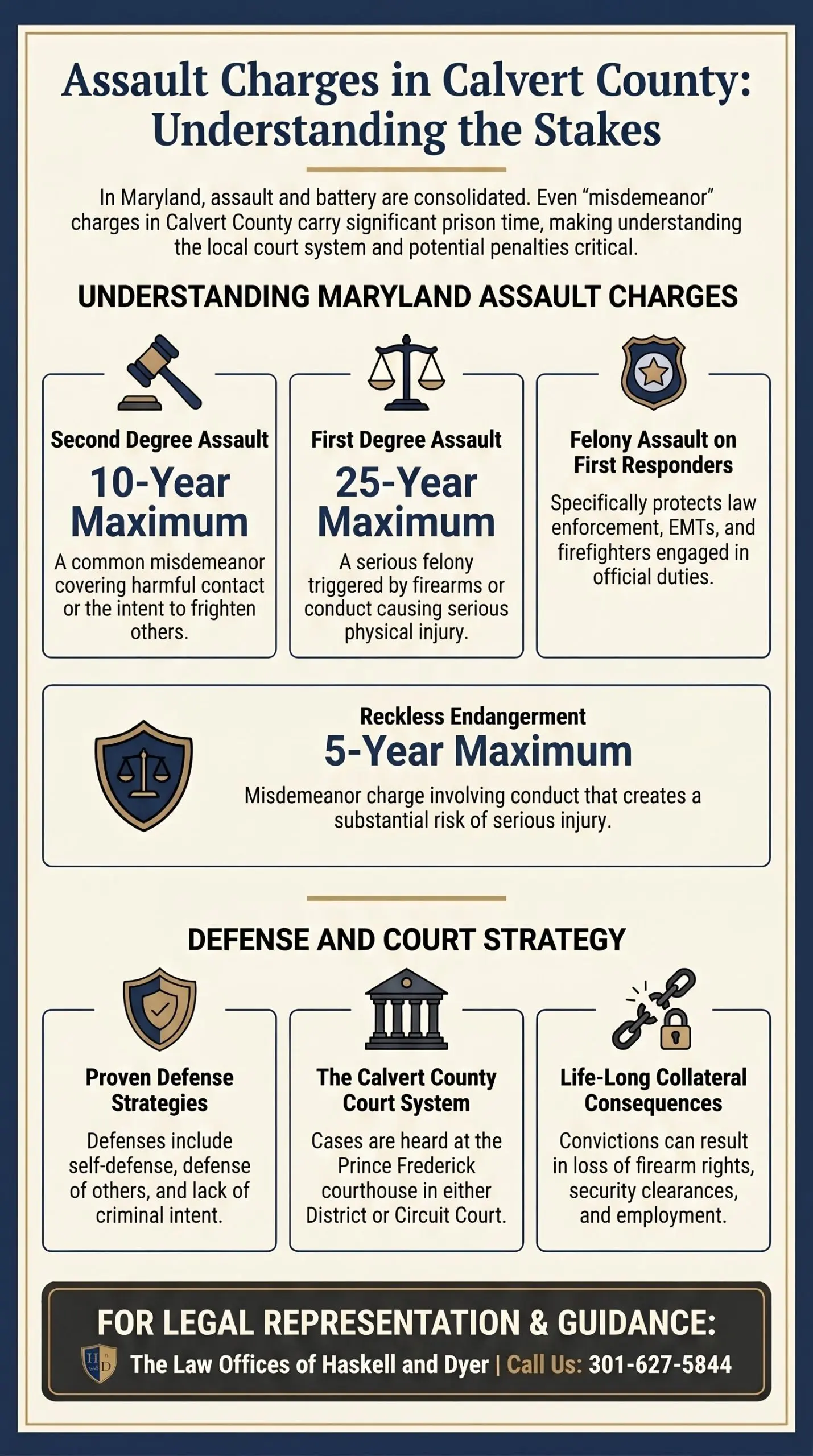
Table of Contents
- How Maryland Treats Assault and Battery
- Second Degree Assault: The Most Common Charge in Calvert County
- First Degree Assault: When the Case Turns Felony
- Felony Second Degree Assault on Officers and First Responders
- Reckless Endangerment: The Charge That Rides Along
- How Calvert County Courts Handle Assault Cases
- Common Factual Scenarios That Lead to Assault Charges
- Defense Strategies That Actually Work
- Collateral Consequences: Beyond Jail and Fines
- Working with The Law Offices of Haskell and Dyer
- Summary
- References
1. How Maryland Treats Assault and Battery
The first thing to understand about an assault and battery charge in Calvert County is that Maryland law does not treat them as separate crimes the way some other states do. Maryland’s assault statute absorbs what used to be three separate common law offenses: assault, battery, and assault and battery. They all fall under the same statutory framework now.
That matters for how a case is charged, how it is defended, and how it is resolved. A defendant who says, “I didn’t commit battery, I only committed assault,” is making a distinction that no longer exists in Maryland law. The question in every case is whether the conduct fits one of the recognized theories of assault:
- Battery type assault: An actual harmful or offensive touching of another person, even if the contact was minor and did not cause lasting injury.
- Attempted battery assault: An attempt to cause harmful or offensive contact, regardless of whether the attempt succeeded.
- Intent to frighten assault: Intentionally placing another person in reasonable apprehension of imminent harmful or offensive contact.
Maryland appellate courts have recognized each of these theories, and a prosecutor in Prince Frederick can pursue a case under any one of them, depending on the evidence. A push during an argument, a punch that missed, or a raised fist and a threatening statement can all be charged as assault. The specific facts shape the level of the charge and the strategy for defending it.
Why this matters practically: Clients often come in believing that because they never actually touched the alleged victim, they cannot be guilty of battery or assault. That is not how Maryland law works. Causing someone to reasonably fear imminent contact is enough to support an assault conviction under the intent to frighten theory.
2. Second Degree Assault: The Most Common Charge in Calvert County
Second-degree assault is the workhorse charge in Calvert County criminal court. Most assault cases start here. The statute is broad enough to cover a wide range of conduct, and prosecutors use it accordingly.
The Elements and the Penalties
A second-degree assault conviction in Maryland is a misdemeanor that carries up to ten years in prison and a fine of up to $2,500. That combination surprises many clients. Misdemeanor does not mean minor when the maximum penalty reaches a decade behind bars. A Calvert County judge has a wide range of sentencing options, from probation before judgment for a first offense to substantial jail time for a serious case.
What It Looks Like in Real Cases
The second-degree assault charges we see most often in Prince Frederick District Court involve:
- Pushing, shoving, slapping, or grabbing during an argument, often between family members, neighbors, or people who know each other
- Punching or striking another person during a physical confrontation
- Threat-based confrontations where the defendant raised a fist, made a verbal threat, or made a physical gesture that created fear of imminent contact
- Attempted strikes that missed, where the prosecution can still prove the intent to cause harmful or offensive contact
- Spitting, throwing objects, or other offensive contact that may not have caused injury but was clearly hostile
Local Settings Where Second-Degree Assault Arises
Calvert County second-degree assault cases routinely begin in settings like:
- Bar and restaurant altercations in Prince Frederick, Solomons, and the twin beaches
- Domestic arguments that turn physical
- Neighbor disputes over property, noise, or ongoing conflict
- Road rage incidents along Route 4, Route 2/4, and Route 231
- Sports and school-related altercations
- Workplace confrontations
- Fights at marinas and waterfront events
None of those scenarios is a separate crime. They are just the real-life situations that most often land in front of a Prince Frederick prosecutor as a second-degree assault charge. For broader context on how Calvert County prosecutors evaluate charges, see our article on why not to plead guilty in Calvert County without reviewing the case first.
3. First Degree Assault: When the Case Turns Felony
First-degree assault is a different category entirely. This is a felony under Maryland law. The maximum penalty is twenty-five years in prison. The charge elevates when the facts show either a level of injury or a weapon that distinguishes the case from a routine physical confrontation.
What Triggers First Degree Assault
Maryland law makes an assault a first-degree offense when the defendant:
- Intentionally causes or attempts to cause serious physical injury to another person, or
- Commits an assault with a firearm, including handguns, rifles, shotguns, and other firearms defined under Maryland law
Defining Serious Physical Injury
The statute has a specific definition of serious physical injury. The injury must:
- Create a substantial risk of death, or
- Cause permanent or protracted serious disfigurement, or
- Cause the loss or impairment of a bodily member or organ
Bruises, scrapes, and minor cuts generally do not satisfy this definition. Broken bones, concussions with lasting effects, deep lacerations requiring surgery, and injuries causing significant permanent damage often do. The line between second and first degree assault often comes down to the medical evidence.
Typical First Degree Assault Scenarios
The cases we see charged as first degree assault in Calvert County typically involve:
- Stabbing incidents or severe beatings with significant injuries
- Strangulation or choking incidents
- Shootings, or pointing and firing a firearm at or near a person
- Assaults with baseball bats, tire irons, or other weapons capable of causing serious injury
- Attacks showing a clear intent to cause life-threatening or permanently damaging harm
The Lesser Included Offense Rule
Here is an important procedural detail: a first-degree assault charge automatically includes second-degree assault as a lesser-included offense. That means a jury or judge can convict on the lesser charge even if the evidence does not support the greater. This gives both the prosecution and the defense options when the case proceeds to trial.
Strategic implication: Because the lesser included offense is automatically in play, the defense strategy in a first degree assault case often focuses on whether the injury actually rises to the “serious” level defined by statute. Winning that argument can mean the case resolves as a misdemeanor second degree assault rather than a felony.
4. Felony Second Degree Assault on Officers and First Responders
Maryland carves out a special felony version of second-degree assault when the alleged victim is a law enforcement officer or other protected first responder. This elevated charge applies when the defendant intentionally causes physical injury to a protected official who is engaged in official duties, and the defendant knew or had reason to know who the person was.
Who Counts as a Protected Victim
The protected categories under Maryland law include:
- Law enforcement officers, including deputies, troopers, and municipal police
- Parole and probation agents
- Firefighters, paid and volunteer
- Emergency medical technicians (EMTs) and paramedics
- Rescue squad members
- Other first responders engaged in official duties
The Penalties
This felony version of second-degree assault carries up to ten years in prison and a fine of up to $5,000. The penalty range is similar to that for standard second-degree assault, but the felony designation significantly alters collateral consequences. Felony convictions affect voting rights, firearm rights, professional licensing, employment, and immigration status in ways that misdemeanor convictions do not.
Common Calvert County Scenarios
These charges typically arise from:
- Physical altercations during an arrest, including resisting and struggling
- Assaults on deputies at the Calvert County Detention Center or the Prince Frederick courthouse
- Assaults on EMS or fire personnel responding to a medical or accident scene
- Incidents with probation agents during home visits or supervision activities
- Confrontations with officers during traffic stops that escalate to physical contact
The Knowledge Requirement
The statute requires that the defendant “knew or had reason to know” the victim was a protected official. This element matters when the officer was in plain clothes, identification was not clearly displayed, or the situation unfolded in a way that left the defendant legitimately confused about who they were dealing with. Defense counsel will push hard on this element when the facts support it.
Why this charge gets pursued aggressively: Prosecutors and judges in Calvert County, like their counterparts across Maryland, take assaults on first responders very seriously. A conviction almost always comes with incarceration on all but the cleanest records and smallest injuries. These are not cases to handle without experienced defense counsel.
5. Reckless Endangerment: The Charge That Rides Along
Reckless endangerment is not technically an assault, but it shows up in many of the same cases. Under Maryland law, a person commits reckless endangerment by recklessly engaging in conduct that creates a substantial risk of death or serious physical injury to another person. A separate subsection covers discharging a firearm from a motor vehicle in a manner that creates the same level of risk.
How It Differs from Assault
The key difference is the mental state. Assault generally requires an intentional act directed at another person. Reckless endangerment requires only reckless conduct that creates a serious risk. That lower threshold lets prosecutors charge reckless endangerment in situations where intentional assault might be harder to prove.
Typical Scenarios
Reckless endangerment charges in Calvert County often arise from:
- Firing a firearm in proximity to other people, even without aiming at anyone specifically
- Brandishing or swinging a weapon in a crowded space
- Dangerous conduct during a fight that puts bystanders at risk
- Aggressive or dangerous driving that endangers passengers, pedestrians, or other drivers
- Incidents where no one was seriously injured, but the risk of serious injury was real and substantial
The Penalties
Reckless endangerment is a misdemeanor punishable by up to five years in prison and a fine of up to $5,000. The penalty is significant but typically less than first-degree assault. The charge often appears alongside assault counts rather than alone.
Not Automatically Included
Unlike the relationship between first-degree assault and second-degree assault, reckless endangerment is not a lesser-included offense of assault. It must be specifically charged. That means a defendant cannot be convicted of reckless endangerment unless the prosecution added that count to the charging document. Defense counsel who sees reckless endangerment charged separately should evaluate whether the state is attempting to create multiple paths to conviction on the same conduct.
6. How Calvert County Courts Handle Assault Cases
Every assault case in Calvert County starts in one of two courts, both located at the Calvert County courthouse complex in Prince Frederick.
The District Court of Maryland for Calvert County
The District Court hears misdemeanors and certain felonies, and it does not conduct jury trials. For most second-degree assault cases without a jury demand, this is where the case begins and often where it ends. A Prince Frederick District Court judge hears the evidence, evaluates the witnesses, and decides guilt or innocence after a bench trial. Sentencing, if the defendant is convicted, happens in the same court.
What to expect in Prince Frederick District Court:
- Docket calls start at 8:30 a.m.
- Cases are typically heard in the order the judge moves through the list
- Defendants are expected to be on time, respectful, and prepared
- Defense attorneys handle most of the substantive interaction with prosecutors
- Disposition can occur in a single appearance or over multiple court dates, depending on the complexity
For a broader walkthrough of what to expect at your first Calvert County court appearance, see our companion article on your first court date at Prince Frederick District Court.
The Circuit Court for Calvert County
The Circuit Court is where jury trials take place. It handles more serious felony cases and appeals from the District Court. First-degree assault cases, felony assault on officers cases, and any case where the defendant demands a jury trial will move to Circuit Court. The pace of a Circuit Court case is typically slower, the preparation is more involved, and the stakes are usually higher.
The Jury Trial Demand
Maryland criminal defendants generally have the right to demand a jury trial when the charge carries a potential sentence of more than 90 days. Nearly every assault charge in Calvert County qualifies. The jury trial demand is a strategic decision that depends on:
- The strength of the state’s case
- Whether the local judge pool in District Court is favorable or unfavorable on this type of case
- Whether the defense benefits from a more formal process
- Whether the state may offer a better resolution to avoid the expense of a jury trial
A good defense attorney evaluates the jury trial question early, because requesting a jury can change the plea negotiation dynamic significantly.
Maryland Case Search
Court records for both the District Court and the Circuit Court are available through Maryland Case Search, the state’s public case lookup system. Employers, licensing boards, and background check companies use this system routinely. Even charges that are later dismissed remain visible unless properly expunged.
Something most clients do not realize: Even a dismissed assault case can appear on Maryland Case Search and affect your background check. Expungement is often a separate post case step, and getting it right matters. We handle expungement requests as part of our broader criminal defense practice.
7. Common Factual Scenarios That Lead to Assault Charges
The facts that drive assault cases in Calvert County repeat themselves. Understanding the typical scenarios helps clients see where their case fits and why certain defenses may be available.
Domestic Disputes
Arguments between spouses, partners, former partners, and other family members produce a significant portion of the assault charges we see. These cases often involve protective orders filed in parallel, and the criminal and civil tracks interact with one another. For guidance on the protective order side, see our overview of common situations where protective orders are necessary.
Neighbor Disputes
Calvert County’s mix of rural properties, planned subdivisions, and waterfront communities produces its share of neighbor conflicts. Disputes over property lines, shared driveways, noise, and long running bad blood sometimes boil over into physical confrontations that end with an assault charge.
Road Rage Incidents
The Route 4 commuter corridor through Huntingtown, Prince Frederick, and Dunkirk, along with Route 2/4 through Lusby and Solomons, produces road rage cases every year. A confrontation at a red light or a confrontation after a lane change incident can escalate quickly to assault charges.
Bar and Restaurant Altercations
Weekend nights in Solomons, in Prince Frederick, and in the twin beaches produce a steady flow of assault cases. Drinks, crowds, and personal conflicts combine to turn disagreements physical. Security staff, bartenders, and other patrons often become witnesses.
Sports and School Incidents
Youth sports, school grounds, and community recreational events produce assault cases involving minors, coaches, parents, and bystanders. These cases often involve juvenile court issues alongside adult charges depending on who was involved.
Workplace Incidents
Disputes between coworkers, confrontations with customers, and confrontations with supervisors can end with criminal charges. These cases often involve workplace video footage, coworker witnesses, and parallel civil liability concerns for the employer.
Police Contact Incidents
Arrests and other police encounters sometimes escalate to assault charges when the defendant struggles, strikes, or pulls away from officers. These are often charged as felony assault on officer cases and handled in Circuit Court.
Weapon-Related Incidents
Firearms, knives, baseball bats, tire irons, and other objects used as weapons all trigger first-degree assault exposure. Even brandishing a firearm can support felony charges in the right circumstances.
8. Defense Strategies That Actually Work
No two assault cases are the same, but a well developed defense strategy typically looks at several angles.
Self Defense
Maryland recognizes self-defense as a complete defense to assault charges when the defendant reasonably believed force was necessary to prevent imminent harm and used only the force reasonably necessary to respond. The reasonableness of both the belief and the force is evaluated from the perspective of the defendant at the moment, not with the clarity of hindsight.
Self-defense arguments work best when:
- The other person started the confrontation
- The defendant had no reasonable opportunity to retreat
- The force used was proportional to the threat faced
- There is physical evidence, witness testimony, or video supporting the defense
Defense of Others
A person may use reasonable force to protect another person from imminent harm under similar principles. A father defending his child, a bystander intervening in an attack, or a friend protecting a companion can all raise a defense of others claim.
Defense of Property
Maryland allows the use of reasonable non-deadly force to prevent a trespass or to defend property. The rules are narrower than self-defense, but the defense can apply in cases involving unwanted intrusions, burglaries in progress, or attempts to take property from the defendant.
Lack of Intent
Assault generally requires an intentional act. Accidental contact, unintentional contact during chaotic events, or contact during consensual physical activity (such as sports) can all support a defense based on the absence of criminal intent.
Mistaken Identification
When the alleged victim did not know the defendant before the incident, identification can be genuinely mistaken. Crowded environments, poor lighting, alcohol consumption, and the stress of the moment all affect the reliability of identification. Defense counsel will push on any weaknesses in the identification.
Credibility Challenges
Many assault cases turn on whose version of events the court believes. If the alleged victim has a motive to fabricate or exaggerate (a pending divorce, a custody fight, a business dispute, a prior confrontation), defense counsel will explore that motive through cross-examination.
Procedural Challenges
Every criminal case has procedural requirements that the state must meet. Problems with the arrest, the Miranda warnings, the chain of custody for physical evidence, or the integrity of any video evidence can all create openings for the defense. Challenging the procedure does not always result in dismissal, but it can affect what evidence comes into the trial.
Negotiated Resolutions
Not every case goes to trial. Many assault cases resolve through negotiated pleas that reduce the charge, avoid jail, or produce probation before judgment. These negotiations are most successful when defense counsel has thoroughly prepared the case and can credibly threaten trial if the state does not offer an acceptable resolution.
For a broader perspective on how Calvert County prosecutors build and stack charges, see our article on how Calvert County prosecutors stack the deck.
9. Collateral Consequences: Beyond Jail and Fines
An assault conviction carries consequences that reach far beyond the courtroom. Clients often focus on jail and fines because those are the most visible penalties. The collateral consequences can affect daily life for years longer than any sentence.
Employment
Most employers run background checks. An assault conviction, especially a felony, appears prominently and can disqualify applicants for jobs involving customer contact, transportation, healthcare, education, security, and any position requiring a professional license. Current employees can be terminated under employer policies even for misdemeanor convictions.
Professional Licensing
Licensed professionals in Maryland, including nurses, teachers, healthcare workers, real estate agents, insurance producers, commercial drivers, and financial advisors, face potential license suspension or revocation after an assault conviction. Many licensing boards require self-reporting of arrests and convictions within short windows.
Firearm Rights
A felony conviction results in a lifetime prohibition on firearm possession under federal law. Maryland adds additional state restrictions. Even certain misdemeanor domestic violence assault convictions can trigger the federal firearm prohibition under the Lautenberg Amendment.
Immigration Status
Non-citizens face severe immigration consequences from assault convictions. Certain assault offenses can trigger deportation, denial of naturalization, and bars to reentry. Immigration consequences are complex and require specialized analysis alongside the criminal defense.
Security Clearance
Federal workers, military personnel, and contractors holding security clearances can lose those clearances after an assault conviction. For families connected to Patuxent River Naval Air Station, Cove Point, and other federal facilities in Southern Maryland, a clearance loss can end a career.
Civil Liability
Criminal assault charges almost always come with potential civil liability. The alleged victim may file a civil suit for damages separate from the criminal case. Statements made in the criminal case, including plea admissions, can be used in the civil suit.
Housing
Landlords run background checks. An assault conviction on record can result in rental application denials, especially for apartments, planned communities, and properties managed by large landlords.
Family Court Impact
Assault charges affect ongoing family court matters. Custody cases, divorce proceedings, and child support enforcement all take criminal history into account. A pending assault charge can change the dynamic in contested family matters overnight.
The broader lesson: A guilty plea to an assault charge is not just a sentence of jail, probation, or a fine. It is a document that follows you into your employment, your housing, your family court case, and often your entire professional life. That is why so many defenders encourage clients to fight winnable cases rather than plead them out for convenience.
10. Working with The Law Offices of Haskell and Dyer
A Calvert County assault charge is not the moment to go it alone or to hire the first attorney who returns your call. The difference between an aggressive, local, well-prepared defense and an outsourced, distant, minimal-effort defense is often the difference between a conviction and a resolution that protects your future.
What We Bring to Assault Cases
Our firm has defended assault and battery cases throughout Calvert County for years. We know the prosecutors, the judges, and the courthouse staff at Prince Frederick. We have seen how local decision-makers evaluate the specific fact patterns arising from Calvert County’s bars, neighborhoods, roadways, and homes. We prepare every case as though it will go to trial, which is the only way to negotiate from a position of strength.
What Happens When You Call
The initial consultation is free. You will speak with an attorney who will listen to what happened, review any charging documents or paperwork, and give you a straightforward assessment of where the case stands. If we take the case, we move immediately to:
- Request preservation of any video, audio, or electronic evidence before it is overwritten
- Identify and interview witnesses before memories fade
- File appropriate motions to challenge the state’s evidence
- Assess protective order and family court intersections
- Negotiate with prosecutors when a negotiated resolution serves the client
- Prepare for trial when trial is the right path
The 24/7 Hotline
Assault arrests rarely happen during business hours. Our 24/7 criminal defense hotline at 240-687-0179 is available when you or a family member needs immediate guidance, whether that is at the detention center, during a police interview, or in the moments after an arrest.
Ready to Talk About Your Case?
Whether you are facing a first assault charge or a felony in Circuit Court, we are ready to listen and to fight. The first consultation is free, and the 24/7 hotline is always open.
📞 Call 301-627-5844
Send a Secure Message
24/7 Criminal Defense Hotline: 240-687-0179
Learn more about our Criminal Defense practice.
Summary
Assault and battery in Maryland is charged under the state’s assault statutes, with battery folded into the same framework. Second degree assault is a misdemeanor but still carries up to ten years in prison. First degree assault is a felony with exposure up to twenty-five years, triggered by serious physical injury or the use of a firearm. A special felony version of second degree assault applies when the victim is a law enforcement officer, firefighter, EMT, or other protected first responder. Reckless endangerment often rides along with assault charges when the conduct created a substantial risk of serious harm. Every Calvert County assault case runs through the Prince Frederick courthouse, either in District Court for misdemeanors and bench trials or in Circuit Court for felonies and jury trials. The defenses that actually work in these cases include self defense, defense of others, lack of intent, mistaken identification, credibility challenges, and procedural challenges to the state’s evidence. The collateral consequences of a conviction reach far beyond jail and fines, affecting employment, licensing, firearm rights, immigration, housing, and family court. Fighting the case the right way, with a local attorney who knows Calvert County, protects everything that would be at stake after a conviction.
Ready for a free consultation? Call Haskell and Dyer at 301-627-5844, use the 24/7 hotline at 240-687-0179, or contact us here.
References
Maryland General Assembly. (2024). Criminal Law Article, Title 3, Subtitle 2: Assault, reckless endangerment, and related crimes. Maryland Code. https://mgaleg.maryland.gov/
Maryland General Assembly. (2024). Criminal Law Article § 3-202: Assault in the first degree. Maryland Code. https://mgaleg.maryland.gov/
Maryland General Assembly. (2024). Criminal Law Article § 3-203: Assault in the second degree. Maryland Code. https://mgaleg.maryland.gov/
Maryland General Assembly. (2024). Criminal Law Article § 3-204: Reckless endangerment. Maryland Code. https://mgaleg.maryland.gov/
Maryland Judiciary. (2024). District Court of Maryland for Calvert County. Maryland Courts. https://www.courts.state.md.us/district/directories/courtmap
Maryland Judiciary. (2024). Circuit Court for Calvert County. Maryland Courts. https://www.courts.state.md.us/circuit
Maryland Judiciary. (2024). Maryland Judiciary Case Search. Maryland Courts. https://casesearch.courts.state.md.us/
Maryland State Bar Association. (2023). Consumer’s guide to criminal law in Maryland. Maryland State Bar Association. https://www.msba.org/
United States Congress. (1996). Lautenberg Amendment, 18 U.S.C. § 922(g)(9): Firearm prohibitions following misdemeanor domestic violence convictions. U.S. Code. https://www.govinfo.gov/
Maryland Office of the Public Defender. (2023). Overview of Maryland criminal procedure. Office of the Public Defender. https://www.opd.state.md.us/
The information provided in this article is for general informational purposes only and does not constitute legal advice. Contacting The Law Offices of Haskell and Dyer does not create an attorney client relationship until a formal agreement is signed. For legal advice specific to your situation, please contact our office directly.