
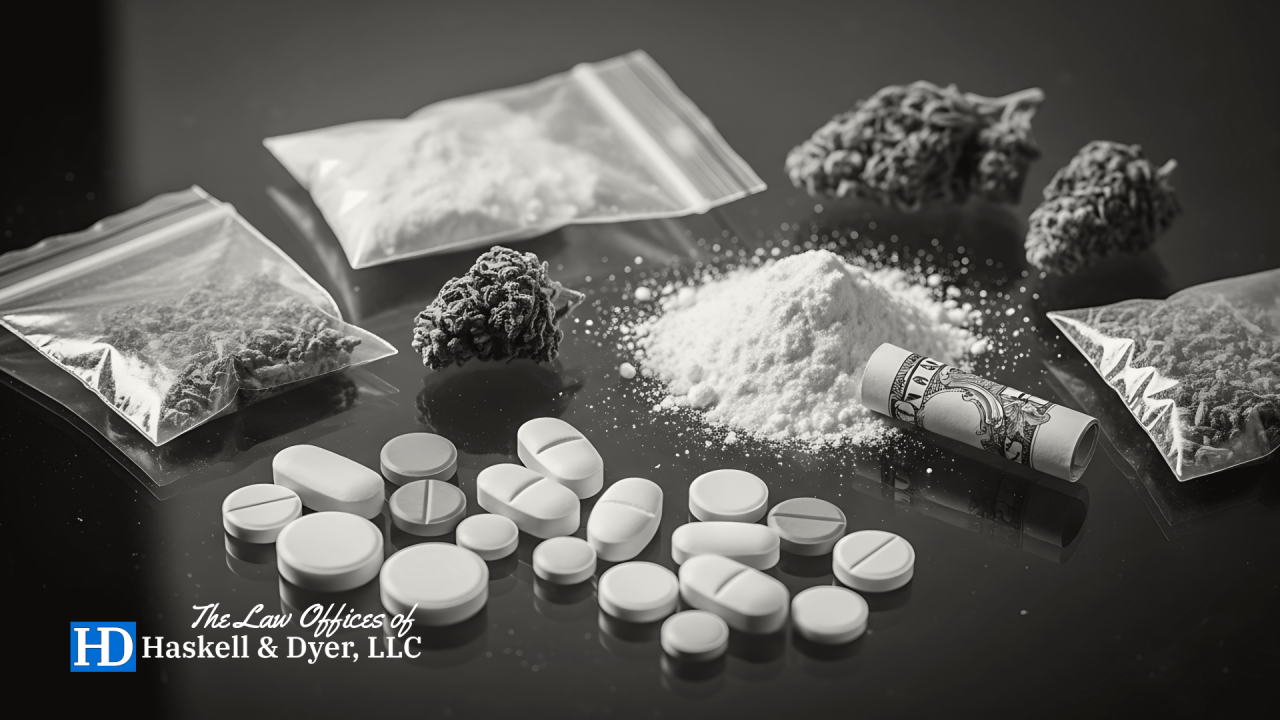
You were stopped for a tail light. Twenty minutes later, a K-9 unit was on scene, your car was being searched, and you were being arrested for felony possession with intent to distribute. Huntingtown traffic stop drug charges follow a specific pattern, and that pattern is often where the best defense opportunities live. Here is what you need to know.
Route 4 through Huntingtown is one of the most patrolled commuter stretches in Calvert County. It is also one of the most common locations for traffic stops that begin as minor equipment or moving violations and end with felony drug charges. At The Law Offices of Haskell and Dyer, we handle these Huntingtown traffic stop drug charges regularly. The defense starts with a careful look at the stop itself, because that is where most of these cases either win or lose.
How a Route 4 Stop Becomes a Drug Case
The typical escalation looks like this:
- Officer observes an equipment violation, a speeding violation, or a lane change issue
- Traffic stop is initiated with the stated basis
- During the stop, the officer identifies some additional factor (nervousness, odor, furtive movements, an inconsistent story)
- The stop extends beyond what a routine traffic stop would require
- Officer requests consent to search, calls a K-9 unit, or identifies probable cause
- Search produces drugs, cash, packaging, or scales
- Driver and any passengers are arrested on possession, PWID, or trafficking charges
Every step in that sequence has legal rules attached to it. A defense that walks through the sequence carefully often finds places where the state overstepped.
The Key Fourth Amendment Issues
The Basis for the Stop
Officers need reasonable suspicion to stop a vehicle. Most traffic stops are based on clear violations (a burned out tail light, a missing tag, an observable moving violation). Some are based on vaguer grounds that can be challenged. Video evidence from the patrol car or body worn camera is usually the starting point.
The Scope of the Stop
A traffic stop cannot be extended beyond the time reasonably needed to address the traffic violation. The Supreme Court has ruled that even brief extensions can violate the Fourth Amendment. If the officer extended the stop to pursue a drug investigation without additional reasonable suspicion, the resulting evidence may be suppressed.
The K-9 Deployment
Bringing a drug dog to the scene has its own set of rules. Key issues include:
- How long the stop was extended to wait for the dog
- Whether reasonable suspicion supported prolonging the stop
- The specific dog’s training and reliability records
- The handler’s training and history
- How the sniff was actually conducted (around the vehicle, timing, physical contact)
Defense attorneys can request the dog’s deployment records, training records, and prior performance history. Many drug dogs have records that raise questions about their reliability.
Consent to Search
If the search was based on consent, the consent must have been voluntary. Consent obtained through threats, coercion, or confusion about the right to refuse can be challenged. Many drivers do not understand they have the right to refuse a search; Maryland law does not require officers to explain that right, but it does affect the reasonableness analysis.
The single most important case evidence: Patrol car dash camera video and body worn camera footage. This video establishes exactly what happened, how long the stop took, what the officer said, and what the driver said. Preservation should be requested within days of the arrest.
The Charges That Can Result
Depending on what the search produces, a Huntingtown traffic stop drug case can generate:
- Simple possession under Maryland Criminal Law § 5-601 (misdemeanor)
- Possession with intent to distribute under § 5-602 (felony)
- Drug trafficking / volume dealer under § 5-612 (mandatory minimum felony)
- Importation under § 5-614 (felony) for large quantities moving through the state
- Drug paraphernalia under § 5-619 (typically a companion charge)
- School zone enhancement under § 5-627 if the stop occurred within 1,000 feet of a school
For a complete breakdown of Maryland drug charges and penalties, see our cornerstone: Calvert County Drug Crimes Defense: The Complete Guide.
PWID Built From a Traffic Stop
The jump from simple possession to possession with intent to distribute is often where Huntingtown traffic stop drug charges become serious. The state typically builds the distribution case on circumstantial evidence:
- The quantity of the drug
- Packaging consistent with distribution (multiple baggies, pre measured doses)
- Scales, cutting agents, or packaging materials
- Large amounts of cash, particularly in small denominations
- Multiple cell phones or phones with messages about drug transactions
- Absence of personal use paraphernalia
Defense counsel pushes on whether the quantity and indicators actually support an intent to distribute as opposed to personal use. In many cases, the PWID can be reduced to simple possession if the evidence of intent is weak.
Commercial Driver Cases
Route 4 carries significant commercial traffic, including CDL holders. A drug charge for a CDL holder creates additional exposure:
- CDL disqualification even for misdemeanor drug convictions in some circumstances
- Employer disciplinary action
- DOT reporting requirements
- Professional insurance and bonding complications
- Long term implications for commercial driving career
Other Companion Charges
Traffic stops producing drug charges often produce related charges at the same time:
- DUI if there were indicators of impairment
- Traffic violations charged separately from the drug case
- Firearm charges if weapons were in the vehicle
- Identity or document offenses if identification issues arose
- Resisting arrest or obstruction charges for anything during the arrest
For related reading, see our article on Huntingtown Route 4 road rage defense which addresses broader Route 4 criminal issues, and our complete guide to Calvert County DUI and traffic defense.
The Defense Framework
A Huntingtown traffic stop drug charges defense typically involves:
- Immediate preservation of dash cam and body cam footage
- Comprehensive Fourth Amendment analysis of the stop and search
- Request for K-9 training and deployment records where applicable
- Challenge to circumstantial intent to distribute evidence
- Lab testing and chain of custody challenges
- Evaluation of diversion programs or probation before judgment options
- Coordination with any companion charges (DUI, traffic, firearm)
- Protection of CDL or professional licensing interests
Rule after any traffic stop drug arrest: Do not consent to any additional searches after the fact. Do not talk about the case on jail phones (they are recorded). Do not discuss the incident with anyone other than your attorney. The first 48 hours set the tone for everything that follows.
Frequently Asked Questions
Real questions Calvert County drivers ask after a Route 4 drug stop. If your situation is not covered here, call us at 301-627-5844 for a free consultation.
Can the police search my car after a traffic stop on Route 4?
Not automatically. An officer needs probable cause, your voluntary consent, or a valid exception to search a car after a traffic stop. If the search relied on consent you did not freely give, on a K-9 alert that came after the stop should have ended, or on suspicion that did not actually exist, a Maryland court can suppress what was found.
How long can a traffic stop legally last?
Only as long as the officer reasonably needs to handle the original violation: checking your license, running tags, writing the citation. Once that work is done, the stop is over. Extending it to wait for a drug dog or to fish for consent, without independent reasonable suspicion, can violate the Fourth Amendment under the Supreme Court’s Rodriguez v. United States decision.
Can I refuse to let the officer search my vehicle?
Yes. You have the right to refuse consent. Maryland officers are not required to tell you that, but you can say it plainly: “I do not consent to a search.” Refusing consent is not probable cause by itself, and it does not give the officer a new reason to hold you longer.
What happens if a K-9 unit is called to my stop?
The handler must arrive within the time the stop would have lasted anyway, or the officer needs separate reasonable suspicion to hold you longer. The specific dog’s training and reliability records are open to challenge. We routinely subpoena those records to test whether the alert was reliable in the first place.
How do prosecutors prove “intent to distribute” if I only had a few bags?
They build it from indirect evidence: the quantity, the packaging style, scales, cash in small bills, multiple phones, and text messages. None of those alone proves intent. We push on every piece of that evidence to argue the case is really simple possession, which can drop a felony exposure down to a misdemeanor.
I have a CDL. What does this charge do to my commercial license?
A drug conviction can disqualify a CDL even at the misdemeanor level, and you may have to self-report under federal DOT rules. We coordinate the criminal defense with the CDL exposure so the resolution we negotiate protects both. Sometimes a probation before judgment can be structured to avoid the CDL hit entirely.
What is the single most important piece of evidence in a Route 4 drug stop case?
The dash cam and body cam video. It shows exactly how long the stop lasted, what the officer said, what you said, and how the K-9 sniff or search played out. We request preservation in writing within days of the arrest because departments sometimes overwrite footage on a rolling cycle.
Will a Calvert County drug arrest affect my federal job or security clearance?
It can. Federal employees and contractors at Pax River, NSA, and other Southern Maryland employers often hold clearances that require self-reporting an arrest. We work the criminal case and the clearance reporting in parallel so the disclosures are accurate and the case resolution is structured to limit clearance fallout.
Pulled Over on Route 4? Now Facing Drug Charges?
We handle Huntingtown traffic stop drug charges regularly. Free consultation and 24/7 hotline.
24/7 Hotline: 240-687-0179
This article is for general information only and does not constitute legal advice. Contacting our firm does not create an attorney client relationship until a formal agreement is signed.