
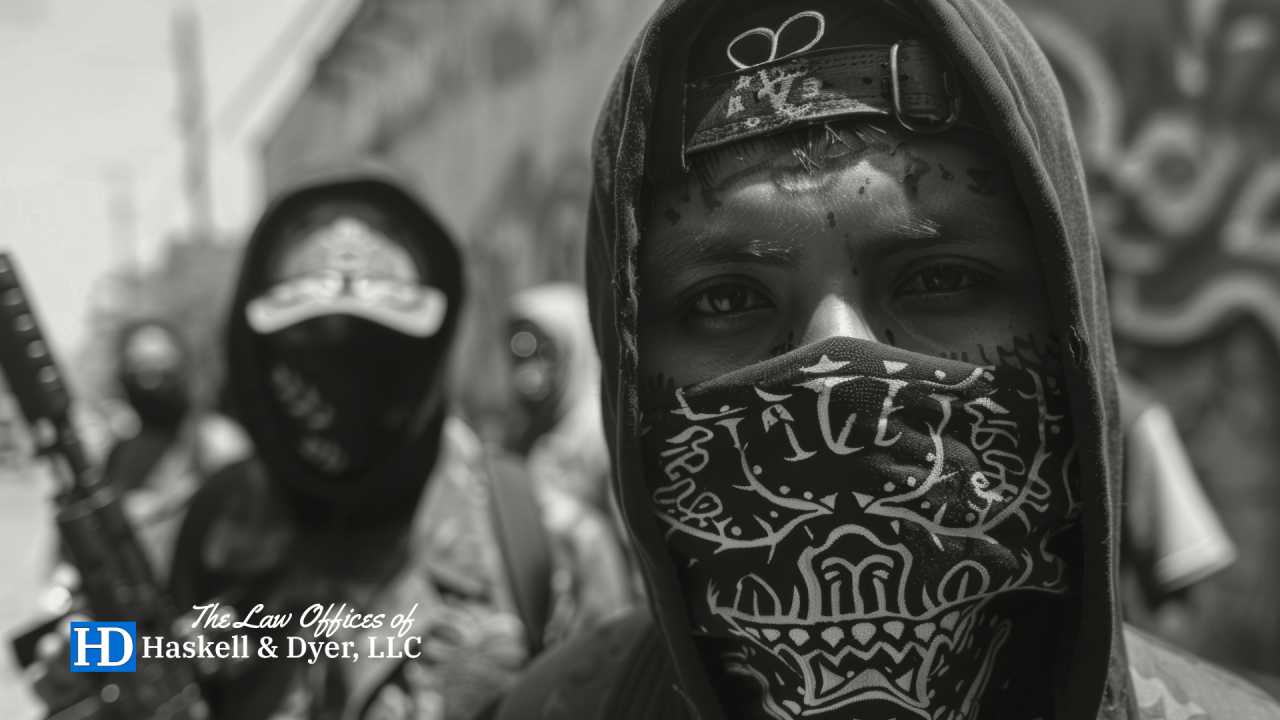
Maryland law enforcement has documented active street gangs, prison gangs, outlaw motorcycle clubs, and transnational criminal organizations operating in Anne Arundel, Calvert, Charles, St. Mary’s, and Prince George’s Counties. The gangs prosecutors charge most often include MS-13, the Bloods, the Crips, 18th Street, Black Guerrilla Family, Dead Man Incorporated, Aryan Brotherhood, Tren de Aragua, and several outlaw motorcycle clubs led by the Pagan’s MC.
Once a gang allegation attaches to a violent crime, theft, robbery, assault, firearm, or homicide charge, the case changes shape. Maryland Criminal Law § 9-804 adds up to 15 years for participation, or up to 25 years if death results, on top of any underlying conviction. Federal RICO exposure can replace state charges entirely. After the January 2025 designation of MS-13 and Tren de Aragua as Foreign Terrorist Organizations, immigration consequences widened. If you or a family member is charged anywhere in these five counties, hire counsel before a single police interview.
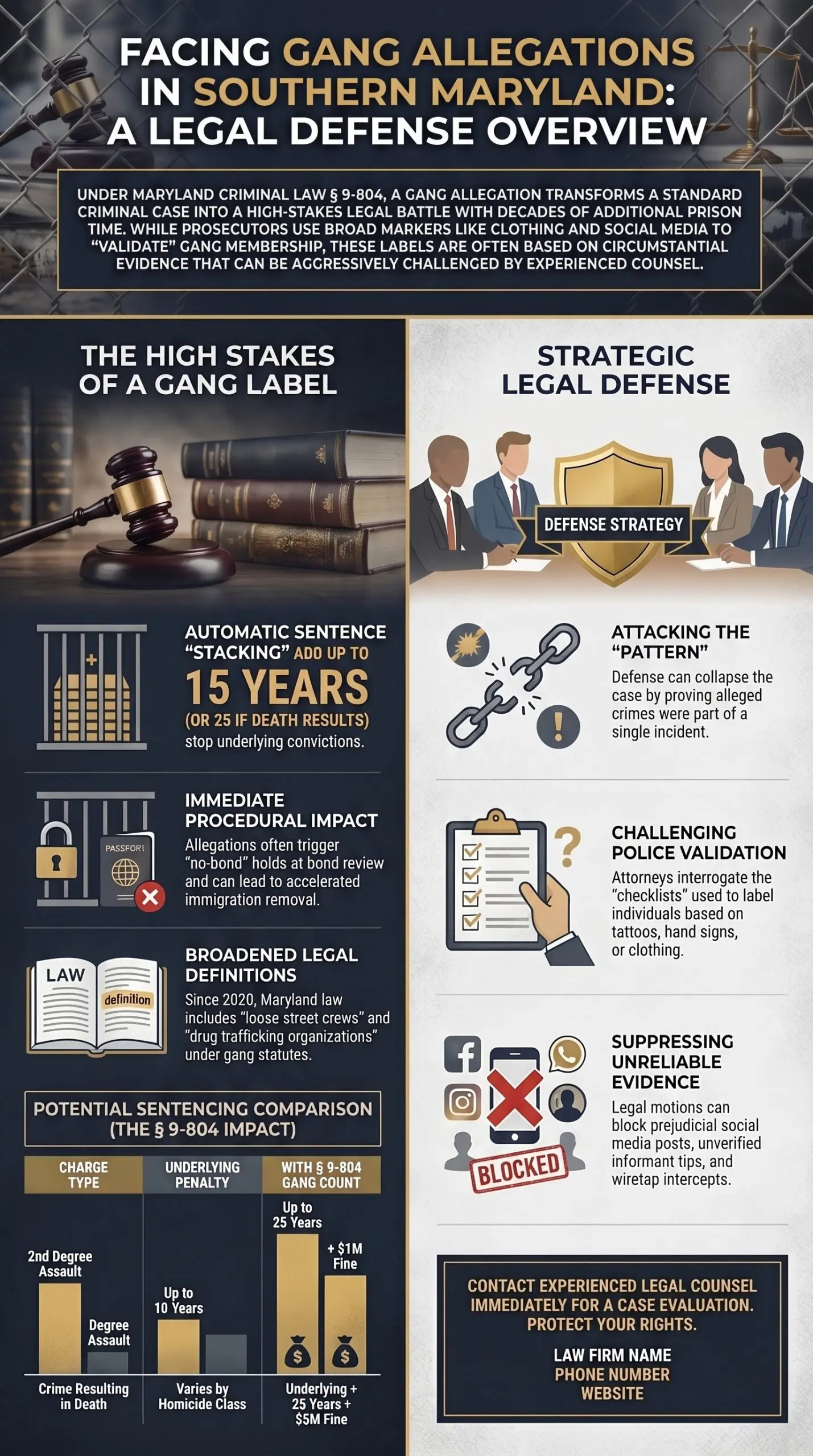
Table of contents
- Why a gang allegation changes a Maryland criminal case
- How Maryland and federal law define a criminal gang
- The four gang categories operating across the region
- Top documented gangs in the five county area
- Prince George’s County
- Anne Arundel County
- Charles County
- St. Mary’s County
- Calvert County
- How prosecutors prove gang membership
- How a defense attorney challenges a gang allegation
- What to do if you or a loved one is charged
- Frequently Asked Questions
- Related Haskell & Dyer guides
- References
Chapter 1. Why a gang allegation changes a Maryland criminal case
If you were arrested and the police wrote gang member, gang associate, crew member, or criminal organization in the report, you are dealing with more than a normal criminal charge. That wording can affect how the commissioner views release, how the judge views bond, how the prosecutor values the case, and how the police continue to investigate you. It can also change how your family, employer, immigration counsel, and co defendants experience the case. One label can make a simple arrest feel impossible to explain.
Haskell & Dyer starts by slowing the case down. We look at what the police actually claim you did, what they claim other people did, and why they are trying to connect those things. We review the charging document, statement of probable cause, search warrants, phone seizures, social media claims, photographs, witness statements, and any alleged gang validation material. The goal is to separate facts from labels as early as possible.
For the person arrested, the most important point is simple: do not try to explain the label away by talking to police. People often think they can clear up a misunderstanding. In gang cases, explanations can become admissions, names can become investigative leads, and casual comments can become evidence of association. We help you protect your bond position, protect your silence, preserve helpful evidence, and prepare for the first court dates with a defense plan focused on proof.
We also help your family understand what is happening. Gang cases can scare everyone around you, and fear can lead people to make bad choices. A parent may call witnesses. A friend may delete posts. A loved one may contact a co defendant. Those actions can create new problems. We guide the next steps so the defense starts with control, not panic. We also help you understand what to say, what not to say, and what paperwork to save before the next hearing.
The same act, charged two different ways, produces two different cases. A bar fight charged as second degree assault carries up to 10 years. The same fight, charged as second degree assault plus participation in a criminal organization under Maryland Criminal Law § 9-804, carries the assault penalty plus up to 15 additional years and a fine up to $1,000,000 (Md. Code, Crim. Law § 9-804, 2024). If a death results, the gang count alone reaches 25 years and a $5,000,000 fine.
That is the basic state level math. The federal math is harsher. Federal RICO conspiracy under 18 U.S.C. § 1962(d) carries up to 20 years, and life if predicate acts include murder. A federal indictment under VICAR (Violent Crimes in Aid of Racketeering, 18 U.S.C. § 1959) lets prosecutors charge a single act of violence as a separate crime if it was committed for the gang.
The 2022 Maryland Gang Threat Assessment names six top gang threats statewide: Black Guerrilla Family, Bloods, Dead Man Incorporated, MS-13, 18th Street, and the Pagan’s Motorcycle Club (Maryland Coordination and Analysis Center [MCAC], 2022, p. 2). Five of those six operate across one or more of the counties Haskell & Dyer covers. Tren de Aragua, the Venezuelan organization that did not appear in the 2022 assessment, is now the subject of Department of Homeland Security warnings across Maryland, D.C., and Virginia (Department of Homeland Security [DHS], cited in Fox 5 DC, 2024).
What “gang affiliation” does to a case at every stage
At bond review, an alleged gang tie often produces a no-bond hold under Md. Rule 4-216. At trial, the State can introduce 404(b) evidence of prior gang acts to prove identity, motive, or pattern. At sentencing, § 9-804 stacks on top of the underlying offense and can run consecutively. On appeal, gang-related convictions face a tougher sufficiency standard because juries hear extensive prior bad acts. A defense lawyer who handles these cases works on all four fronts at once.
The January 20, 2025 executive order designating MS-13 and Tren de Aragua as Foreign Terrorist Organizations added a fourth front: immigration removal under accelerated procedures (Executive Order 14157, 2025). The Kilmar Abrego Garcia case, where Prince George’s County police labeled a Hyattsville day laborer as MS-13 based on a Chicago Bulls hat and a confidential informant tip, then saw him deported to El Salvador’s CECOT prison in March 2025 before the Supreme Court ordered his return, shows what happens when a gang label travels through agencies without challenge (CNN, 2025; Wikipedia contributors, 2026).
Chapter 2. How Maryland and federal law define a criminal gang
Maryland law does not let the State win a gang case by saying the word gang enough times. The prosecutor must prove specific legal points. There must be an alleged criminal organization. There must be a pattern of organized criminal activity. There must be evidence connecting you to the conduct charged. A person can know someone, live in the same neighborhood, appear in a photo, wear certain clothing, or be present during an arrest without being legally responsible for everything the State attributes to a group.
Haskell & Dyer examines the exact statute being used and compares it to the evidence. We ask basic questions that often matter. What is the alleged organization? Who belongs to it? What crimes make up the alleged pattern? Are those crimes separate incidents or one event repeated in different words? What proof connects you to the group? What proof connects you to the specific charge? What proof shows intent? If the State cannot answer those questions with admissible evidence, the gang count becomes vulnerable.
For the person arrested, this matters because fear can make a case feel hopeless. A gang accusation sounds final, but it is still an allegation. The courtroom runs on proof, motions, evidence rules, witness credibility, and legal definitions. Our work is to make the State meet those requirements. We do not let a broad label replace the harder job of proving your conduct, your intent, and your alleged role beyond what the law requires.
We also explain the difference between the underlying charge and the gang charge. You may be accused of assault, robbery, theft, firearm possession, drug distribution, or homicide, and then the State may add a criminal organization count. Those are not the same thing. Each count has separate elements, separate defenses, and separate sentencing exposure. A careful defense treats them separately and attacks each one on its own terms.
Maryland Criminal Law § 9-801 defines a “criminal organization” as an enterprise of any structure, formal or informal, whose members engage in a pattern of organized crime activity, have one of their primary objectives as the commission of underlying crimes, and share an organizational or command structure (Md. Code, Crim. Law § 9-801, 2024). The 2020 amendment, Chapter 422, broadened the definition to capture “street crews” that lack formal hierarchy. That change matters in Anne Arundel and Prince George’s Counties, where prosecutors now charge loose drug crews under the same statute used against MS-13.
“Pattern” under § 9-801(c) means the commission, attempt, conspiracy, or solicitation of two or more underlying crimes that were not part of the same incident. The list of underlying crimes is broad: murder, assault, robbery, theft, drug distribution, firearm offenses, witness intimidation, and human trafficking all qualify.
The federal definition under 18 U.S.C. § 521 requires five or more members and conduct that affects interstate or foreign commerce. Federal RICO under 18 U.S.C. § 1962 is broader still and covers any “enterprise” engaged in a pattern of racketeering activity. The 2022 MGTA notes that federal prosecutors brought 749 MS-13 cases nationwide between 2016 and 2020, with Maryland leading every other federal district at 77 prosecutions in 2017 and 2018 alone (MCAC, 2022, p. 18; Center for Immigration Studies [CIS], 2025).
Maryland does not have a statutory definition of who counts as a “gang member” (MCAC, 2022, p. 16). Police identification therefore turns on a department by department checklist of factors: tattoos, hand signs, monikers, colors, social media activity, association with known members, and confidential informant identification. A defense attorney who can attack each factor can sometimes knock out the entire gang count.
Chapter 3. The four gang categories operating across the region
Police reports often use categories that sound official and intimidating. Street gang. Prison gang. Motorcycle club. Drug trafficking organization. Transnational criminal organization. Those categories can make a case look organized before anyone has tested the evidence. The category matters because each one creates a different prosecution theory. It affects how the State explains motive, membership, hierarchy, communication, and alleged criminal purpose.
Haskell & Dyer forces the State to be specific. If prosecutors claim a street gang case, we look for actual proof of membership, set affiliation, leadership, communication, and a pattern of conduct. If they claim a prison gang case, we look at correctional records, alleged Security Threat Group files, informants, and whether the prison related evidence has anything to do with the charge. If they claim a motorcycle club or drug crew case, we test whether the State has evidence of criminal organization or is grouping people together because they know each other.
For the person arrested, this is where the defense starts to become practical. You need to know what theory the State plans to use against you. You need to know whether the evidence is about you or about other people. You need to know whether the prosecutor is trying to use old photos, phone contacts, music, clothing, social media, or neighborhood ties to make the case sound larger. Once the theory is clear, we can target it with discovery requests, motions, witness challenges, and negotiation strategy.
We also look at whether the State is mixing categories to make the case sound worse. A drug case can be described as a crew case. A prison classification can be used in a street case. A social media post can be treated as proof of membership. These shortcuts matter because they can affect bond and trial evidence. We work to keep each claim tied to actual proof.
Street gangs. The most common category. Street gangs include national networks like the Bloods and the Crips, the transnational MS-13 and 18th Street, and locally rooted crews. Street gangs divide into sets, cliques, or chapters with their own rules and territory (MCAC, 2022, p. 5).
Prison gangs (Security Threat Groups). The Maryland Department of Public Safety and Correctional Services classifies these as STGs. Members keep allegiance after release. The largest in Maryland is the Black Guerrilla Family. The most established homegrown prison gang is Dead Man Incorporated. The oldest white supremacist prison gang in the country is the Aryan Brotherhood (MCAC, 2022, pp. 7-8).
Outlaw motorcycle gangs. The Pagan’s MC is the most prominent in Maryland and one of the four most dangerous in the United States. The Wheels of Soul and the Thunderguards also operate in the state and along the I-95 corridor (MCAC, 2022, pp. 8-10).
Transnational criminal organizations. MS-13 fits here as well as in the street category because of its El Salvador command structure. Tren de Aragua, founded in a Venezuelan prison, expanded into the D.C., Maryland, and Virginia region between 2023 and 2025 and was added to the federal foreign terrorist organization list on January 20, 2025 (Executive Order 14157, 2025; Fox 5 DC, 2024).
Hybrid gangs and “drug trafficking organizations” charged as gangs
The Newtowne 20 drug trafficking organization in Annapolis is a current example. Federal prosecutors call it a DTO. State prosecutors charge participation in a criminal organization under § 9-804. The 2017 Annapolis kingpin case against Traymont Wiley used the same statute. After the 2020 amendment, prosecutors can attach gang charges to small, loosely organized drug crews that would not have qualified before. If the indictment uses the words “drug trafficking organization,” “crew,” “street gang,” “set,” or “clique,” § 9-804 is in play.
Chapter 4. Top documented gangs in the five county area
MS-13 (Mara Salvatrucha)
MS-13 began in Los Angeles in the 1980s among Salvadoran immigrants and now operates in at least 42 states and the District of Columbia (Wikipedia contributors, 2026). The 2022 Maryland Gang Threat Assessment calls it “by far, the most violent” street gang operating in Maryland (MCAC, 2022, p. 19).
MS-13 organizes into cliques. Maryland has documented cliques in Prince George’s, Montgomery, Frederick, Anne Arundel, and Baltimore Counties. Named cliques federal prosecutors have charged in this region include the Weedams Locos Salvatruchas (Adelphi), Los Ghettos Criminales Salvatruchas (Landover Hills and Baltimore County), Sailors (Hyattsville), Westerns (Prince George’s County), Delicias Locos Salvatruchas (Oxon Hill), Fulton Locos Salvatruchas, Pinos Locos (Wheaton), Langley Park clique, and others (U.S. Department of Justice [DOJ], 2024a; DOJ, 2024b; Wikipedia contributors, 2026).
MS-13 mottos include “mata, viola, controla” (kill, rape, control) and “ver, oir y callar” (see, hear, and shut up) (DOJ, 2022a). The principal rule is that members must attack rivals, called “chavalas,” whenever possible, and must never cooperate with law enforcement.
The Bloods
The Bloods are the most pervasive street gang in Maryland by raw membership numbers (MCAC, 2022, p. 19). The 2009 Department of Legislative Services report counted Bloods sets in 20 of Maryland’s 24 jurisdictions (Department of Legislative Services [DLS], 2009). Subsets active in the region include the Murdaland Mafia Piru in northwest Baltimore, the Hillside Gang in Cherry Hill, and various Annapolis sets.
The Bloods welcome members of any race or gender. Their initiation requirements range from “jumped in” beatings to a sexual initiation for female recruits (MCAC, 2022, p. 5). The gang relies heavily on prison recruitment and uses prison releases to extend territory.
The Crips
The Crips have a smaller but documented Maryland presence. The Eight Trey Gangsta (ETG) Crips drew a federal indictment of 10 members in October 2020 for racketeering, drug conspiracy, and murder in Baltimore (DOJ, 2020a). The J30 Payback Crips in Northeast Baltimore drew 14 arrests in June 2019 (CBS Baltimore, 2019). The 2009 DLS report identified Crips sets in 9 Maryland counties, with subsets in 8 of them.
18th Street (Barrio 18)
18th Street is MS-13’s primary international rival, though both gangs trace back to Los Angeles. Unlike MS-13, 18th Street accepts members of any ethnicity (MCAC, 2022, p. 5). Maryland documented activity centers on Montgomery and Prince George’s Counties, where federal prosecutors charged four 18th Street members in December 2019 with murdering a 19 year old runaway whose body was recovered in Dickerson (MCAC, 2022, p. 14).
Black Guerrilla Family
BGF began in 1966 in California’s San Quentin prison and migrated to Maryland in 1996 (MCAC, 2022, p. 7). The 2022 MGTA calls BGF the largest Security Threat Group in Maryland. The gang organizes into “regimes” or “bubbles” tied to specific Baltimore territories. Federal prosecutors have brought RICO cases tying BGF leaders to murder, drug distribution, and conspiracy.
Dead Man Incorporated
DMI formed in the late 1990s or early 2000s when its founder, Perry Roark, was rejected from BGF for being white. Roark merged three existing prison gangs and was sentenced to life in 2013 on federal racketeering charges (MCAC, 2022, p. 7). DMI accepts both male and female members, and frequently coordinates with BGF on specific criminal acts despite the racial divide.
Aryan Brotherhood
The Aryan Brotherhood, also called “The Brand,” “Alice Baker,” and “AB,” began in San Quentin in 1964 (MCAC, 2022, p. 8). The motto is “blood in, blood out.” In September 2020 an Anne Arundel County judge gave the maximum sentence to two AB members who stabbed a Dead Man Incorporated inmate more than 50 times at the Maryland Correctional Institution Jessup, in retaliation for an attack at a different prison (MCAC, 2022, p. 8).
Tren de Aragua
Tren de Aragua originated in the Tocoron prison in Aragua, Venezuela, where the gang controlled the facility for years (WJLA, 2024). As more than 8 million Venezuelans fled economic collapse under Nicolas Maduro, members migrated outward. The Department of Homeland Security issued a 2024 bulletin warning law enforcement in D.C., Maryland, and Virginia of TdA expansion (Fox 5 DC, 2024). DHS has connected the gang to retail theft, counterfeit ID rings, ATM jackpotting schemes, hotel takeovers, gun smuggling, and sex trafficking. President Trump’s January 20, 2025 executive order designated TdA a Foreign Terrorist Organization.
Pagan’s Motorcycle Club
The Pagan’s is one of the four most dangerous outlaw motorcycle gangs in the United States, with over 1,300 members across 100 chapters (MCAC, 2022, p. 9). The number “4” sewn into Pagan’s jackets stands for “live and die.” Membership grew 50% between 2017 and 2020 after the club allowed dark-skinned Hispanic and Asian members for the first time. In October 2021 the Pagan’s national president, Keith “Conan” Richter, was sentenced to 33 months in federal prison as a felon in possession of a firearm.
Wheels of Soul and Thunderguards
The Wheels of Soul is a 400 to 500 member multi-ethnic outlaw motorcycle club founded in Philadelphia in 1967 (MCAC, 2022, p. 10). The Thunderguards Motorcycle Club is a Black 1%er club founded in 1965 in Wilmington, Delaware. Both have a Maryland footprint along the I-95 corridor, and both have produced trafficking and weapons indictments in the region.
Locally rooted gangs and DTOs
The 2022 MGTA also lists a number of locally rooted Maryland organizations charged under § 9-804 or federal RICO: the Old York Money Gang, Cruddy Conniving Crutballs (Triple-C), Black Magic, One-Way, Almighty Glo Boys, PA-32, the Brown Drug Trafficking Organization (Anne Arundel County), and others. The Murdaland Mafia Piru sits at the intersection of “local” and “Bloods subset.”
Chapter 5. Prince George’s County
Prince George’s County is the most active gang prosecution jurisdiction in Maryland outside Baltimore City. The 2022 MGTA places Prince George’s, Charles, Calvert, Montgomery, and St. Mary’s in the “Western Metro Region” and lists multiple notable cases there (MCAC, 2022, p. 14).
MS-13 cliques in Prince George’s. Federal indictments since 2020 have named the Weedams Locos Salvatruchas (Adelphi), the Westerns clique (Hyattsville area), Los Ghettos Criminales Salvatruchas (Landover Hills, with reach into Baltimore County), the Sailors clique (Hyattsville Home Depot area, the same clique referenced in the 2019 Abrego Garcia stop), and the Delicias Locos Salvatruchas (Oxon Hill). Federal prosecutors secured racketeering and murder convictions against multiple WLS members for the August 2020 murder of an alleged informant in a Prince George’s County park. Sentences in that case included 26 years for Castillo Calderon, 28 years each for Brayan Torres and Franklyn Sanchez, 22 and 16 years for two co-defendants, and 30 years for Kevin Rodriguez-Flores in a related Stafford County body burning case (DOJ, 2024a; DOJ, 2023a; DOJ, 2021).
18th Street. December 2019 saw four 18th Street members charged with the murder of 19 year old Sara Gutierrez-Villatoro, whose body was recovered in Dickerson. Police alleged the killing was retaliation for cooperation (MCAC, 2022, p. 14).
Bloods, Crips, and local crews. Prince George’s County police list active Bloods, Crips, and local crew presence in Hyattsville, Capitol Heights, Suitland, Oxon Hill, and District Heights. Anderson Diaz Blanco, an MS-13 member, was convicted in 2024 in the 2022 point blank execution of 27 year old Antoine Dorsey in Prince George’s County (CIS, 2025). The substantive assault, robbery, and firearm counts that pair with most gang allegations in the county follow the Maryland framework covered in our Prince George’s County guide to defending assault and battery charges.
Tren de Aragua. The DHS bulletin and Maryland’s ICE Director have specifically warned of Tren de Aragua activity in the Prince George’s County corridor.
Chapter 6. Anne Arundel County
Anne Arundel sits in the Baltimore Region under the MGTA’s regional breakdown. The county recorded 10 homicides in 2024, the lowest number in over a decade, and a 17% drop in homicide year over year (Eye on Annapolis, 2025). Several active gang prosecutions remain ongoing.
MS-13 in Annapolis. A February 13, 2025 federal indictment charged Manuel “Castigo” Erazo Alvarado, 46, and Erick “Kilo” Guillen Pleitez, both of Annapolis, with murder in aid of racketeering for a 2017 killing. The U.S. Attorney’s Office announcement involved the Anne Arundel County Police Department, the Annapolis Police Department, and the Maryland State Police (DOJ, 2025).
Bloods activity and the Brown Drug Trafficking Organization. In October 2021 gang leader David Tico Brown and associate Michael Anthony Copeland pled guilty to the “Brown Drug Trafficking Organization” charges covering Anne Arundel County, Baltimore County, and Baltimore City. The organization used hotels in Brooklyn Park and elsewhere to cook, package, and distribute narcotics, and forced women into sex trafficking in exchange for hotel rooms, money, and drugs (MCAC, 2022, p. 12).
Newtowne 20 DTO. A federal investigation that began in 2022 culminated in a January 25, 2024 takedown of the Newtowne 20 drug trafficking organization in Annapolis. As of late 2025, sentenced co-defendants include Keith Williams (68 months, November 2024), Raheem Allsup (48 months, May 2025), Leonard Simms (57 months, July 2025), and Kelly Bowers (84 months, February 2026). The 2017 state level Newtowne 20 case against Traymont Wiley used Maryland’s drug kingpin statute (Maryland Gazette, 2018; Southern Maryland Chronicle, 2025; Fox Baltimore, 2026).
Aryan Brotherhood. The September 2020 Maryland Correctional Institution Jessup stabbing produced two AB life sentences and remains one of the highest profile prison gang cases in the county.
2017 Crownsville incident. Four MS-13 members pled guilty in 2019 to the 2017 luring and murder of a 18th Street gang associate in Crownsville. The victim was suffocated, stabbed repeatedly, and decapitated (MCAC, 2022, p. 6).
Chapter 7. Charles County
Charles County is patrolled by the Charles County Sheriff’s Office and falls within the Southern Maryland Information Center (SMIC) coverage area, headquartered in Waldorf. Charles County has produced MS-13 prosecutions, Bloods prosecutions, and a steady volume of drug trafficking organization cases.
The Southern Maryland MS-13 indictment. In August 2007 federal prosecutors indicted 19 alleged MS-13 members tied to Southern Maryland in what was, at that time, the largest federal MS-13 case in the District of Maryland (Congressional Record, 2007). That indictment established Charles County and the surrounding Waldorf, La Plata, and Indian Head corridor as MS-13 territory in the federal pattern of prosecution.
Waldorf as a residence and operating area. Multiple Maryland MS-13 federal defendants have listed Waldorf addresses, including Daniel Michael Harris Sr. (14 year sentence for four armed robberies, Greenbelt 2024) and Thaddeus Lamont Wills (55 year sentence, racketeering, 2024) (DOJ, 2024c). The 2021 Frederick MS-13 murder trial of Kevin Rodriguez-Flores referenced Charles County connections.
Bloods and local DTOs. Charles County prosecutions tend to track a different pattern from MS-13. Local Bloods sets, supplied through Baltimore and the District of Columbia, run drug distribution networks across Waldorf, La Plata, and Bryans Road. State and federal indictments charge participation in a criminal organization under § 9-804 alongside the underlying drug counts.
SMIC coordination. Charles County is the headquarters jurisdiction for the Southern Maryland Information Center, the regional fusion node for Charles, Calvert, and St. Mary’s. Tips and intelligence on suspected gang activity are routed through SMIC at 301-609-5939 or smic@ccso.us (MCAC, 2022, p. 21).
Chapter 8. St. Mary’s County
St. Mary’s County’s gang volume is lower than Prince George’s or Anne Arundel, but documented activity exists. The St. Mary’s County Sheriff’s Office handles the bulk of gang-related cases, with federal partners on the larger ones.
Bloods sets. Local Bloods sets supplied through Washington, D.C., and Prince George’s County run drug distribution networks across Lexington Park, Leonardtown, California, and Charlotte Hall. Recent prosecutions have involved fentanyl, cocaine, and firearm trafficking.
MS-13 spillover. The same federal MS-13 indictments that named Prince George’s cliques periodically include St. Mary’s County addresses. The county has not produced its own named MS-13 clique in federal court records, but Hispanic communities in Lexington Park and California have seen recruitment activity consistent with MS-13 patterns described in the 2022 MGTA. When the gang count cannot be sustained, the case continues under the underlying assault framework covered in our St. Mary’s County assault and battery defense guide, and theft and robbery counts proceed under the St. Mary’s County theft and robbery defense framework.
Naval Air Station Patuxent River and federal jurisdiction. Crimes committed on the NAS Patuxent River reservation fall under federal jurisdiction. Gang related crimes that touch the base, including drug distribution to military personnel, can produce parallel federal and state prosecutions.
St. Mary’s in the SMIC region. St. Mary’s, like Charles and Calvert, routes gang and criminal activity intelligence through the Southern Maryland Information Center.
Chapter 9. Calvert County
Calvert County has the lowest population of the five and the smallest gang footprint, but documented activity exists, particularly tied to drug trafficking out of Washington, D.C., and Prince George’s County. The Calvert County Sheriff’s Office handles the bulk of cases.
Out of county actors. Recent Calvert prosecutions repeatedly involve defendants from Washington, D.C., Prince George’s County, and Baltimore who travel into Calvert to conduct drug sales, robberies, or shootings. Examples include the August 2023 shooting death of Dakarai N. Milburn in Calvert County by Anthony Hill of Washington, D.C. (second degree murder plea, March 2024) and the May 2023 M&T Bank robbery in Dunkirk that produced a 32 year sentence for Jemel Anthony Brown of Washington, D.C. in February 2024 (Southern Maryland News Net, 2024).
Drug distribution networks. Calvert sees regular trafficking arrests along the MD Route 4 corridor and at the Solomons Island Road interchange. Cases typically involve fentanyl, cocaine, and methamphetamine. State prosecutors have brought § 9-804 charges where the evidence supports a pattern of organized activity.
Gang affiliated robbery and theft. The Calvert County Sheriff’s Office documents periodic robberies and thefts where suspects later turn out to be tied to D.C. or Prince George’s County street crews. These cases produce assault, robbery, and use of a firearm in a crime of violence charges, with § 9-804 stacking when the State can prove pattern. The substantive counts that result are walked through in our Calvert County assault and battery defense guide and our Calvert County theft and robbery defense guide.
Cross county coordination matters at the charging stage
Maryland § 9-804(i)(3) lets State’s Attorneys from multiple counties join causes of action in a single indictment when violations occur across jurisdictions. The Attorney General can join too, with consent. That means a Calvert defendant whose alleged crew also operated in Prince George’s can face a joint indictment that follows the strongest evidence into the most aggressive jurisdiction. This is why early defense counsel matters even when arrests look like local matters.
Chapter 10. How prosecutors prove gang membership
Maryland law does not define “gang member” by statute (MCAC, 2022, p. 16). Prosecutors must build the affiliation through evidence. The standard playbook includes:
Tattoos, hand signs, and colors. MS-13 tattoos commonly include “MS-13,” “X3,” “503” (El Salvador’s country code), or devil horn imagery (New Jersey State Commission of Investigation, 2018). Bloods use red, Crips use blue, the Pagan’s use the number 4 sewn into jackets. Police photograph these markers at booking and present them through gang expert testimony.
Monikers. “Castigo,” “Kilo,” “Insolente,” “Conan,” “Felon.” Gang nicknames recur across federal indictments and become anchors in the prosecution narrative.
Social media. Facebook, Instagram, Snapchat, Signal, WhatsApp, Telegram, TikTok, and YouTube postings show up in nearly every modern Maryland gang case (MCAC, 2022, p. 11). The Eight Trey Gangsta Crips and Murdaland Mafia Piru indictments both relied heavily on social media.
Confidential informants. Most gang cases include at least one cooperating witness, often a former member trading testimony for a sentence reduction. The reliability and bias of these witnesses are central defense issues.
Wiretaps and Title III intercepts. Federal MS-13, Bloods, and Newtowne 20 cases consistently rely on Title III wiretap evidence under 18 U.S.C. § 2510 et seq. Title III applications must show probable cause and necessity, and they can be challenged.
Gang expert testimony. Both Maryland and federal courts admit gang expert testimony from police investigators on structure, hierarchy, terminology, and meaning of acts. Daubert and Frye-Reed challenges are available but rarely succeed without a focused defense expert.
Police gang database entries. Many departments maintain gang validation databases. Entry typically requires meeting two or three from a checklist of factors. The validation can be challenged on due process and accuracy grounds.
Chapter 11. How a defense attorney challenges a gang allegation
Defending a Maryland gang case takes work on multiple fronts. The strategies that have succeeded in this region include:
Attacking the “pattern” element. Section 9-801(c) requires two or more underlying crimes “not part of the same incident.” If the State’s evidence stacks two acts that flowed from a single course of conduct, the pattern collapses and the gang count fails.
Challenging the validation. Police gang validation often turns on circumstantial markers (clothing, location, photo with known member). The defense can demand the validation file, identify the criteria used, and put the validating officer on the stand. The Abrego Garcia case in Hyattsville is the clearest cautionary example: a Chicago Bulls hat and a confidential informant tip became the basis for a foreign terrorist designation that took six months and a Supreme Court order to undo (CNN, 2025).
Severance under Md. Rule 4-253. Most gang indictments charge multiple defendants. Severance motions can separate a less culpable defendant from co-defendants whose acts will dominate the trial.
Suppression of Title III intercepts. Wiretap applications must show necessity, meaning normal investigative techniques have failed or would fail. Defense motions challenging necessity have produced suppression of substantial evidence in federal racketeering cases.
Daubert and Frye-Reed challenges. Gang expert opinions on hierarchy, meaning of slang, and identification through tattoos can be challenged when the methodology lacks peer review or replicability.
Brady, Giglio, and Jencks demands. Cooperating witnesses come with deals. The defense is entitled to those deals, the witness’s prior statements, and any impeachment material under Brady v. Maryland and 18 U.S.C. § 3500.
Negotiating off the gang count. Many prosecutors will trade the gang count for a guilty plea on the underlying offense, especially when the State’s gang proof is thin. That trade often produces a major sentencing benefit because the gang count carries up to 15 years (or 25 if death resulted) consecutive to the underlying conviction. The substantive Maryland framework that controls the underlying counts is walked through in our county-specific guides for Prince George’s, St. Mary’s, and Calvert assault and battery defense.
Rule 5-404(b) limits. Prior bad acts evidence to prove gang membership is admissible only for non-propensity purposes. A focused motion in limine can keep the most prejudicial prior acts out of the trial.
Chapter 12. What to do if you or a loved one is charged
Stop talking. The first thing officers want is a statement. Once a gang allegation is in play, every word becomes evidence in the federal RICO file even if the state case ends. The right answer to every question is: “I want a lawyer.”
Preserve everything. Phones, social media accounts, locked files, photos, contact lists. Do not delete anything. Deletion after charges file can support an obstruction count under Md. Crim. Law § 9-303 or 18 U.S.C. § 1512.
Do not contact co-defendants. Calls to alleged co-conspirators get recorded. Texts get pulled in subpoenas. Letters get reviewed by detention facility staff. Federal investigators have used jail calls to add witness tampering counts in MS-13, BGF, and Bloods cases.
Do not consent to searches. Officers may ask for consent to search your home, your car, your phone, or your social media. You can say no. A search without consent requires a warrant, and warrants can be challenged.
Get counsel before bond review. The first bond hearing in a Maryland gang case usually happens within 24 to 48 hours of arrest. A defense attorney who appears at that hearing can sometimes prevent a no-bond hold that would otherwise stand for months.
Understand the immigration angle if it applies. The 2025 FTO designations of MS-13 and Tren de Aragua mean that even an alleged affiliation can produce immigration consequences. A criminal defense attorney working with an immigration specialist can sometimes prevent removal while the criminal case proceeds.
Charged with a violent crime in any of the five counties?
The Law Offices of Haskell & Dyer represents clients facing assault, robbery, theft, firearm, homicide, and gang-related charges across Anne Arundel, Calvert, Charles, St. Mary’s, and Prince George’s Counties. Decades of trial experience. Federal and state practice. Confidential consultations available 24 hours a day.
Frequently Asked Questions
What happens when a gang charge is added to a Maryland criminal case?
A gang charge under Maryland Criminal Law § 9-804 can add up to 15 years in prison, or up to 25 years if a death results, on top of the underlying charge. It also increases the likelihood of no-bond status, harsher sentencing, and possible federal prosecution.
How does Maryland law define a criminal gang?
Maryland defines a criminal organization as a group of individuals with a shared structure that engages in a pattern of criminal activity. This includes street gangs, prison gangs, drug crews, and loosely organized groups involved in repeated criminal acts.
What types of gangs operate in Southern Maryland?
Law enforcement has documented street gangs like MS-13, Bloods, and Crips, prison gangs such as Black Guerrilla Family and Dead Man Incorporated, outlaw motorcycle clubs like the Pagan’s MC, and transnational organizations including Tren de Aragua operating across the region.
How do prosecutors prove gang affiliation in Maryland?
Prosecutors rely on tattoos, social media activity, gang colors, monikers, confidential informants, wiretaps, and expert testimony. They may also use police gang databases and prior acts to establish a pattern of criminal activity.
Can a gang charge be challenged in court?
Yes. Defense attorneys can challenge the alleged pattern of activity, dispute gang validation criteria, file motions to suppress evidence, request severance from co-defendants, and attack the credibility of informants and expert testimony.
What should you do if you are accused of gang involvement?
Do not speak to law enforcement without an attorney. Preserve all evidence, avoid contacting co-defendants, and refuse consent to searches. Secure legal representation immediately, especially before the initial bond hearing.
Can gang charges lead to federal prosecution?
Yes. Cases can escalate to federal charges under RICO or VICAR statutes, which carry significantly harsher penalties, including life sentences for serious offenses like murder.
Do gang allegations affect immigration status?
Yes. Gang allegations, especially involving groups designated as foreign terrorist organizations like MS-13 or Tren de Aragua, can trigger deportation or removal proceedings even without a conviction.
Are gang charges common in Calvert County, Maryland?
Calvert County has a smaller gang footprint, but cases do occur, often involving individuals traveling from Prince George’s County, Washington DC, or Baltimore for drug trafficking, robbery, or violent crimes.
Why is early legal representation critical in gang-related cases?
Early legal representation can impact bond decisions, prevent damaging statements, challenge evidence before it is fully developed, and reduce the risk of enhanced charges or federal escalation.
Related Haskell & Dyer guides
The substantive violent crime, theft, robbery, and weapons charges that anchor most gang prosecutions are covered in detail in our county-specific defense guides. When a gang count is dropped, dismissed, or never proven, the case continues on the underlying counts, which is where most of the practical defense work happens.
References
CBS Baltimore. (2019, June 28). 14 suspected gang members arrested after months-long drug investigation in NE Baltimore. https://baltimore.cbslocal.com/2019/06/28/14-suspected-gang-members-arrested-after-months-long-drug-investigation-in-ne-baltimore/
CBS Baltimore. (2026, February 4). Anne Arundel County man sentenced to 7 years for selling cocaine, fentanyl and other drugs. https://www.cbsnews.com/baltimore/news/anne-arundel-county-drug-trafficking-maryland/
Center for Immigration Studies. (2025, May 5). A quick recap of MS-13 activity in Maryland. https://cis.org/Arthur/Quick-Recap-MS13-Activity-Maryland
CNN. (2025, April 1). Trump administration concedes Maryland father from El Salvador was mistakenly deported and sent to mega prison. https://www.cnn.com/2025/04/01/politics/maryland-father-mistakenly-deported-el-salvador-prison
Congressional Record. (2007). MS-13 and counting: Gang activity in Montgomery and Prince George’s Counties. House Hearing, 109th Congress. https://www.congress.gov/event/109th-congress/house-event/LC11126/text
Department of Legislative Services. (2009). Criminal gangs in Maryland. Office of Policy Analysis. https://dls.maryland.gov/pubs/prod/CourtCrimCivil/Gangs.pdf
Eye on Annapolis. (2025, January 9). Anne Arundel County sees significant drop in violent crime in 2024. https://www.eyeonannapolis.net/2025/01/anne-arundel-county-sees-significant-drop-in-violent-crime-in-2024/
Executive Order No. 14157, 90 Fed. Reg. 8439 (2025, January 20). Designating cartels and other organizations as Foreign Terrorist Organizations and Specially Designated Global Terrorists.
Fox 5 DC. (2024, November 19). DHS warns of violent Venezuelan gang ‘Tren de Aragua’ expanding in DC area. https://www.fox5dc.com/news/dhs-warns-violent-venezuelan-gang-tren-de-aragua-reaching-dc-area
Fox Baltimore. (2026, February 5). Anne Arundel County man gets 7 years in fentanyl, cocaine conspiracy case. https://foxbaltimore.com/news/local/sentenced-drug-trafficking-organization-prision-anne-arundel-county-man
Maryland Coordination and Analysis Center. (2022). Maryland gang threat assessment 2022. https://mcac.maryland.gov/wp-content/uploads/2022/09/2022-Maryland-Gang-Threat-Assessment.pdf
Maryland Code, Criminal Law § 9-801 (2024). Definitions.
Maryland Code, Criminal Law § 9-804 (2024). Participation in criminal organization prohibited.
Maryland Gazette. (2018). Annapolis man pleads guilty to being drug kingpin. https://digitaledition.mdgazette.com/tribune/article_popover.aspx?guid=fee01d08-c867-424a-9fd9-925c76031ef4
New Jersey State Commission of Investigation. (2018). Organized crime spotlight: MS-13. https://www.nj.gov/sci/documents/MS-13report.pdf
Office of Justice Programs. (n.d.). Mara Salvatrucha (MS 13) in Montgomery County Maryland. https://www.ojp.gov/ncjrs/virtual-library/abstracts/mara-salvatrucha-ms-13-montgomery-county-maryland
Southern Maryland Chronicle. (2025, November 21). Anne Arundel woman pleads guilty in Newtowne drug conspiracy. https://southernmarylandchronicle.com/2025/11/20/anne-arundel-woman-pleads-guilty-in-newtowne-drug-conspiracy/
Southern Maryland News Net. (2024). Calvert County crime solvers archives. https://smnewsnet.com/archives/category/law/crime-solvers/cal-crime-solvers/
U.S. Department of Justice. (2020a, October 7). Ten alleged members of Crips gang in Baltimore face federal indictment for racketeering and drug conspiracies, murder, assault with a dangerous weapon, robbery, and related firearms charges. https://www.justice.gov/usao-md/pr/ten-alleged-members-crips-gang-baltimore-face-federal-indictment-racketeering-and-drug
U.S. Department of Justice. (2021, July 2). Six alleged MS-13 members facing federal indictment for extortion of Maryland businesses. https://www.justice.gov/usao-md/pr/six-alleged-ms-13-members-facing-federal-indictment-extortion-maryland-businesses
U.S. Department of Justice. (2022a, February 7). MS-13 gang member sentenced to 41 months in federal prison for assault. https://www.justice.gov/usao-md/pr/ms-13-gang-member-sentenced-41-months-federal-prison-assault
U.S. Department of Justice. (2023a, August 1). Two Maryland MS-13 gang members sentenced to 22 years and 16 years in federal prison for participating in a racketeering conspiracy, including murder. https://www.justice.gov/usao-md/pr/two-maryland-ms-13-gang-members-sentenced-22-years-and-16-years-federal-prison
U.S. Department of Justice. (2024a, February 5). MS-13 gang member sentenced to 26 years in federal prison for a racketeering conspiracy, including a murder in Maryland. https://www.justice.gov/usao-md/pr/ms-13-gang-member-sentenced-26-years-federal-prison-racketeering-conspiracy-including
U.S. Department of Justice. (2024b, March 19). Maryland MS-13 gang member sentenced to 25 years in federal prison for participating in a racketeering conspiracy, including a murder. https://www.justice.gov/usao-md/pr/maryland-ms-13-gang-member-sentenced-25-years-federal-prison-participating-racketeering
U.S. Department of Justice. (2024c). District of Maryland press releases (Wills sentencing, Harris sentencing). https://www.justice.gov/usao-md/pr/
U.S. Department of Justice. (2025, March 20). Maryland MS-13 gang members indicted for murder in aid of racketeering. https://www.justice.gov/usao-md/pr/maryland-ms-13-gang-members-indicted-murder-aid-racketeering
U.S. Immigration and Customs Enforcement. (2025, January 24). HSI Baltimore investigation into Maryland MS-13 gang members leads to federal prison sentences for murder conspiracy. https://www.ice.gov/news/releases/hsi-baltimore-investigation-maryland-ms-13-gang-members-leads-federal-prison
Wikipedia contributors. (2026). Deportation of Kilmar Abrego Garcia. https://en.wikipedia.org/wiki/Deportation_of_Kilmar_Abrego_Garcia
Wikipedia contributors. (2026). MS-13. https://en.wikipedia.org/wiki/MS-13
WJLA. (2024, November 21). Violent Venezuelan gang now appears to be in the DC area. https://wjla.com/news/local/dc-maryland-virginia-venezuelan-gang-violent-violence-crime-tda-tren-de-aragua-robbery-theft-venezuelan-gang-fairfax-county
Disclaimer
This article describes documented gang activity reported by Maryland law enforcement and provides general information about Maryland and federal gang prosecution. It is not legal advice. Reading this article does not create an attorney-client relationship with The Law Offices of Haskell & Dyer. Every case turns on its own facts. If you or a family member faces criminal charges, gang-related or otherwise, contact a qualified defense attorney for confidential advice about your specific situation. Laws and law enforcement priorities change. Information in this article is current as of the publication date.