

Bottom Line Up Front
A DUI or serious traffic charge in Prince George’s County travels two roads at once. One ends at the District Court of Maryland for Prince George’s County in Hyattsville or Upper Marlboro, where the State seeks a conviction and a sentence. The other ends at the Maryland Motor Vehicle Administration, where the driver’s license is at stake within ten days of the stop. Each path has its own deadlines, its own evidence rules, and its own consequences. Missing the ten-day MVA deadline gives up the right to challenge an automatic license suspension, even when the criminal case is still going to trial. From a routine Capital Beltway stop in Forestville to a felony crash investigation on Indian Head Highway, an effective defense addresses both tracks at the same time. The decisions made in the first ten days shape every outcome that follows.
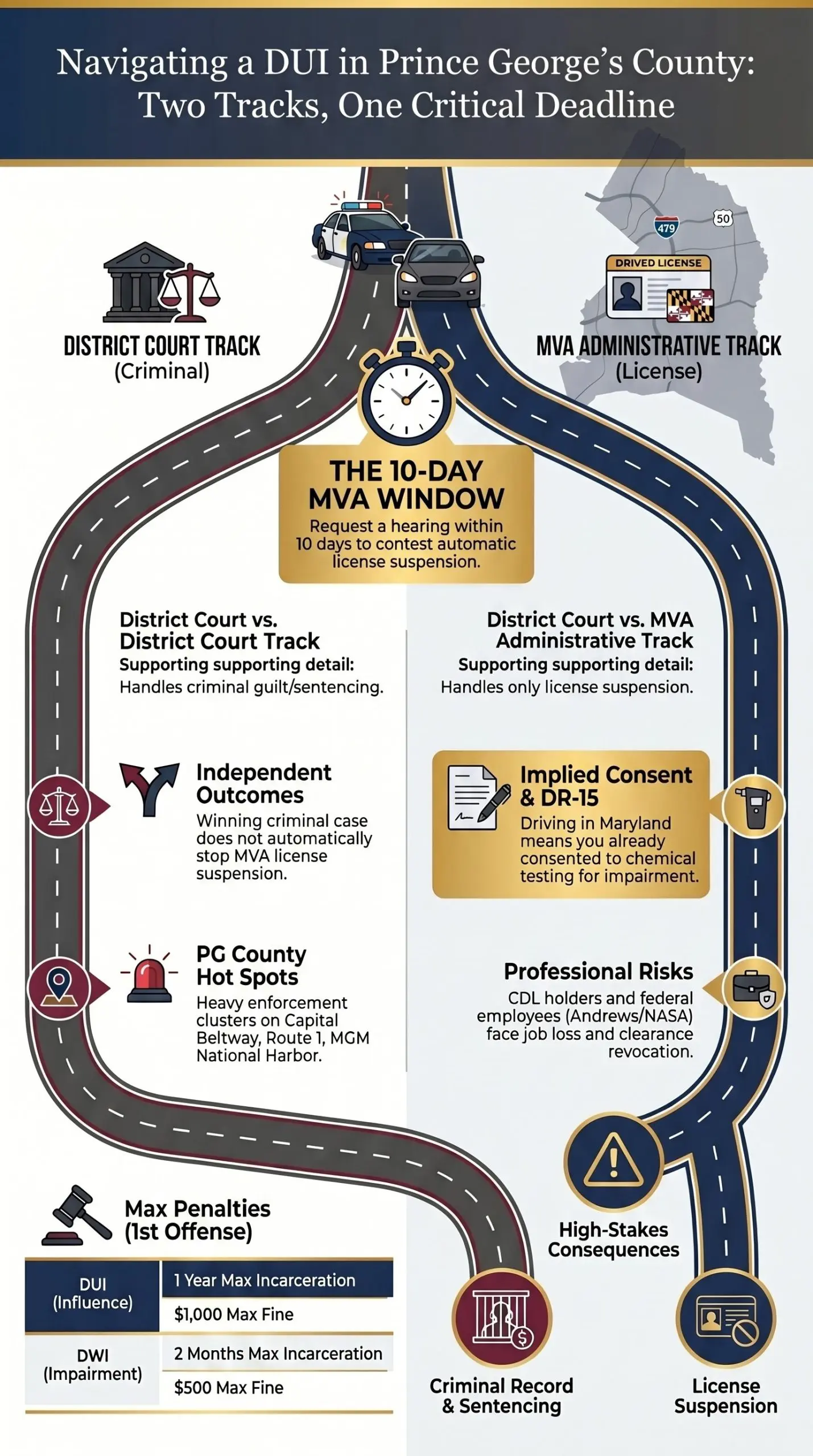
Table of Contents
- Maryland’s DUI Statute and the Per Se Limit
- The Traffic Stop and the Standardized Field Sobriety Battery
- The Breath Test, the DR-15, and Implied Consent
- The MVA Administrative Track and the Ten Day Window
- Prince George’s County Hot Spots: From the Beltway to MGM National Harbor
- CDL Drivers and the Federal Workforce Consequences
- Repeat Offenses and Felony DUI Exposure
- Drug Influenced Driving and Marijuana DUI
- Other Serious Traffic Offenses: Reckless, Suspended License, Hit and Run, Vehicular Manslaughter
- From Citation to Disposition in Hyattsville and Upper Marlboro
- Frequently Asked Questions
Prince George’s County contains some of Maryland’s most heavily traveled roads. The Capital Beltway runs the entire eastern half of the county. Interstate 95 cuts north-south through the eastern county. US Route 50 connects east to Annapolis and west into the District. US 301 runs south toward Charles County. Route 1 carries the northern commuter traffic from the District line through Hyattsville, College Park, and Beltsville. Indian Head Highway (MD 210) carries the southern commuter traffic. Pennsylvania Avenue (MD 4), Branch Avenue (MD 5), Central Avenue (MD 214), and a network of secondary roads tie the rest of the county together. Each road conducts traffic enforcement daily.
The volume produces a steady DUI and serious traffic docket. The Maryland State Police troopers from Barrack “Q” in Forestville patrol the Capital Beltway and US 50. The Prince George’s County Police Department patrols the county’s interior roads. The municipal departments (Hyattsville City, College Park, Bowie, Greenbelt, Laurel, and others) handle their respective city limits. The University of Maryland Police covers the College Park campus and adjacent streets. Federal officers handle Joint Base Andrews, NASA Goddard, and other federal facilities. Each agency handles its own DUI and traffic enforcement, and all cases funnel into the District and Circuit Courts.
This article walks through the full Maryland framework for DUI and serious traffic prosecution, with attention to how those rules play out in Prince George’s County specifically. It covers the criminal statute, the field sobriety battery, the breath test and DR-15 process, the MVA administrative track, the local enforcement geography, the CDL and federal workforce consequences, the repeat offense framework, drug DUI, other serious traffic offenses, and the path from charging document to disposition. The goal is not to substitute legal counsel; it is to give drivers facing these charges the framework needed to make informed decisions early enough for those decisions to matter.
1. Maryland’s DUI Statute and the Per Se Limit
Maryland’s drinking and driving laws live in Section 21-902 of the Transportation Article. The statute creates several distinct offenses with overlapping but distinct elements. Subsection (a) prohibits driving while under the influence of alcohol, the more serious of the two principal alcohol offenses. Subsection (b) prohibits driving while impaired by alcohol, a lesser included offense. Subsection (c) prohibits driving while impaired by any drug, combination of drugs, or alcohol and a drug. Subsection (d) prohibits driving while impaired by a controlled dangerous substance.
The numbers that drive most cases are the per se thresholds. A blood alcohol concentration of 0.08 or higher establishes the per se violation under § 21-902(a)(1)(i)(2). A BAC of 0.15 or higher activates additional aggravating factors, including mandatory minimum penalties on subsequent offenses. A BAC of 0.04 or higher is sufficient for commercial drivers under separate CDL provisions. A BAC of 0.02 or higher applies to underage drivers under Maryland’s zero-tolerance framework.
The penalties scale with conviction history. A first-offense DUI carries up to 1 year of incarceration and a $1,000 fine. A first offense DWI (the “impaired” charge under subsection (b)) carries up to two months and a $500 fine. Subsequent offenses carry escalating penalties, with mandatory minimums attaching after the second conviction within five years and additional penalties for high BAC levels.
DWI is not a “minor DUI.” The DWI charge under subsection (b) is sometimes presented to defendants as a less serious alternative to DUI, and, in terms of penalties, it is. As a matter of record, however, a DWI conviction still goes on the driving record, still affects insurance, still produces MVA points, and still triggers federal employment and security clearance reporting. The reduction from DUI to DWI is meaningful but it is not a clean exit.
The collateral consequences of any DUI or DWI conviction reach beyond the criminal sentence. Insurance premiums climb substantially. Employer disciplinary processes are activated, particularly for federal employees, federal contractors, security clearance holders, and CDL drivers. Professional licensing boards in many fields require disclosure. Immigration consequences attach for non-citizens. Each of these is independent of the criminal sentence and often outlasts it.
2. The Traffic Stop and the Standardized Field Sobriety Battery
Most DUI cases in Prince George’s County begin with a traffic stop for an unrelated reason: speeding, weaving, an equipment violation, a minor traffic infraction. Some begin at DUI checkpoints, particularly during holiday weekends when federal grant money funds high visibility enforcement. Some begin at crash scenes when the driver involved in a collision is suspected of impairment. The Calvert County analog of holiday enforcement patterns is walked through in our Holiday DUI Enforcement guide, and the dynamics are the same on the Capital Beltway and Pennsylvania Avenue corridors.
Once an officer has reasonable articulable suspicion that a driver may be impaired, the officer typically administers the standardized field sobriety test battery. The National Highway Traffic Safety Administration developed three standardized tests: the horizontal gaze nystagmus, the walk and turn, and the one leg stand. Each test has scoring criteria that the officer must follow precisely, and the results are intended to support a probable cause determination for arrest.
The tests have well-documented reliability problems. Horizontal gaze nystagmus depends on the officer’s interpretation of involuntary eye movements and is affected by lighting conditions, head position, contact lenses, and a substantial number of medical conditions unrelated to alcohol. The walk and turn and the one-leg stand are physically demanding tests that produce false positives for drivers with lower-body injuries, balance disorders, ear infections, age-related issues, and many other conditions. NHTSA’s own validation studies report accuracy rates that fall short of the certainty often suggested at trial.
Defense counsel reviews the body camera footage of the SFST administration carefully. Officers sometimes deviate from the prescribed procedure: giving instructions out of order, failing to demonstrate the test correctly, scoring more clues than the validated criteria support, or administering the test in conditions (uneven pavement, sloped roadside, poor lighting, traffic noise) that compromise the result. Each deviation supports a defense argument at trial or at a suppression hearing.
The PBT and the evidentiary breath test are different. The roadside preliminary breath test (PBT) is a portable device that provides a rough indication of breath alcohol content. PBT results are generally not admissible at trial as evidence of the driver’s BAC. The evidentiary breath test administered at the police station on a calibrated machine produces the result that becomes the per se evidence at trial. The two tests differ, and the procedural protections and rights that apply to each differ. Drivers should be aware that asking to speak with counsel before the evidentiary breath test triggers the implied consent framework discussed in the next chapter.
3. The Breath Test, the DR-15, and Implied Consent
Maryland operates an implied consent framework for breath and blood testing. By driving on Maryland roads, every driver is deemed to have consented in advance to chemical testing when an officer has reasonable grounds to believe the driver was impaired. The consent is not absolute; the driver retains the right to refuse, but refusal carries its own consequences under the MVA administrative scheme.
Before the evidentiary test is administered, the officer reads the driver the DR-15 advice form. The form explains the consequences of taking and failing the test (a 180-day suspension on a first offense at 0.08 to less than 0.15, a longer suspension at 0.15 or higher) and the consequences of refusing the test (a 270-day suspension on a first offense, a longer suspension on subsequent refusals). The form also explains the option to participate in the ignition interlock program in lieu of suspension. The driver signs the form to acknowledge receipt and indicates whether they will take the test.
The decision to take or refuse the test is one of the most important decisions in a Maryland DUI case, and it must be made within minutes of the request. Drivers who blow over 0.08 face the per se prosecution at trial and a substantial license consequence at the MVA. Drivers who refuse face a longer suspension but no breath test result for the State to use at trial. The right answer depends on the specific facts (consumption pattern, time elapsed, prior history, license requirements, employment implications), and the answer that is right for one driver may be wrong for another.
The right to consult counsel before the test is limited but real. Maryland courts have held that drivers have a limited right to consult with counsel before deciding whether to take the breath test, when consultation can be arranged without unreasonable delay. The right is limited; the driver cannot delay the test indefinitely while seeking counsel. But a reasonable opportunity to consult is part of the framework. Drivers who know to ask, and to do so calmly and clearly, sometimes secure the consultation that drives the right decision.
The evidentiary breath test machine used in Maryland is the Intox EC/IR II, manufactured by Intoximeters. The machine produces a digital reading of breath alcohol concentration. The reliability of any individual test depends on the machine calibration, the operator’s certification, the observation period before the test, the sample collection protocol, and a number of other factors. Defense counsel reviews the maintenance records, the calibration logs, the operator certification, and the procedure used in the specific case. Successful challenges to test results are not uncommon when the procedure was flawed.
4. The MVA Administrative Track and the Ten Day Window
The MVA administrative track is the most common place where DUI cases go wrong, because most drivers do not know it exists separately from the criminal case. The administrative track is run by the Office of Administrative Hearings, not by the District Court. The hearing addresses license suspension, not criminal liability. The two tracks proceed independently and produce independent outcomes.
The ten-day window is the central deadline. After a driver fails or refuses a breath test, the officer issues a temporary paper license that expires in 45 days. Within those first ten days, the driver must request an MVA hearing to contest the automatic license suspension that will otherwise take effect at day 46. Missing the ten-day window forfeits the right to contest the suspension, regardless of whether the driver wins the criminal case. The license suspension proceeds automatically.
The hearing itself is a contested administrative proceeding before an administrative law judge. The MVA presents the officer’s certification, the breath test result (if applicable), the DR-15 form, and any other documentation. The defense can challenge the officer’s reasonable grounds, the procedural compliance with the DR-15 advice, the breath test administration, and other elements. Successful challenges produce no suspension or a reduced suspension. Unsuccessful challenges produce the standard suspension period under the statutory framework.
Maryland’s ignition interlock program runs alongside the administrative process. A driver who agrees to participate in the interlock program can sometimes avoid suspension entirely by installing an approved device on the vehicle and using it for the required period. The program preserves the ability to drive while the case is pending and is often the right choice for drivers whose employment depends on driving. Our Calvert County ignition interlock guide walks through the program in detail; the same program rules apply in Prince George’s.
Charged with DUI in Prince George’s County?
The ten-day MVA deadline runs whether you act or not. Haskell & Dyer represent accused drivers throughout Prince George’s County, on both the criminal and administrative tracks.
Main Office: 301-627-5844
24/7 Hotline: 240-687-0179
5. Prince George’s County Hot Spots: From the Beltway to MGM National Harbor
DUI enforcement in Prince George’s County clusters in identifiable settings. Understanding where the cases come from helps frame the typical evidence and the typical defense.
The Capital Beltway corridor. I-495 runs the entire eastern half of the county and produces the highest volume of DUI stops. The Maryland State Police troopers from Barrack “Q” in Forestville patrol this stretch around the clock. Stops on the Beltway tend to begin with a moving violation (speeding, weaving, lane violations) or a crash, and the troopers are highly trained in DUI investigation. Body camera footage and dash camera footage are typically thorough.
The Route 1 college corridor. The bar and restaurant strip along Route 1 from Mount Rainier through Hyattsville and into College Park produces a steady DUI flow on Thursday, Friday, and Saturday nights. The University of Maryland Police, Hyattsville City Police, College Park Police, and Prince George’s County Police all patrol this area. Stops typically occur after closing time as drivers leave the establishments.
MGM National Harbor and the Fort Washington area. The casino, hotel, and entertainment district at National Harbor produces DUI stops in the surrounding area on weekend evenings throughout the year. MD 210 (Indian Head Highway) and the connecting roads to the Beltway carry the traffic, and the enforcement reflects the volume.
FedEx Field on game days. Sundays during football season produce a predictable DUI spike around the stadium in Landover. Tailgating, alcohol service, and the post-game return traffic combine to make this one of the most consistent enforcement scenes in the county. Stops occur on the connecting roads (Brightseat Road, Arena Drive, Central Avenue) and on the Beltway approaches.
Bowie and Laurel commuter routes. US 50, US 301, and the I-95 corridor produce DUI stops on the commuter routes used by Bowie, Mitchellville, Laurel, and Beltsville residents. The Maryland State Police and the local municipal departments handle the bulk of these stops.
The southern county routes. MD 210 (Indian Head Highway), MD 5 (Branch Avenue), and the connector roads to Charles County result in DUI cases involving drivers traveling between Prince George’s, Charles, and St. Mary’s counties. The cross-jurisdictional travel sometimes produces stops in different jurisdictions than the alleged conduct, with the case ultimately filed where the stop occurred.
Holiday enforcement is the predictable surge. Memorial Day, Independence Day, Labor Day, Halloween, Thanksgiving, Christmas, and New Year’s all produce DUI enforcement spikes funded by federal highway safety grants. Checkpoints, saturation patrols, and coordinated multi-agency operations all intensify. Drivers who plan ahead during these weekends avoid the cases that the enforcement is specifically designed to produce.
6. CDL Drivers and the Federal Workforce Consequences
Commercial driver’s license holders face a separate and more aggressive consequence framework. Under federal regulations and Maryland’s CDL provisions, a CDL holder convicted of DUI faces a one-year disqualification of the CDL on a first offense, even if the offense occurred in a personal vehicle. A second offense produces lifetime disqualification, with limited reinstatement after ten years in some cases. Trade-specific impacts (for hazmat, school bus, or passenger endorsements) often follow disqualification.
The 0.04 BAC threshold for CDL drivers is half of the standard threshold. A CDL holder operating any commercial motor vehicle at 0.04 or higher faces immediate out-of-service status. The consequences attach regardless of whether the driver is in a personal or commercial vehicle at the time. The CDL provisions interact in complex ways with the standard DUI provisions, and counsel familiar with both is materially helpful.
For drivers who work for or with the federal government (a significant share of the Prince George’s County workforce), additional consequences attach. Security clearance holders must self-report any arrest, and any DUI arrest typically triggers a clearance review. Suspension of clearance is common; revocation often follows for serious cases. Federal civilian employees face administrative review under agency rules. Federal contractors face base access reviews that can result in termination of employment, regardless of criminal disposition.
Active duty service members at Joint Base Andrews, NASA Goddard personnel, and IRS employees in New Carrollton all face additional administrative tracks running alongside the criminal case. The Uniform Code of Military Justice can result in military prosecution alongside civilian charges for active-duty members. Defense strategy in these cases must address all of the parallel tracks.
7. Repeat Offenses and Felony DUI Exposure
Maryland scales DUI penalties dramatically with prior conviction history. The second offense within five years carries a mandatory minimum of five days’ incarceration, with a maximum of two years. The third offense within five years escalates further. Maryland has not historically classified DUI alone as a felony, but several enhanced circumstances can produce felony exposure even on a single offense.
Felony DUI under Transportation Article § 21-902.1 reaches conduct that produces serious physical injury or death and certain repeat offense scenarios. Driving under the influence and causing a life-threatening injury supports a felony charge with up to ten years of incarceration. Vehicular homicide while under the influence produces felony exposure with substantially longer maximum sentences.
The aggravating factors that drive felony charges include a high BAC (0.15 or higher), the presence of a minor in the vehicle (which produces a separate child endangerment count), prior conviction history, the operation of a commercial vehicle, and the occurrence of a crash. Each factor adds incremental exposure, and combinations of factors can quickly push a case from a misdemeanor to a felony.
The five year lookback runs from conviction, not arrest. The repeat offense provisions in § 21-902 measure the five year window from the date of the prior conviction, not the date of the prior offense. A driver whose first arrest was eight years ago but whose plea did not enter until five years ago is still within the lookback window. Counsel reviews the prior record carefully to identify the actual conviction dates and the impact on the current case.
8. Drug Influenced Driving and Marijuana DUI
Maryland prohibits driving while impaired by any drug, combination of drugs, or alcohol and a drug under § 21-902(c) and (d). The drug-influenced driving framework reaches both prescription medications and controlled dangerous substances. The State must prove that the driver was impaired by the substance, not merely that the substance was present in the driver’s system.
Marijuana DUI cases have grown substantially in volume since Maryland legalized adult recreational use in 2023. Adult recreational use is legal; driving while impaired by marijuana remains a criminal offense. Maryland does not have a per se threshold for THC, the way it does for alcohol; the prosecution proceeds on an impairment theory with evidence of consumption (admissions, observed use, residual smell) and observed impairment (driving conduct, SFST performance, statements).
The evidentiary challenges in marijuana DUI cases are substantial. THC remains detectable in blood and urine for substantially longer than the period of impairment. A blood test that shows THC presence does not necessarily establish current impairment. Defense counsel develops the timeline carefully, distinguishes between consumption and impairment, and challenges the State’s expert testimony on the relationship between detected levels and actual impairment.
Drug recognition evaluations (DREs) are sometimes used by trained officers to develop drug DUI cases. The DRE protocol involves a multi-step examination, including pupil measurement, vital signs, and other tests to identify the substance involved. The DRE methodology has reliability issues that defense counsel can develop at trial, and successful challenges to DRE testimony are not uncommon.
9. Other Serious Traffic Offenses: Reckless, Suspended License, Hit and Run, Vehicular Manslaughter
The DUI statute is the most prominent traffic offense, but several other serious traffic offenses also result in frequent prosecutions in Prince George’s County. Each is a misdemeanor or felony rather than a payable infraction, and each carries criminal record consequences.
Reckless driving. Maryland reckless driving under Transportation Article § 21-901.1 is a misdemeanor punishable by up to 60 days of incarceration and a $1,000 fine. It is not a payable ticket. The conduct includes driving in a willful or wanton disregard for the safety of persons or property. Excessive speed, aggressive lane changing, and similar conduct support the charge. Our reckless driving as a crime not a ticket guide explains the framework in detail.
Driving on a suspended or revoked license. Driving on a suspended license under Transportation Article § 16-303 is a misdemeanor with a maximum one-year incarceration on a first offense, with escalating penalties for subsequent offenses. Most cases involve drivers who did not realize their license was suspended (often because of unpaid tickets, missed court dates, or insurance issues). The Calvert County analog appears in our suspended license guide.
Hit and run. Failure to remain at the scene of an accident is a serious offense in Maryland. Failure to remain and exchange information after an accident involving property damage is a misdemeanor. Failure to remain after an accident involving injury is a more serious offense, and failure to remain after an accident involving death is a felony with substantial exposure.
Vehicular manslaughter and homicide. When a death results from impaired driving, reckless driving, or grossly negligent driving, vehicular manslaughter and homicide charges become available. Maryland vehicular manslaughter under § 21-902.2 and vehicular homicide under § 21-902.3 produce felony exposure ranging up to ten years for vehicular manslaughter and longer for the more serious offenses. The Calvert County homicide framework, which applies the same statutes, is detailed in our Calvert County homicide defense guide.
License points add up faster than drivers expect. Maryland assigns points to most moving violations, and accumulation triggers MVA action. Eight points produce a suspension; twelve points produce a revocation. Several aggressive-driving citations can quickly push a clean record into suspension territory. The points framework operates independently of any criminal exposure, and managing it requires attention to each citation as it is issued.
10. From Citation to Disposition in Hyattsville and Upper Marlboro
The criminal track for a DUI or serious traffic case in Prince George’s County moves through several stages. Understanding the structure helps drivers make the right decisions at each point.
Citation or arrest. A driver suspected of DUI is typically taken into custody and transported to a police facility for the evidentiary breath test. After booking, the driver is usually released on conditions, sometimes within a few hours. Drivers cited for less serious traffic offenses often receive a paper citation at the scene with a court date scheduled.
The first court appearance. The case is initially filed in the District Court of Maryland for Prince George’s County, with the Hyattsville location handling north county cases (4990 Rhode Island Avenue) and the Upper Marlboro location handling south county and serious cases. The first court date is typically a pretrial appearance at which the defendant enters a plea and the State produces preliminary discovery.
Discovery and pretrial motions. The defense requests discovery under Maryland Rule 4-262 (for District Court) or Rule 4-263 (for Circuit Court). The State produces police reports, body camera footage, dash camera footage, breath test records, calibration logs, and other materials. Counsel reviews each item and identifies issues for pretrial motions.
Trial or plea. District Court cases are tried before the bench unless a jury demand is filed (which removes the case to Circuit Court at Upper Marlboro). The defense decides whether to demand a jury based on the strength of the State’s evidence, the suppression issues, and the prosecutorial environment. Most DUI cases that proceed to disposition resolve through plea negotiation, but a meaningful share go to trial when the defense identifies a viable defense theory.
Sentencing. When a case ends in conviction, sentencing follows. Maryland’s sentencing guidelines provide a framework, and the court considers the specific facts, the defendant’s history, the mitigation evidence, and the State’s recommendation. Treatment court alternatives are sometimes available for cases involving substance use issues, particularly for repeat offenders. Probation Before Judgment under Criminal Procedure § 6-220 is generally available for first-time DUI defendants and is the most favorable outcome for drivers seeking to preserve their record.
Mitigation begins before the court. Defendants who arrive at sentencing with a substance use evaluation completed, treatment underway, attendance at MADD victim impact panels, character letters in hand, and a clear demonstration of accountability give the court a record on which to grant favorable dispositions. Defendants who arrive empty-handed often leave with convictions when they did not need to. Our first 24 hours after a traffic arrest checklist outlines the early steps to protect the case.
Defense That Starts Before Day Eleven
A first-time DUI in Prince George’s County does not have to become a permanent record. The decisions made in the first ten days shape every outcome that follows. Haskell & Dyer represents accused drivers in Prince George’s County on both the criminal and MVA administrative tracks.
Main Office: 301-627-5844
24/7 Hotline: 240-687-0179
Closing Thoughts
A Prince George’s County DUI or serious traffic case looks daunting from the inside. The two parallel tracks (criminal and MVA), the ten-day deadline, the federal workforce consequences, the CDL exposure, the repeat offense framework, the drug DUI complications, and the related serious traffic offenses can all feel like more than any one driver should have to track. The cases that go well are those in which someone who knows the system is tracking the deadlines and issues from the start.
The legal framework that produced the charge is the same framework that protects the driver. Maryland’s evidentiary standards, the procedural protections that apply to breath tests, the discovery obligations of the State, the right to challenge the SFST administration, the right to challenge the breath test calibration, the right to contest the MVA suspension, the right to a jury trial in Circuit Court, the right to favorable disposition for first time defendants, all are built into the statutes and rules. Effective defense uses each of those rights at the right time.
Haskell & Dyer represents accused drivers across Prince George’s County, including residents of Hyattsville, College Park, Riverdale Park, Mount Rainier, Brentwood, Cheverly, Bladensburg, Greenbelt, Berwyn Heights, New Carrollton, Lanham, Beltsville, Adelphi, Langley Park, University Park, Hillcrest Heights, Suitland, Forestville, District Heights, Capitol Heights, Seat Pleasant, Glenarden, Landover, Largo, Mitchellville, Bowie, Laurel, Upper Marlboro, Croom, Aquasco, Brandywine, Clinton, Camp Springs, Temple Hills, Oxon Hill, Fort Washington, Accokeek, and National Harbor. The firm understands the local courts, local prosecutors, local enforcement practices, and the MVA administrative process, and it builds defenses that account for both tracks at every stage.
Frequently Asked Questions
Is a DUI in Prince George’s County one case or two?
A DUI creates two separate tracks: the criminal case in District Court and the administrative license case with the Maryland Motor Vehicle Administration.
What is the 10 day MVA deadline after a DUI arrest?
You must request an MVA hearing within 10 days to challenge the automatic license suspension. Missing the deadline can cause the suspension to take effect even if the criminal case is still pending.
What is the difference between DUI and DWI in Maryland?
DUI is the more serious charge and usually involves a BAC of 0.08 or higher or substantial impairment. DWI involves a lower level of impairment but still carries serious consequences.
Do I have to take field sobriety tests in Maryland?
Field sobriety tests are generally voluntary, but the results are often used as evidence in DUI cases.
What is the DR-15 form?
The DR-15 is the Maryland advice of rights form explaining the consequences of taking or refusing a breath or blood test after a DUI stop.
What happens if I refuse a breath test?
Refusing a breath test can trigger a longer MVA license suspension than failing the test, though it may affect the evidence available in the criminal case.
Where are Prince George’s County DUI cases handled?
DUI cases are usually handled in the District Court of Maryland for Prince George’s County in Hyattsville or Upper Marlboro.
What are common DUI enforcement areas in Prince George’s County?
Common enforcement areas include the Capital Beltway, Route 1, College Park, MGM National Harbor, FedEx Field, Bowie, Laurel, Indian Head Highway, and major commuter corridors.
How does a DUI affect CDL drivers?
CDL drivers face stricter rules, including possible one year disqualification for a first offense and lifetime disqualification for a second qualifying offense.
Can a DUI affect a federal job or security clearance?
Yes. Federal employees, military personnel, and contractors may face reporting duties, clearance review, job discipline, or access issues after a DUI arrest.
Can marijuana use lead to a DUI in Maryland?
Yes. Adult cannabis use may be legal, but driving while impaired by marijuana remains a criminal offense in Maryland.
What other serious traffic charges are common in Prince George’s County?
Common serious traffic charges include reckless driving, driving on a suspended license, hit and run, aggressive driving, and vehicular manslaughter or homicide.
Can a DUI traffic stop be challenged?
Yes. The defense can challenge the legality of the stop, field sobriety testing, breath test procedure, body camera evidence, and MVA paperwork.
Can first time DUI defendants get Probation Before Judgment?
Probation Before Judgment may be available for many first time DUI defendants, but it depends on the facts, record, and court decision.
What should I do after a DUI arrest in Prince George’s County?
Request your MVA hearing within 10 days, avoid making statements, preserve paperwork, and contact a DUI defense attorney immediately.
References
49 C.F.R. Part 383 (2024). Federal Motor Carrier Safety Regulations: Commercial Driver’s License Standards. Washington, DC: U.S. Department of Transportation.
Maryland Code Annotated, Criminal Procedure Article § 6-220 (2024). Probation before judgment. Annapolis, MD: General Assembly of Maryland.
Maryland Code Annotated, Transportation Article § 16-303 (2024). Driving on suspended or revoked license. Annapolis, MD: General Assembly of Maryland.
Maryland Code Annotated, Transportation Article § 16-205 (2024). Implied consent. Annapolis, MD: General Assembly of Maryland.
Maryland Code Annotated, Transportation Article § 21-901.1 (2024). Reckless driving. Annapolis, MD: General Assembly of Maryland.
Maryland Code Annotated, Transportation Article § 21-902 (2024). Driving while under the influence or impaired. Annapolis, MD: General Assembly of Maryland.
Maryland Code Annotated, Transportation Article § 21-902.1 (2024). Driving while under the influence causing life-threatening injury. Annapolis, MD: General Assembly of Maryland.
Maryland Code Annotated, Transportation Article § 21-902.2 (2024). Vehicular manslaughter. Annapolis, MD: General Assembly of Maryland.
Maryland Motor Vehicle Administration. (2024). Administrative per se: License suspension procedures. Glen Burnie, MD: Maryland Department of Transportation.
Maryland Rules. (2024). Maryland Rules 4-262 and 4-263: Discovery. Annapolis, MD: Court of Appeals of Maryland.
National Highway Traffic Safety Administration. (2018). Standardized field sobriety testing instructor manual. Washington, DC: U.S. Department of Transportation.
U.S. Department of Defense. (2023). Personnel security clearance reporting requirements: DoD Directive 5220.6. Arlington, VA: Author.
U.S. Const. amends. IV, V, VI.
Legal Disclaimer: This article provides general information about Maryland DUI and traffic law and is not legal advice. Reading it does not create an attorney client relationship with Haskell & Dyer or any of its attorneys. Maryland law changes, and the application of any statute, court rule, or administrative regulation depends on the specific facts of an individual case. Statutes are cited to the Maryland Code as in effect at the time of writing and may have been amended since publication. If you have been charged with DUI, DWI, or any other serious traffic offense in Prince George’s County or anywhere in Maryland, you should consult with a qualified attorney about the facts of your case, paying particular attention to the ten day MVA deadline.
For a confidential consultation, call Haskell & Dyer at 301-627-5844 or our 24/7 hotline at 240-687-0179.